Category Archives: Humanities

The Constructive Task

Fall                                                   Waning Harvest Moon

Another morning of cool, wet weather.  The beginning of October.  No.  Scratch that.  The end of October.  I recognize this fall weather actually; it comes to us courtesy of the climate that used to be Indiana’s.  This is the weather pattern of my boyhood.  Sunny, sometimes warm, sometimes not fall days, then rain drifting over into ice or snow with some cold, a January thaw that makes everything muddy and nasty, then a bit more cold and snow until March when the muddy, nasty part returns until spring.  This weather pattern had a good deal to do with my move north, since I wanted stable seasons and in particular real winters.  Now it seems the weather patterns I left have begun to follow me.

The Liberal Spirit is on Ancientrails now, just look on the left side, all the way at the bottom under Ge-ology.  This presentation completed a six part exploration of, first, the movement West of Unitarian-Universalism, and then the nature and future of liberalism, especially as it applies to matters often called religious.  I like working in three parts because it encourages me to think longer than the usually 5-7 page presentation, to take an idea further, develop it.  Not sure what I might do next, but I do feel a need to begin what my old seminary theology professor would call the constructive task.

Constructive theology as an abstract idea involves the coherent development of ideas, ideas about the ultimate nature of reality, human existence and the forces that work on both of them.  My notion of a Ge-ology, which continues to rattle around, make sense, but defy careful development is a significant part of where I want to go, but there’s a lot more to piece together.  The whole notion has become a more and more pressing idea for me as I work in the Sierra Club legislative arena.  It confirms what I have known now for some time.  The representative democracy which serves our nation well at a conflict reduction level, does not work well when it comes to deep, systemic change.  Its checks and balances, its partisan politics and its ephemeral nature make radical change not only unlikely, but almost impossible.  This is by design and it does well at frustrating regional ambitions or the rise of a revolutionary faction, yet those same mechanisms also frustrate radical analysis, even in those instances in which it is so obviously needed.

Upstairs now to our business meeting, still massaging our way toward Kate’s retirement, getting comfortable with the financial side and with our new life.  Not long now.

Let There Be Lights

Fall                                               Waxing Harvest Moon

Speaking of money, I know about a good sale.  Lights on Broadway in Brooklyn Park is closing and they have really marked down their tremendous diversity of lighting products.  If you need any kind of lamp at all, it’s a good place and time to buy them.  Kate and I spent the morning there, finishing up some lighting choices we had left over from the remodel now some time ago.

After that, lunch at Khan’s Mongolian Barbecue.  Lunch with Kate is a date every time, dinner, too.  Our life together continues to unfold in new and positive ways.

No tour this week so I can hit the Latin hard.  I flagged off Greg last week because I just had too much to do, but I’ve finished Chapter 21 and will work tomorrow on Chapter 22.  Maybe get in a bit of work on the Metamorphosis.

I put this link in an e-mail to friends and I thought I’d add it here, too.  An amazing graphic presentation on scale from sizes below neutrinos all the way to local clusters of galaxies and beyond.  Scale of the Universe.

The Limits of Rationality

Fall                                           Waxing Harvest Moon

Gave Liberal II this morning.  Lot of conversation, a little consternation.  Best piece was a conversation with Ian Boswell, the music director.  We discussed the limits of rationality and the integration of reason and soulfulness that great music represents.  He pointed to the late sonatas of Beethoven.  This has given me food for thought for Liberal III:  The Future.

Feeling Rushed

Fall                                              Waxing Harvest Moon

With Latin on Friday and my tour day on Thursday things can get a bit rushed.  I’m feeling a bit behind right now since my sententiae antiquae are not done and my translation of the reading remains.  The Baroque tour is done, however and I look forward to giving it twice tomorrow.  Tomorrow, too, is the Thaw exhibition lecture.

Not sure when I’m going to get my sententiae done, especially the vexed English to Latin, maybe late tomorrow night, just like real school.  Over the weekend it’ll be bulbs, bulbs and the first draft of the Future of Liberal Thought.

Books Along the Way

Fall                                  Waxing Harvest Moon

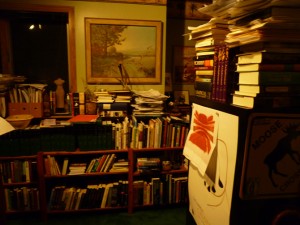
I have begun to accept that I will never read everything I want to read.   Books sit stacked up on the floor in my study; they lie on top of rows of other books on bookshelves;  all my 6702010-10-09_0461bookshelves are full and many have books piled on top of them.  Each one I want to read.  Some I want to use only as reference, but most I want to read cover to cover.  The books range in topic from fairy tales and folklore to basic scientific texts on biology and geology, from philosophy to theology, art history to renaissance life, china, japan, india and cambodia to single dictionaries and the multiple volumes of the OED and the Dictionary of Art.  Of course there is fiction, too, and poetry, works on historiography and works on the enlightenment.  This doesn’t count the 90 books I now have on my kindle, many fiction, but many non-fiction, too.

When it comes to books and learning, I seem to not have an off button.  Maybe it’s a pathology, an escape from the world, from day to day responsibility, could be, but I don’t think so.  Reading and learning feel hardwired, expressions of genes as much as personal choice.  So it’s tough for me to admit that I have books here, in my own house, that I may never read.  A man has only so many hours in a day and I find spending any significant amount of them reading difficult.

That always surprises me.  I love to read, yet it often feels like a turn away from the world of politics, the garden, connecting with family and friends, so it takes discipline for me to sit and read for any length of time.  Instead, I read in snippets, chunks here and there.   Even so, I get a lot read, finishing the Romance of the Three Kingdoms took a lot of dedication, for example.  One year, I put the books I finished in one spot after I finished them.  I don’t recall the number or the number of pages, but it caused me to sit back and wonder how I’d done it.

Sometimes I fantasize about stopping all other pursuits, sitting down in my chair and begin reading through the most important books, the ones on the top of my list.  Right now that would 6702010-10-09_0460include the histories of Herodotus and substantial commentary.  The Mahabharata. Several works on Asia art.  A cabinet full of books on the enlightenment and liberalism.  Another cabinet full on calendars and holidays.  I will never do it.  Why?  Because I do have interests, obsessions maybe, that take me out into the garden or over to the State Capitol and the Minnesota Institute of Arts, the homes of the Woolly Mammoths and our children.  Kate and I will, I imagine, resume at least some of our SPCO attending when she retires and there will be travel, too.

This relates to an odd self-reflection occasioned by Lou Benders story of my first day on the Ball State Campus.  According to him, there was a picture of the Student Body President, I reached out and touched it and told him, “I’m going to do that.”  Three years later I ran and lost for Student Body President.  The year was 1969.  Recalling this, I wondered if my intention, my ability to clarify my direction had waned.  Had I defocused, living my life with no clear intentions, drifting along, letting life happen?

Then I recalled the moment I told Kate I wanted to write, the moment four years ago when I realized I had to put my shoulder behind the Great Work, creating a benign human presence on the planet, the moment I began to pester Deb Hegstrom for a spot in the junior docent class of 2005, the time when Kate and I decided to push our property toward permaculture-the harmonious integration of people, plants and animals in a specific spot in a sustainable way.  No, I’ve not lost my ability to focus.  Not at all.6702010-10-09_0462

This life, the one I’m living now, is the one I’ve chosen to live, a life Kate and I have made together.  And that feels good.

Who knows, maybe I will finish these books?  Who knows?

Let There Be Darkness

Fall                                                Waxing Harvest Moon

Let’s try darkness again.  In Taoism the familiar Taiji makes my point about the essential and complementary nature of light and dark.  Taoism gives equal weight to the yin and yang* represented in the taiji, the small circle of yin within the yang and of yang within the yin, emphasizing the Taoist belief that all things contain their opposite to some degree.  So, one part of my argument simply notes that light and dark are both necessary, necessary to each other, nothing apart from each other.  In the Taoist taiji they represent the dynamic movement of heaven to which all things must conform.

In our Western cultural tradition, though, light has taken precedence over darkness, both in a physical and in an ethical sense.  Jesus is the light of the world.  Persephone goes into Hades and the earth mourns her absence until her return when it blossoms into spring.  Eurydice dies and Orpheus goes to the underworld to retrieve her.  Dante’s Divine Comedy finds Dante wandering, lost in the dark wood of error, before he begins his descent, guided by Virgil, into the multiple layers of hell.  The traditional three-story universe also reinforces these ideas:  Heaven above, earth, and the infernal regions below. Milton’s Paradise Lost follows the rebellion in heaven and the casting out of Lucifer, the Morning Star, into hell where he builds his enormous palace, Pandemonium.  Our common sense understanding of death involves hiding the body beneath the earth.  Why?

Coming out of the spiritualist tradition represented by Camp Chesterfield (see below) death involves a transition into the light, the spirit world.  Ghost Whisperer, a TV program, uses the trope from this tradition, as dead souls are led into the light.  It is, perhaps, no wonder that darkness, night and the soil come off badly in our folk metaphysic:  up and light is good; down and dark is bad.

I wish to speak a word for the yin, symbolized by the moon, the female, the cold, the receiving, the dark.  The moon illustrates the taiji perfectly.  In the dark of night, the moon, yin, reflects the sun’s light, yang, and offers a lambent light, neither yin nor yang, but the dynamic interplay between the two.  So we could look for art that features the moon as one route into the positive power of darkness.

Also, any seasonal display in a work of art, whether of spring, summer, fall or winter can open the question of each season’s value, its role in the dynamic of growth and decay, emergence and return.  This can lead to a discussion of the importance of the fallow season, the season of rest, the earth’s analog to sleep.  This can lead to a discussion of sleep and its restorative powers.

Art work of mother and child, or especially, mother and infant, can stimulate a discussion, in this context, of the womb, of the fecund nature of the dark where fetuses and seeds develop before their emergence into the world of light.

Similarly, death focused works of art can open up a discussion of birth and death as dynamic moments of change, yin and yang of human (or animal) development.  This could lead to conversation about the Mexica (Aztec) belief that life is the aberrant condition and that death is the vital, regenerative moment; we are here, goes one Mexica poem, between a sleep and a sleep.

Winterlight festivals represent a western imbalance focused on the light, the yang, and a tendency to cast the yin in a negative light, something to be avoided or eliminated or held in check.  As I said previously, this is understandable given the pre-historical science which made the return of the sun doubtful and therefore terrifying.  Many of these festivals are, too, our favorites:  Christmas, Deepavali and for a different traditional reason, Hanukkah.

In my own faith tradition, roughly pagan, I look forward to the dying of the light and celebrate as my most meaningful holiday, the Winter Solstice.  Of course, I also celebrate the return of the light that begins on that very day, but first I immerse myself in the long night, the many hours of darkness.  This affords me an opportunity to acknowledge the dark, to express gratitude for its manifold gifts.   In this way my idiosyncratic faith has a ritual moment that honors the taiji, utilizing the cues given by the natural world.

To find art that emphasizes this aspect of darkness I plan to walk the museum from top to bottom, searching for images and objects that can help our visitors understand that when they celebrate the festivals of light that darkness is the reason for the season.  I would appreciate any thoughts or ideas.

*In Chinese culture, Yin and Yang represent the two opposite principles in nature. Yin characterizes the feminine or negative nature of things and yang stands for the masculine or positive side. Yin and yang are in pairs, such as the moon and the sun, female and male, dark and bright, cold and hot, passive and active, etc. But yin and yang are not static or just two separated things. The nature of yinyang lies in interchange and interplay of the two components. The alternation of day and night is such an example.
Diversity

Fall                                            Waxing Harvest Moon

Whew.  Sierra Club am.  Latin at noon.  Touring the Embarrassment of Riches show for Lindquest and Venum from 5:30 to 7:00.  A very diverse day.  Fun in that respect, but also tiring.

Greg took me through some Latin readings to test my level of retention since we paused back in mid-summer.  He decided I was fine to pick up again where we left off in July.  Good to know my brain has not gone soft.

Around 4 pm I took off for the cities and went to the Ford Bridge on 46th street.  Jon e-mailed me and asked for me to take some shots from the bridge looking north.  He wanted some of the fall colors.  Don’t know how good the images are, but I took them, then scooted over to the museum for my stint in the Embarrassment of Riches show.

It came to me while touring this show that it validated many of those who came through in a way similar to African and Chinese galleries for their respective ethnic communities.  That is, these folks saw images that were of the world in which they moved.  They may not all be in it personally, but in working with clients they cross over many of these thresholds.

A different experience than I had anticipated, but not a bad one.  Interesting, rather than revelatory.

Photocentrism

Fall                                              New (Harvest) Moon

OK,I made this up.  Photocentrism is a focus on the virtue of light that, by implication, puts darkness in a negative or bad relative position.  Just because I made it up, however, does not mean I’m joking.  The context:  the docent annual meeting today and the presentation of a new December of the month called Winterlights.  I agree that Winterlights is a complex noun that has a rich associative feel.  I even agree that the celebrations in what I have long called holiseason–Thanksgiving to January 6th, the traditional 12th day of Christmas, Epiphany (visit of the Magi to Bethlehem), and the date for the celebration of Christmas in the Eastern Church–offer an unparalleled opportunity to learn from other cultures about matters deep in the human psyche:  Thanksgiving, Advent, Deepavali, Hanukkah, Posada, Winter Solstice/Yule, Christmas, Western New Year on January 1, the 12 days of Christmas and maybe Kwaansa, though its constructed nature makes me a bit shy of it.  Eid al Adha, the Muslim holiday that marks the end of Hajj by celebrating the Irbrahim and Ishmael story, falls in November this year, but not within holiseason itself, so I’m going to leave it out of this discussion.

The festivals or holidays of light, in particular Deepavali, Hanukkah, Winter Solstice (although is a special case as we shall see) and Christmas (more for what it replaces, Saturnalia, than what it celebrates itself) do have a common thread.  Deepavali, Winter Solstice and Christmas all relate to the despair felt in subsistence agriculture communities when the light of the sun seemed as if it would wink out and perhaps disappear altogether.  This fear, of the Sun’s final rising, put its mark on well-known pre-historical landmarks like Stonehenge, Chichen-Itza and the great Newgrange dolmen in Ireland.  Without a knowledge of the physics and celestial mechanics of the earth’s orbit and the sun’s central place in our solar system, it was frightening to consider the possibility that this time, this winter, the gradual diminishment of daylight might proceed all the way to an apocalyptic darkness.  No light for the crops.  No crops for the animals.  Cold all the time.

What to do?  According to theories of sympathetic magic, like produces like, so the logical response to oncoming darkness was a bonfire, a torch, a brave manifestation of light and heat in hopes that the sun, since it is like light and heat, will either be rekindled or seduced into rising again.  And these practices work.  Each time the bonfires were lit, the torches paraded, the sun did not disappear, but returned to once again start the growing season and stave off starvation and freezing for another year.

All of this makes sense, granting the scientific understandings of these early peoples.  As cultures grew more sophisticated and astronomical knowledge became a bit more advanced, however, it did put out the lingering fear that the darkness would one day come and never leave.  So holidays that focused on light, especially, but fire, too, became integral parts of the cultural and religious traditions of many peoples.

They all leave out one important thing, though.  The virtues of darkness.  I first became aware of the following arguments when I began to research the goddess, the great mother goddess.  I won’t get into here the debate surrounding the contention by some that a great mother goddess preceded the monotheistic, patriarchal deities of the Abrahamic religions, though I’ll tip my hand enough to say that I don’t find the evidence compelling.

What I found out about darkness surprised me and changed my mind about how I view it.  Darkness is as necessary as light.  Seeds start growing in the dark soil, away from light and even after they penetrate the surface, their roots continue to press their way into the surrounding nutrient-filled earth.  Mammal babies live their first few months of life in the moist, nourishment rich environment of their mother’s womb. (OK, not in the marsupials and the platypus and the echidna’s instance, but you get the drift.)  Darkness creates the time of rest and restoration for us and for many animals.  It is when we sleep and when we dream.  Darkness is the natural condition of space, attenuated by billions of stars only in what amounts to a small total area of the vastness of the universe.  Light itself requires a degree of darkness to create vision.  Anyone who’s ever been in a whiteout where snow and sky mix to create a vertiginous world with no up and down, no distinguishing characteristics understands the problem well.  Or consider a bright, very bright light and its affect on your sight.

This argument can be cast as a feminist one in which the light represents patriarchy and the darkness the creative agency of women.  It can also relate to anti-racism work in that we tend to equate darkness, blackness with evil, with corruption and decay.  This denies the regenerative, restorative and generative nature of darkness and narrows our conceptual world in literally dangerous ways.

How could this relate to Winterlights?  Without this kind of background the celebration of light has a sinister side as well its assumed positive one.  The celebrations of light only make sense in terms of the deep cultural background and when we go there we need to understand the fear that created these holidays has also unbalanced our appreciation of the other state, darkness.  I’ve not given it any thought, but I imagine there works of art that make darkness a central theme, that could be used to help put the other holidays in a balanced perspective.

Hanukkah is a special case here in which the focus does not seem to be on the Winter Solstice but on a cultural achievement by the Maccabees, the expelling of the Greeks.  It does however beautiful-darknessshare a darkness dispelling theme with the others.

There is more to say here, much more, but I’m hungry.  Catch you later.

A Life in Ruins: Part II

Fall                                    Waning Back to School Moon

When I visited Angkor in 2005, I wrote a piece for my Pilgrimage series entitled, A Life in Ruins.  Ephesus, Delphi, Delos,Rome. Pompeii, numerous civil war battlefields and Attuthya are among the many ruins I’ve visited, trying to piece together from blocks of stone, information plaques and Blue Guides their meaning and significance. At Knossos I wondered what it felt like to be in the labyrinth of rooms that made up what entered legend as the habitation of the Minotaur.  At Delos I imagined what the birth of Apollo and Diana was like.

Given that history, amazing is an understatement when I discovered my actual life had become a site with ruins, not one, but many.  In my hometown of Alexandria the first factory in which I2010-10-02_0396 worked, Johns-Manville has nothing left but concrete coated pillars and a loading dock.  I worked as a receiving clerk the summer I was there, so I knew exactly what went on there when the trains loaded with coak and limestone rolled onto the factory grounds.

That was the first, but far from the last.  The old High School, my middle school, gone.  Tomlinson, my first elementary school. Gone.  Most of the businesses of my youth, abandoned shells.  This is only in Alex.  In Anderson the mighty General Motors Guide  Lamp and Delco Remy, employers once of 25,000, gone.  Parking lots and concrete factory pads covering thousands of square feet and fenced in with tall chain link are all that remains.

If we had a magic button we could push, one that would light up the home’s lost among those 25,000, we would have a better estimate of the lives ruined along with these structures.  These are the missing elements at Ephesus, Rome, Delos.  What about the lives of the priests, the grounds keepers, the cooks, the sailors?  Like members of my class and their parents forces beyond their control eliminated the places where they earned their livings.  Places made sacred by the holy work of labor.  So much desecration.

These factories, these shops, these shuttered houses, these abandoned people are the friends and family with which I spent the weekend, real people, not statistics.  Never did I think that the mighty flood of cars bearing workers on Highway 9, no absurdly named Highway of Vice Presidents, would dry up.  Never did I think that the vibrant small town of my youth with its mens store, its womens store, two variety stores, two pharmacies, a bakery, two theatres, bars and banks and service stations would fade away only to be replaced by dollar stores and wholesale outlets.

So this weekend, an affair of the heart most of all, a reconnecting with those who lived then, only underscores the pain.  I will never visit a new ruin again with the same detached attitude.  Real people lived there;  real people suffered.

Moving From the Theoretical to the Concrete

Lughnasa                                            Waxing Back to School Moon

Kate has had a nasty cold since Monday and I can feel it trying to claw its way up my esophagus, making my throat scratchy.  My hope is that the recent two time bout I had with some bug in July, then August has revved up my immune system.  With rest I can pound this sucker down before it takes hold.

Starting back on Latin today.  I took part of July, all of August and the last couple of weeks off with the bees and the vegetables and the orchard.  Thought I’d get work done on Ovid, review, but in fact I got very little done.  An old student habit of mine, if it’s not pressing, it’s not getting done.  I’m looking forward to the weekly sessions, building toward enough confidence to tackle Ovid and others on my own.  It’s a project, like the bees, that keeps the gears turning, not giving them a chance to rest.  Best that way.

A few years back it was the MIA docent training.  Then the move into permaculture and vegetables and fruit.  That one’s still underway as I learn the complicated dance of seasons, cultivars, pests, harvest and storage.  The MIA training, for that matter, only gives you enough legs to get into the books and files yourself, training you to look and think about art, but each tour demands specific self-education on the objects and the purpose of that tour.

(Minoan Gold Bee pendant from Crete, circa 2000 BC)

Part of my impatience with the seminary experience is that I’ve moved so deeply into more concrete endeavors.  Art has the object as an anchor, then its history and context.  Latin has words, grammar and literature as well as Roman history.  Vegetables and fruit have real plants, particular plants with needs and products.  The bees have the bees themselves, the colonies, woodenware, hive management, pest control, honey extraction.  This is, probably, the world I was meant to inhabit, but philosophy and the church lead onto another ancientrail, that of the abstract and faraway rather than the particular and the near.  It’s not that I don’t have an affection, even a passion for the theoretical, I do, but I find my life more calm, less stressful when I work with art, with potatoes and garlic, with conjugations and declensions.

I now have almost three decades of life devoted to the theoretical, the abstract and the political so I bring those skills and that learning to my present engagement with the mundane, but I no longer want to live in those worlds.  They are gardens others can tend better than I can.