Category Archives: Garden

A Two-Person Garden

Lughnasa                                    Waning Grandchildren Moon

Kate and I have shifted our bedtimes and risings to 6:30.  This allows us to get out to work in the garden when it’s still the cool of the day.  This morning Kate continued to restore the original look and feel to the orchard while I finished up the mulch in the front, moved her growing mound of pulled weeds and gathering lettuces and kale for today’s meals.

There was, too, the matter of the original guild plantings in the orchard.  Guilds complement each other and, in this case, the fruit tree under which they grow.  Over the last two years we’d let the clover go, after a two year effort prior to that eliminating what Paula, owner of Ecological Gardens, called, “…that damn quack.”  The good news:  no quack back.  The bad:  clover all over.  In the process we lost some of the plants in the guilds.  I know what they are now and will replace them over the next couple of weeks.

It was also weed identification day, so I spent time in the orchard, my “Weeds of the Northeast” in hand, shuffling through the pages trying to find a match.  The ones I could not identify I have concluded for now are plants that have a place.

We’re now going to work an hour to two in the mornings together.  That should be enough to manage.  I used to be able to care for our perennials in an hour a morning, but our various plots have grown beyond that.  It’s a two person yard now and Kate’s wonderful recovery has added her back to the team.  Yeah!

Today perennial bulb orders to go in, too.  Over the vegetable and bee years, the ramping up years, I’ve pretty much left the old perennial beds to themselves, only occasionally working them and then  usually when the situation demanded, rather than requested, me.  Now we’re a bit further along with the orchard, the vegetables and the bees and I want to return some attention to the bulbs and perennial flowers that I love.  Bulb planting happens in October when the rest of the garden has died away, so there’s little conflict in time for that chore.

Getting the Week Underway

Summer                                               Full Grandchildren Moon

Vega the wonder dog update.  Now the focus shifts to Vega.  Who has learned to open the patio door, both ways, with a quick twist of her super strong neck.  Last night Kate and I sat outside reading and talking, a pleasant evening.  Vega looked inside, saw her sister Rigel and Kona waiting to come outside.  She did what any nice big sister would do.  She went over and opened up the door, letting the two out.  Of course, like most three year olds she does not close the door.

Hilo goes into the vet today to get her kidney values.  We have a little bit of hope that her condition will have improved since her physical.  Not likely, but she does seem to feel better now than she has.

Working at memorizing verb conjugations while I’m off the weekly chapter preparations.  Took a yellow tablet to the nightstand last night, reading the perfect tense endings just before I went off to sleep.  Sure enough, I dreamed of Julius Caesar and the Appian Way.  No.  But, I do think I remembered the perfect tense endings. We’ll see later in the week.

At 2pm today a designer from Mickman’s comes by to give us an estimate on a water feature for the two patio areas where we’ve had trouble keeping plants alive.  I want something simple, two-levels, with enough noise to shut out the minimal traffic noise from Round Lake Boulevard.  Hard to say what the cost will be until he looks at the site.

(you know.  something like the pic. just kidding.)

Now outside for a bit more weeding in the cool of the morning, then preparations for my tour tomorrow morning.  China, my favorite.

A B- Garden

Summer                                              Full Grandchildren Moon

Lugnasa, August 1, the Celtic first fruits festival heralds the beginning of the harvest cycle of holidays.  Lugnasa, Mabon (Fall Equinox) and Samain, October 31st, carry our sacred calendar though the bread made from the first wheat to the last of the crops gathered into storage.  This means that the tenor of the year, changed at the Summer Solstice, has begun to gather force, no longer is the emphasis on growing and nurturing, but on collecting and senescence.   At least in the vegetable garden and at Artemis Hives.

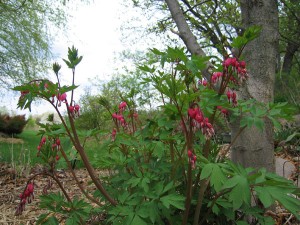
The flower garden still has a few licks to get in yet as the chrysanthemums, monk’s hood, fall blooming crocus, clematis softlily250and asters preen themselves as the light begins to fade from the sky and the air cools.  Right now the hemerocallis are going strong, creating a lively dance of color in the perennial beds.
Truth in writing disclosure:  this has not been the best gardening year.  I’ve not put in the amount or quality of labor I have in the past and the garden shows it.  I’ve had trouble keeping my focus focused, my priorities prioritized.  This is a fact for me in the best of times, but when I don’t pay close attention my center can shift often.   Elsewhere I’ve called this the valedictory life, that is, a life in which I try to get an A in everything I do, instead of settling for a B or a C once in a while.

To make the valedictory life more challenging I find the world has many things that fascinate me, as any reader of this blog will have learned by now.  Right now, at very best, I’d give the garden a B- this year.  Sad to say.

On the other hand, I can make it better and that’s what I’m going outside to do right now.

Seeing What We Really Have Here

Summer                                             Waxing Grandchildren Moon

We are well past midsummer here in the northern latitudes.  The garden’dicentra09s peak bearing season will commence although we have already had blueberries, strawberries, raspberries, currants, garlic, lettuce, greens, onions, parsnips, beets and sugar snap peas.  Ahead of us are tomatoes, green peppers, potatoes, more greens, onions, beets, lettuce, butternut squash, leeks, wild grapes and carrots plus the odd apple.   Our orchard has a ways to go before it matures.  And I have a ways to go before I can care for the fruit trees in the manner to which they need to become accustomed.
All of which opens up the purpose of this little experiment in permaculture and the tending of perennial flowers and plants.  A long while back I bought three quarter-long horticulture classes from the University of Guelph in London, Ontario.  It took me a while to complete it, maybe a year all told.  The course helped me integrate and deepen what I’d learned by trial and error as I cared for the daffodils, tulips, day-lilies, hosta, croci, roses, trees and shrubs that then constituted our gardens.

In its salad days (ha, ha) the notion involved a root-cellar and the possibility of at least making it part way off the food grid.  Fewer trips to the grocery store, healthier food, old fashioned preservation.  A mix of back-to-the-land and exurban living on our own little hectare.  Last year the notion began to include bee-keeping.  Now called Artemis Hives.

As the reality of the size of our raised beds, the likely peak production of the fruits and vegetables possible has become clear to me, I have a more modest though not substantially different goal.  We will eat meals with fresh produce and fruits during the producing part of the growing season.  We will preserve in various ways honey,  grapes, apples, pears, raspberries, strawberries, blueberries, tomatoes, potatoes, onions, garlic, squash, beets, greens and parsnips.  These we will eat during the fallow days that begin as the garden goes into senescence in late August and early September and last through the first lettuce and peas of the next growing season.  We will supplement these with greens grown hydroponically and use the hydroponics to start seeds and create transplants for 2011.

None of this will remove us in any major way from the store bought food chain.  We will not solve or resolve much of our carbon footprint.  But some.  More than most perhaps, but far too little to claim even a modest victory.  So, should we give up?

Not at all.  Why?  Well, there is a richer, deeper lesson here than living wholly off our own land.  That lesson, taught again, day by day and week by week, and again, lies in the rhythm of the plants, the bees, the land and the weather.  An old joke from the 50’s asked, “What do you call people who practice the rhythm method?” (Catholics at the time)  Answer:  “Parents.”  The permaculture and perennial flowers here at Seven Oaks is a rhythm method.  What do you call folks who practice this rhythm method?  Pagans.

Ours is a life that flows in time with the seasonal music of the 45th latitude, the soil on our land, the particularities of the plants we grow, the energy of the bee colonies that work alongside us, the various animal nations that call this place home.  This is the profound lesson of this place.  Seven Oaks is a temple to the movement of heaven and the bees of Artemis Hives are its priestesses.

Ray

Summer                                    Waxing Grandchildren Moon

Ray, the Andover High School junior who mows our yard, came over today and we moved the shredded bark into its home on the beds and walkways of the vegetable garden.  He’s 15 or 16.  I’m not.  Nap time will be important today.

We discussed his swimming.  He swims for the Andover High School team.  “Is the Andover team any good?”  “Well, it’s a young program.  Not like Anoka’s.”  He admires Michael Phelps and has that swimmer body with the developed upper chest and broad shoulders.  He came here from swimming.  5 days a week during the summer, 6 during the school year.  Dedicated.

We found him courtesy of a copied flier he put in our mail-box.  It was good timing since Kate, our mower, had hip surgery scheduled in June.  Ray also does other yard work, like helping me re-mulch the vegetable gardens.  He works hard, thinks ahead and is generally pleasant.  A testament to his kind.  The teen-age boy kind.

The Herd rumbles into Andover around 6 or so.  Kate’s worked hard to get the food ready.  She also did a lot of weeding over the week-end.  It’s nice to have her home and I’ll be glad when she retires in January.

A Snap. No, Really.

Summer                                             Waxing Grandchildren Moon

Started the morning with my favorite kind of work, mechanical.  Question:  how to get the mower deck off the lawn tractor.  It is, I recall the salesman saying 14 years ago, “A snap.”  Well, he should have been here.  Nuts and bolts, screws and hammers don’t respond well to my ministrations.  If it can be done the easy way–a snap–and the hard way–my way–guess which I end up pursuing?  Yep.  Same deal with the bagger.  So easy.  Hmmm.  The best that can be said is that, in the end, I figured out that the easy way was also the only way to get them off, but it took a good while to realize that.  Plus some words I wouldn’t use in a polite blog.

After that, hooking up the new wagon to our 15 year old Simplicity was a snap.  No, really.  One cotter pin, insert bolt through wagon tongue and tractor hitch and away we went to the 5 cubic yards of shredded mulch.  A few pitchfork moves later I was back in the front yard delivering shredded bark to Kate who toiled away in the vineyards (literally) of our long untended front flower patches.

Much better than the wheel barrow method I’ve used all these years.  I took the weeds back to the woods and put them in their very own pile.  Nice.

After the nap I’ve spent time recovering wooden steps and slabs from eroded sand, sweeping, piling, that sort of thing.  It’s hot, but not too bad outside.

All this in service of the upcoming Woolly Mammoth meeting.  We have visitors out here twice a year and this year they came within two weeks of each other.  Great planning on our (my) part.  Well, I shouldn’t say in service of the meeting.  This work really prompts us to do things we’ve neglected over this year and they’ll stay done for a while.  One of the many positive functions of friends.

More meeting related work later on, too.  Groceries.  Start cooking. (helping Kate) Cleaning furniture.  Those sorts.

The Odor Of Sanctity

Summer                                    Waxing Grandchildren Moon

Have you ever smelled fresh bees wax?  A smell that takes you right to the essence of the natural world.  It exudes a sense of well-being, freshness, vitality.  I harvested some honey today for the Woolly meal on Monday night.  The honey and the honey comb offer that same sensation; perhaps, as latter day Catholics might have said, it is the odor of sanctity.

The experience this morning took me back to two other smell, for me equally enmeshed with the natural world as our obvious home.  The first one, of the longest standing for me, I experience in the  produce cooler at Cox’s Supermarket when I worked there as a boy.  This smell combined apple scents, oranges, bananas, lettuce, watermelon, whatever was in season into a perfume that drew me back often.  I would sneak away from stocking shelves or breaking down boxes, push the plunger that opened the door, step inside and be transported to paradise, a place where everything suggested abundance, nourishment and fine flavor.

Another one of these scents came to me only this year as I harvested parsnips.  Lifting the tapered white parsnip out of the ground, I brought its roots, only just holding the parsnip in its intimate relationship with the soil, to my nose.  Ah.  Again, freshness, vitality, well-being.  It was as if, for a moment, I inhabited the parsnip’s underground world, the place where it truly lived.  There, with the scent, I could trace the connections between the parsnip and its source of nutrients in the soil around it; I could feel the back and forth of vegetable and soil as they interacted in a dance older than the oil beneath the Gulf, older than the iron ore on the range.

Yes, as I think of it, the odor of sanctity is it, exactly.  The sacred blossoms into molecules that excite this oldest sense, the one that relates us most closely to the rest of our animal brothers and sisters.  The sacred emerges from the sophisticated work of the honey bee turning nectar into honey.  The sacred emerges from the fruits of the earth as they await transport to our tables.  The sacred emerges within the top layers of  soil, that thin web of living things that supports the plants from which we all take our sustenance.  Yes, the sacred emerges in these places, and it sends out an aroma to draw attention to itself.

We Call This Place Home

our-woodsSummer                                New (Grandchildren) Moon

Outside this morning, finishing my tea on the patio, a hummingbird darted in and out of the lilies, gathering the last bits of nectar, passing on final touches of pollen.  Like the possum from yesterday’s adventure the hummingbird shares this patch of land with us, too.  Possum, groundhogs, gophers, chipmunks, squirrels, raccoons, rabbits, deer, hummingbirds, blue jays, goldfinches, red-headed and pileated woodpeckers, a great horned owl, crows, grosbeaks, dogs, mice, skinks, salamanders, garter snakes, garden spiders, wolf spiders, worms, bees, moths, wasps, caterpillars and butterflies and many others, most one-celled or many-celled, I imagine, live here.

They live here as we do,  making a home, finding and preparing food, eating their meals, raising their young, growing to old age, dying.  Our home takes up more space, yes, and our decisions impact the land in dramatic, sometimes even drastic ways, but that we are only one species among hundreds that live here is beyond question.

When we leave, either through death or otherwise, the generations yet unborn of these animals and insectshighrise and other life forms will, perhaps, know no difference.  If fact, if the house became abandoned, many of them would find a use for it as shelter, as a place to raise their families, perhaps as a source of food.

All of us, all of us who live here, are only here for a while.  It is so important that we leave this place a better one for all its inhabitants.  If each of us only took this one objective, a prime objective?, to leave our places better for all those who live in them, wouldn’t the world be safe now and into the future?

S…L…O…W

Summer                                       Waning Strawberry moon

Engine turning at low  rpm’s.  Latin today and my tutor.  Greg (tutor) thinks I’ve gotten past the barrier I experienced before he took for Portugal.  Getting back up to speed after a two-week lull was not so easy, the mental machinery does not spin up for action quite as quickly as it used to.  So, I’ve got to stay at it to get it.  The new way.  Life changes our learning pace and perhaps our style, but it doesn’t diminish our capacity–or so I’ve read.  It’s also my experience.

Ear infection taking attention my body might otherwise devote to the fact that the grandkids are coming either tomorrow or Sunday.   We’re ready.  Sort of.

The garden will get some attention tomorrow after I buy an umbrella, umbrella stand and a new firepit for the brick patio.  Field trip to Fleetfarm.  I love Fleetfarm.  It’s one of those crazy places you probably don’t know about unless you use the stuff they sell: electric fencing, watering troughs, ivormectin.  Lot of fun.

Well, it may go slow, but I’m gonna get on the treadmill.  Now.

Here Comes The Sun

Summer                                       Waning Strawberry Moon

After weeding Kate and I took off for lunch–at Benihanas, not nearly as good as our own, much closer, Osaka–and a visit to Lights on Broadway.  A bit of dithering about where the order was, where the paperwork was, who was on third and who was on second I picked up the track lighting fixtures that had fritzed out on us.  Nice to have light the full length of the kitchen table now.

Then, a nap.  A long nap.  Two hours.  I got up earlier than I wanted to this morning thanks to dogs barking.  Even earlier tomorrow.

After so many days of rain, a very soggy June, we have a run of yellow suns on all the weather forecast sites through Sunday.  Tonight the temperature should hit 46.  Good.

Kate has no anxiety about the procedure tomorrow.  She does, she says, “surgery well.”  I’d have to agree.  The back surgery was in January and that’s been behind us for several months.  I still want her out of the hospital as fast as possible since hospitals have a lot of iatrogenic disease and a lot of it is very intractable, super bugs, all studied up on the antibiotic armamentarium.

The perennial beds now look like a gardener lives here.  That feels better.

Spoke with a woman about a spirituality in art tour for July 8th.  It’ll be my first tour in a while.  Looking forward to it.