My presentation on time falls under the sumi-e moon and I plan to use sumi-e. I’m taking my brushes, ink, ink stones, red ink pad, Kraft paper, and rice paper. As well as my hourglasses. I will do Shakespeare’s soliloquy from Macbeth as a counter point. Each person will first practice an enso on the Kraft paper, then do one on rice paper.
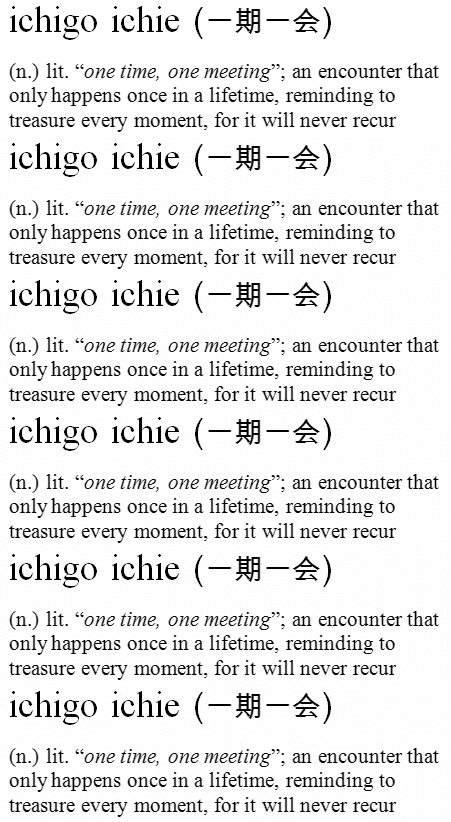
What is an enso? The word means circle in Japanese. In Zen it has a much more expansive meaning.* Zen is, of course, Chan Buddhism, a curious blend of Taoism and Buddhism created in China. Monks from Japan went to China to learn about Chan and brought it back to Japan. They also brought back the practice of drinking tea, which initially was a stimulant to help with long meditation sessions. It later transmogrified into the Japanese tea ceremony with its beautiful idea of ichi go ichi e, or once in a lifetime.
*”In the sixth century a text named the Shinhinmei refers to the way of Zen as a circle of vast space, lacking nothing and holding nothing in excess. At first glance the ancient ensō symbol appears to be nothing more than a miss-shaped circle but its symbolism refers to the beginning and end of all things, the circle of life and the connectedness of existence. It can symbolize emptiness or fullness, presence or absence. All things might be contained within, or, conversely, excluded by its boundaries. It can symbolize infinity, the “no-thing”, the perfect meditative state, and Satori or enlightenment. It can even symbolize the moon, which is itself a symbol of enlightenment—as in the Zen saying, “Do not mistake the finger pointing at the moon for the moon itself.” In other words, do not mistake doctrines, teachings or explanations, which are intended to guide one toward enlightenment, for enlightenment itself. Ensō can also represent the moon’s reflection on water, thereby symbolizing the futility of searching for enlightenment outside oneself.” Modern Zen
And, then, time. Last qabbalah class on time yesterday evening. Next week presentations. I have to come up with something and I got nothin’. Might go with an hourglass. It’s a nice physical symbol since in it time seems to run out, then be restored with an easy flip. Hourglasses, on their sides, are also shaped like the infinity image. So, there’s measured time, yet measured time that can be reversed, and eternal time, running on past the end of earthly time. Might go with Shakespeare.
We’ve been pulling at the strands of various ideas about time, from measured time to eternal time to shabbat moments and the radical obvious, time is only ever the present. The past and the future have no reality, no agency, save in the present.
Rabbi Jamie asked an interesting question last night. Why do any of this? What’s the point? He leans toward the practical, unwilling to dwell only in the abstract. Learning has to count. As readers of this blog know by now, I’m more on the dwelling in the abstract end of the pool, so I appreciate his pulling me back into this life with questions like this.
The answer he gave to his own question, with which I agree, was this. I’m not quoting. We do it to hold our notion of self more lightly, to give the ego a rest from its orientation to survival, to making it in the world. At the soul level, the most basic level of our human existence, we all connect. Think the collective unconscious, the divine spark, in the image of the sacred. In effect qabbalah posits an Oversoul, or better, an under or inner soul, the quality of which is the same for all humans.
I mentioned the irony that we spend our time developing a firm sense of self, striving for authenticity and compassion, only, at the end of life to give it up. Yes, we all agreed, that’s a good reason for holding the self lightly. We have to let it go. The soul, if there is such a thing, and I’m not ready to say there isn’t, that links us all to all, does not need the self.
The image, from Rabbi Rami Shapiro, that makes this clearest for me was that of waves on the ocean. Our life is a wave on the ocean. It rises out of the ocean, exists and moves on its own, and at its end, sinks back into the ocean. Never was it anything other than ocean.
Been thinking about revelation. In a way I’m not sure is new, but I don’t recall seeing it anywhere. So, we have all these sacred scriptures. What makes them sacred? The claim is their autographic nature, written in some mysterious way by the hand of a god or gods. I’m going to bracket the claim of divine authorship and ask not about the content of the tales, at least not the content usually involved in exegesis and hermeneutics, but about the way revelation shows up in them.
I came to this idea at a mussar class last week when we were discussing Abraham (Avram) as an example of emunah, or grace/faith. Emerson came to mind, his words about having a revelation to us and not the dry bones of theirs. We were discussing Abraham as a model of emunah. What we’re trying to do, I said, is learn from Abraham’s story why he trusted God. We’re trying to learn through the veil of thousands of years and through the words written about Avram. Words, for most of us, in translation. Words we know passed through many different redactors. We want to know how Avram experienced revelation otherwise why would we find the stories sacred?
Abraham_Serving_the_Three_Angels Rembrandt_
God appears to Abram. God comes to him in a vision. God speaks to him. God comes to Abram in sleep, in darkness and dread: “As the sun was going down, a deep sleep fell on Abram; and lo, a dread and great darkness fell upon him. 13 Then the Lord said to Abram…” Gen. 15:12-13a, RSV Abram asks God how he will know that what he says is true.
It came to me then that the fundamental question of Biblical, Vedic, or Koranic texts is an epistemological one, not first a metaphysical one or a hermeneutical one. That is, how does revelation show up? How do we know it when we see it? How might we realize Emerson’s plea for a revelation to us, not the dry bones of theirs? What is the nature of revelation? How can we experience it now, not rely on an ancient game of telephone?
Well, one way might be to use the sacred texts not as either mythology or divine communication through their content, but as clues to the nature of revelation itself. How, in other words, did the sacred texts represent the experience of revelation? What was it like? How did it become confirmed as revelation? At least to those reported to have experienced it directly?
Please note that I’m not making an assumption here about the source of revelation or its truth claims as evidence of divine communication. I’m asking the question, what has revelation looked like? How has the experience of revelation been identified? What are its marks? Can we seek it? Might we find it if we did?
Abraham’s Counsel to Sarai (watercolor c. 1896–1902 by James Tissot)
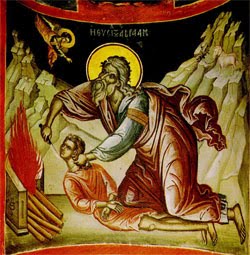
Going back to Abram. Let’s use him not as an example of faith or of covenant or of divine nation-building, but as an example of one who experiences direct revelation. What is it like? How does he know (the epistemological question) that he has experienced revelation? The writers of the story, or the editors of the oral tradition when it was written down, or the embellishers and editors of the story as it passed both through oral transmission and different textual editions, use particular verbs: Avram heard, saw (a vision, an appearance), dreamed, felt (darkness and dread), was delivered (defeat of enemies).
Following Avram’s story we might say that revelation comes through language, through emotions, through dreams, through particular actions to him. Not very distinctive in its medium, then, at least not distinctive from usual human experience. So what is it about a communication or an interpretation of an action that identifies it as special, different, sacred?
My first suspicion is that it is much like the nativity story, and perhaps the crucifixion and resurrection narratives, too, ex post facto events created to explain the origins and influence of remarkable individuals. Who would receive communications from beyond this reality? Individuals who’ve already been established as significant, powerful, influential. Like that guy Abraham, warlord, father of many children, father of our nation. How did he get where he is? He heard the still small voice. He understood things others of us missed. He was in touch with, what? Something many of us ignored, perhaps.
But, let’s say for the sake of this investigation that it’s not only this reading backwards into an important person’s life, well after the fact; but, that revelation is just that. Revelatory. Forget of what for now. Why are some dreams revelatory? Why are some appearances revelatory? Why are some inner voices revelatory?
I’m not sure we can penetrate this. We have the after story. After the garden. After the promise to Avram. After Sarah’s miraculous births. After the Garden of Gethsemane. After the journey by night to the Temple Mount. After the birth of Krishna. Yet how can we know the inner experience of personages from thousands of years in the past? We barely understand our own inner experience. And if we can’t answer the epistemological question, how did Avram know what he claimed to know about God, then we can’t decide the value of his claims. Aside from their value as myth and legend.
Perhaps then Emerson’s quest for a religion of revelation to us rather than the dry bones of theirs is fruitless. Perhaps. I would say and will stop here for now, that the only way we can understand the nature of revelation is to search for its marks in our own lives. We will not find answers in ancient texts because the layers, the barriers to knowing the mind of another becomes insurmountable in them. What has been revealed to you? What was its source? How do you know?
Ted of All Trades came by yesterday. We want to add a screen door on the front so we can keep the front door open during the summer. Screen not for bugs, in this case, but dogs. He offered a couple of suggestions, one we’re considering. Maybe have it open left instead of right. Why? Chinooks and other high winds, often well 0ver 60 mph, can catch, in our situation, a right hand swinging door and wham it against the house.
The Gap
There’s a gap between our composite deck at the east facing door and the garage. For younger folks, not a big deal, but for Kate, with neuropathy in both feet, the jagged surface created after several snows becomes treacherous. We had a work around the last two years with rubber mats I threw over the snow once I shoveled it, but that’s an imperfect solution. The advantage of the composite decking is that I can use a plastic snow shovel and just shove the snow off. A back preserving snow removal method and one I can then extend all the way to the garage. Ted proposed a floating deck extension. Sounds fine.
In other trade folk news I had Will out on Tuesday to talk about stump grinding. Two years ago I cut down about 60 trees for fire mitigation. I can do it, but I can’t leave stumps cut very close to the ground, too hard for me to hold the saw steady far below my waist. Lots of centrifugal force on a chainsaw blade and I tip it into the ground. Instant dull blade. With 60 I’m not going to do it. He’s not gotten back to me with a bid because he usually bids stump removal by the inch diameter and I think he’s shocked at the potential cost.
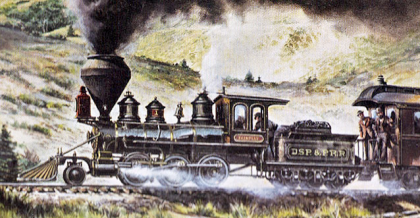
Anyhow he knew a lot of cool stories about our area. Two for instances. Back when Denver was being built, end of the 19th century, there was a mining railroad that ran from Denver all the way to Fairplay, about 60 miles. It ran along the present route of Hwy. 285, our main thoroughfare east and west now. Ore on the train, into the Denver. Smelting.
But. Some smart guy realized that the train also ran through the mountains. Which had lots and lots of old growth Ponderosa and Lodgepole pine. Never been forested. Wait. So much building in Denver, all this wood. Aha. The lumberjacks left the forested east face of the Front Range untouched, a first acknowledgment of a view shed, I suppose, but between there and Fairplay they clear cut everything! Made sense back then. Just trees. Far away from civilization. Free. Today though the small, evenly aged forests that we have, that create much of the fire danger for us are a direct result of this work. Young forests, never thinned, and now with a century + of fire suppression. A combination of the worst possible forest management techniques.
A building left in Webster, now a ghost town
Second story. The Reynolds Gang gold. This was one’s good if you’re a little short on retirement funds. Back in the same time period there was a rip-roaring, bar and brothel filled town called Webster beyond Guanella Pass but before Kenosha Pass. There’s no visible evidence of Webster from 285 today, but then it was a place where miners and lumberjacks came to relax. Or, their equivalent of that idea. Not the sabbath, for sure.
Lots of gold and silver. The Reynolds Gang, twice, robbed Webster, getting away with a substantial horde. A railroad guy asked then governor of Coloradao, John Evans, (a main Denver thoroughfare is named after him), for help. “Sure,” he said. He sent out the Colorado Militia, a group of state paid thugs who had recently mustered out of the civil war. They knew killing.
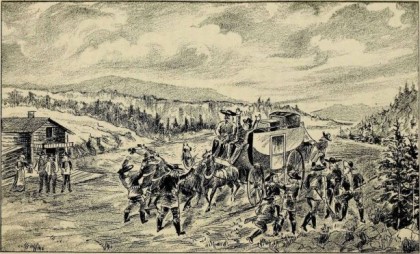
One night they found the gang around a camp fire somewhere still in the Webster area. The Militia, which I think was modeled after the Texas Rangers, did not what any upstanding law enforcers would do. They went in with guns hot, lighting up the night with muzzle flashes. All dead, except a small group, maybe 2 or 3, who escaped with the loot. No one saw them leave and they ran in the dark so they didn’t pay attention to where they ran.
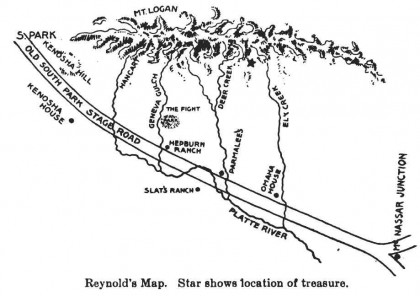
Yes. They dug a hole or found a small cave or animal den, stashed the loot and ran on to escape the militia. They lived long enough to mention to somebody that they’d stuck a knife in a tree to mark the sport. But the militia caught up with them later. Dead. So somewhere in the mountains around the former townsite of Webster is a tree with the tang of a knife protruding, probably about 20 feet up now, allowing for the growth of the tree.
And, no. No one’s ever found it. Get out the metal detector. Or, Kate suggested, power up your drone. We could live large in the third phase on Reynold’s gang gold.
Trying my hand at a short story in the style of Robert Aickman. If you appreciate strange fiction with a literary style, then you’ll love Aickman. His work is as distinctive as Kafka and some use the term Aikmanesque to reference it, as the word Kafkaesque references Kafka’s unique style. Aickman uses dense description of place and characters to lull the reader into a sense of the narrative, but he subtly tweaks certain aspects that color a character’s mood or personality and the apparently normal world in which they live. At some point in the story, a line gets crossed between this world and a surreal one that you then notice lurked behind even the first few paragraphs.
Rabbi Rami Shapiro spoke to Beth Evergreen parents on how to talk about god to their kids. You can see on the board four terms and a fifth, panentheism, finishes it. (That’s Rami to the left standing and Rabbi Jamie to his right.) I think the first four are well known, panentheism perhaps not so much so. While pantheism says god is everything and everything is god, (all-god), panentheism says nature is part of god but god is more than that, too, perhaps even beyond time and space. The most well known panentheist, at least when I was in sem, admittedly 45 years or so ago, was Alfred North Whitehead, proponent of process theology.
My brother Mark asked me recently whether I was a theist or a deist. I wrote back, sort of tongue in cheek, polytheist atheist. This morning I thought, polyatheist. I like the contradiction, the tension between these two words. All the words on Rami’s sheet assume a monotheistic stance in which one believes, does not believe, doubts, makes coincident with nature or inclusive of nature but not limited by it. None of them describe my location in the world of god thought.
Perhaps better, polytheist agnostic. Even that doesn’t carry quite the right emphasis. What was it they said on the x-files? I want to believe? When I graduated from college, yes, it was 1969, 49 years ago, I decided to revisit Christianity. I chose to use Soren Kierkegaard’s leap of faith as a model. After reading his Fear and Trembling, I decided I would live as if the Christian god were real and that the gospel stories were true. That’s how I ended up in seminary in 1971.
It was not a perfect reenchantment of my world. A lot of Christianity, even then, I just ignored. Nothing would have made me predeterminist or even one interested in salvation beyond this life. The God and the Jesus I believed in were guarantors of a just world, a world where evil could be fought successfully and where evil denied our essential oneness as a species, allowing certain people to feel privileged due to race, gender, wealth, nationality, sexual preference. “Let justice roll down waters, righteousness like an everflowing stream.” Micah 5:24 Or, Luke 4:18-19: “The Spirit of the Lord is upon me, because he has anointed me to preach good news to the poor. He has sent me to proclaim release to the captives and recovering of sight to the blind, to set at liberty those who are oppressed, 19 to proclaim the acceptable year of the Lord.”
Martin Luther King, liberation theology, Jesus as a revolutionary those were my touchstones. Yes, I meditated, prayed, interpreted scripture, very occasionally served the sacraments, but the core of my shift from college non-belief to Christian clergy lay in the political implications of Christianity. This was a thin rationale for a metaphysical commitment. And, it broke apart. By the time I left the Presbyterian ministry in 1991, the scaffolding of bible, god, jesus, prayer had long ago collapsed.
When my then spiritual director, John Ackerman, said, “Charlie, you might be a druid,” I laughed. Then, I thought, hmmm. No, not a druid, but yes one whose religious instincts lead him to the garden, not for a last prayer before crucifixion, but as a participant in the web of life, hands in the soil. This was reinforced when Kate suggested I look for a particular focus for my writing. Since part of leaving the ministry meant novels, I took her suggestion seriously.
Duncan, John; The Riders of the Sidhe; Dundee Art Galleries and Museums Collection
I have two broad genealogic streams in my dna, Irish and Welsh, and German. Ellis and Correll for the Celtic side, Spitler and Zike for the Germanic. I chose the Celtic side first, exploring the realm of Celtic religion. The Celtic Faery Faith, a book by W.Y. Evans Wentz, who went on to translate and make popular, the Tibetan Book of the Dead, was an early influence. As I got deeper and deeper into crafting novels, always fantasy, always with an ancient religion at their heart, I began to entertain strange thoughts.
What if Cernunnos, the horned god of nature in Celtic myth, was real? Tailte, a Celtic goddess of the earth, came from a euhemerized Welsh woman. Euhemerus, a Greek mythologist, lived in the late 4th century B.C.E., and proposed that myth was an exaggerated account of the lives and deeds of real people. Thus, euhemerization might suppose that behind Zeus there was a strong, dominant man who ruled imperiously over his people. Or, that a certain Welsh woman, a gardener and farmer, one with a remarkable ability to make things grow and to find useful plants and animals in the wild, might become an Earth goddess. So euhemerization blurs the line between the real and the mythical. Had Cernunnos been a hunter so in touch with his prey that his success seemed super-human?
A more recent and accessible example of another myth-making process is Pele on the Big Island. Perhaps Pele was a strong, fiery Hawai’ian woman of long ago, one drawn to the vulcanism of her homeland. Perhaps she danced with the lava, foretold eruptions, protected people from the ravages of sulphuric gases. She may have come to hold the role of goddess of fire, goddess of the vital forces beneath the Hawai’ian archipelago, through repeated tales of her amazing feats. Or, it might be that ancient Hawai’ians personified the enigmatic and brutal forces of Mauna Kea, Kilauea, and Mauna Loa just as the residents of Leilani Estates have done since the eruptions began last week.
William-Adolphe Bouguereau (1825-1905) – The Youth of Bacchus (1884)
In my own post-Christian world these sorts of gods and goddesses resonate. The notion of one deity behind it all, a wizard or sorceress of creation, seems silly. That certain groups might confuse the god they hold closest with a monotheistic deity makes sense to me; that others might actually agree with them makes no sense to me. There cannot be more than one, one god. Simple logic.
When two groups assert that their god is The One, one of them has to be wrong and in my opinion, both are. Which leaves us where? Well, the assertion of two all-powerful deities makes sense to anyone with a polytheistic bent. Why is Allah any more sensible than Athena? Why is Yahweh any more divine than the triple-goddess Brigit? Why is Brahma more explanatory of cosmic matters than Ahura Mazda and Angra Mainyu?
So, I have become a polyagnostic. I doubt the existence of all the gods and goddesses ever imagined. I do not chose Yahweh to doubt anymore than I choose faeries and Odin to doubt. Yet. I want to believe. I want to see Pele at work in the now 18 fissures breaking through the human hubris of Leilani Estates. I want to find the god and the goddess, Cernunnos and the Maid, frolicking naked in the fields of Beltane. I want to see the Wild Hunt cross the sky. And, yes, I’d like to see Yahweh deliver the tablets or speak from the bush. Hell, I’d even like to watch Allah send Mohammad by horse to the temple mount, through the sky. I could stand in the Mithraeum and be doused by blood or water. It’s not hard to imagine, for me, diving into a holy well and ending up in the Otherworld.
What I’m trying to say here is that my doubt is not tied to the monotheistic faiths, rather it is tied to the polytheistic nature of global religious thought. Polyagnostic. I doubt and embrace all gods and goddesses, all nymphs, daiads, faeries, banshees, rashis, and chupacabras.
If we were to divide polyagnosticism into two camps, one leaning toward belief and one leaning toward polyatheism, I would be in the leaning toward belief group. I suppose that’s what keeps me a friend of all sorts of religious belief systems, all sorts though not all. I believe in the numinous, in the unseen mystery, in the still small voice that comes from the rock, the mountain top, the flowing river, the growing grass, the blooming flower. I believe it’s no accident that these forces have been named sacred, called divine. I think it’s appropriate to anthropomorphize them, to find in the wind Boreas, to find in the magma chamber, Pele, to find on Mt. Sinai, Yahweh. These are sources of wonder for me and ones I cherish.
I just don’t know which ones are more real than the others, or, if they’re all real in some way. I’m not even sure I know what real means or could mean here.
The Persistence of Memory, Dali, 1931. By Image taken from About.com, Fair use, en.wikipedia.org/w/index.php cur id 20132344
Time last night. Qabbalah. Does the past exist? Oh? How do you know? Key learning, something I have to learn and relearn, the past exists, yes, but only in the present. Just like, oddly, the future. Why? We never have any time other than the present. Never. We can pull ourselves away from awareness of the present by being focused on the past regrets, anger, guilt, yet we can only experience the past in the present. So, whether it has any ontological reality or not, we cannot know it except as a ghost that we carry forward with us.
Likewise, the future never arrives. Free beer tomorrow. Our dreams or fears or hopes or anguish about a future event can affect us, but, again, only in the present. Now is all there is, and, again oddly, the moment we think of the now, it is past.
Kilauea Leilani May 5 lava fountains 230 feet high, USGS
Moment to moment the Reconstructionist prayer book says, the process of creation is renewed. Creation continues. Revelation continues. Tradition changes. This seems right to me and offers us substantial hope. We are not bound by past. This moment is new and we can choose in it to experience the past differently, to change the narrative, to reframe. In the same way we can choose-this is very existential-to reframe our future hopes and fears.
In the present, which has never existed before and will recede as if it were never there, all things can be made new. This is a subtle idea, at once obvious and at the same time almost impossible to grasp. Yet it is true that the 71 years of my life have passed in moments, always in the now. Even in 1947 my life passed moment to moment in increments, the very same as the increments I experience today in 2018.
Reb Zalman, founder of the Jewish Renewal movement, and a resident of Boulder until his death, talks about sin as a remnant of the past that is no longer useful, a story whose narrative obscures our ability to be in the present and, therefore, to make choices in the present. I really like this idea since it removes sin from morality and certainly removes it from any stain on the essence of a person. When we discussed this last night, I offered a metaphor from gardening, “A weed is a plant out of place.”
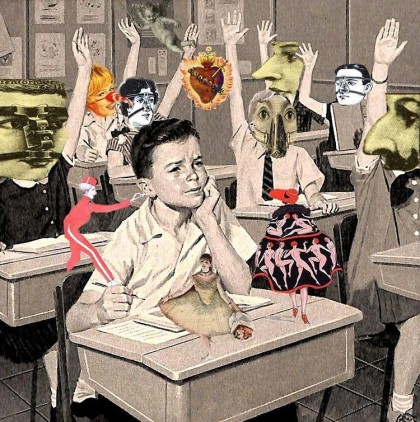
Back in the day, the now further and further away day, I always went to class. I might have missed a few, but it was rare. I enjoyed learning from lectures, getting in the mix of dialogue, thinking out loud. Last night I was the only student in the qabbalah class on Time.
Rabbi Jamie and I had a solid hour together talking about the nature of the sabbath, the notion of sacred time, and, hidden space-time. L’Olam va’ed, translated most often as forever and ever, has another translation, hidden time witnessed. The second translation, a qabbalist’s, points to the intersection of the three dimensions: space, time, and soul. Soul is consciousness in this frame. It is a nexus that is crucial to understanding existence per se. Without all three, space, time and consciousness, the fabric of the universe cannot exist, or, perhaps better, in my opinion, couldn’t be known as we humans know it.
The tao. The tao feels like the central idea that I have learned, even though it’s pretty damned slippery. Putting it into this qabbalistic paradigm, being one with tao is awareness of L’Olam va’ed. When our soul sees hidden time, we see reality as it is, a moving generative force and we can align ourselves with its flow, not impede it.
Being human is a daunting task, steeped in misdirection, existential isolation, perception clouded by tradition, by language, even by our body. Qabbalists and taoists and ch’an buddhists have worked, hard, to peel the onion of our awareness. They are subtle, in their own way as subtle as particle physics or genetics or neuroscience, attempts to understand this task, the one none of us can jettison, save through suicide. They differentiate from the narrowing tendency of science by insisting on a full, a comprehensive positioning of this strange creature that we are in the wild.
Make no mistake, the universe is the true wilderness and we wander in it as innocents, thrown into it for what reason we do not know, headed toward a destination we do not understand and cursed or blessed with awareness, consciousness, soul as we travel.
Thought experiments like taoism, qabbala, ch’an or zen buddhism try to shock us out of our stupor, the life lived without seeing the wilderness for what it is, the life lived within the conventions of a particular time, a particular language, a particular place, a life lived without knowing what life is. Most people find little reason to peak behind the curtain of this emerald city that we think is what is. The apparent life, the one with family and money and the NFL and food and houses and sunlight and night, seems to be all that could be. We do not question, we try to paddle the little barque of our body on this river (life) often using only our hands over the edge of the boat.
And yet there is more, not more in the sense of more layers or more depth, for those layers and depths, the wilderness, always surround us, are the water to which we are the fish, but more in terms of what we can know, what we can access, what we can use to help us become awake. Woke, in the current vernacular, not woke to racism and sexism and oppression in this instance, but woke to the true majesty and wonder of life itself, of this wilderness journey, this most ancient of ancientrails.
Do you want to wake up? Shake off the slumber of convention? Head out into the wilderness knowing it for what it is? If you do, there are paths to take, fellow pilgrims with whom to travel. I honestly don’t know whether it’s important or not to peel the onion, only that in doing so, I’ve become alive, able to see. And I prefer that consciousness, awareness to life as a long sleep.
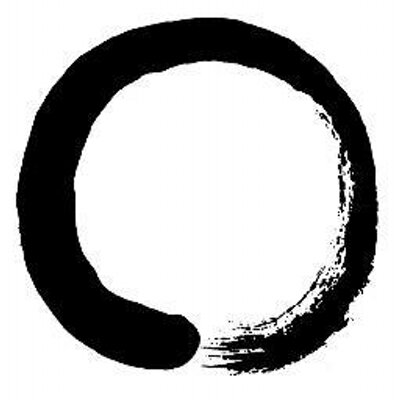 My presentation on time falls under the sumi-e moon and I plan to use sumi-e. I’m taking my brushes, ink, ink stones, red ink pad, Kraft paper, and rice paper. As well as my hourglasses. I will do Shakespeare’s soliloquy from Macbeth as a counter point. Each person will first practice an enso on the Kraft paper, then do one on rice paper.
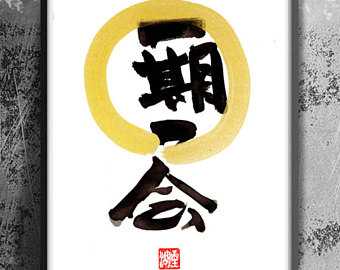 What is an enso? The word means circle in Japanese. In Zen it has a much more expansive meaning.* Zen is, of course, Chan Buddhism, a curious blend of Taoism and Buddhism created in China. Monks from Japan went to China to learn about Chan and brought it back to Japan. They also brought back the practice of drinking tea, which initially was a stimulant to help with long meditation sessions. It later transmogrified into the Japanese tea ceremony with its beautiful idea of ichi go ichi e, or once in a lifetime.
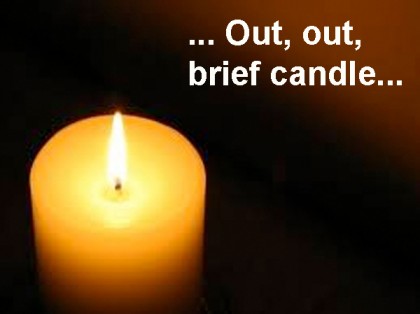 “Tomorrow, and tomorrow, and tomorrow,
 We’ve been pulling at the strands of various ideas about time, from measured time to eternal time to shabbat moments and the radical obvious, time is only ever the present. The past and the future have no reality, no agency, save in the present.
 The answer he gave to his own question, with which I agree, was this. I’m not quoting. We do it to hold our notion of self more lightly, to give the ego a rest from its orientation to survival, to making it in the world. At the soul level, the most basic level of our human existence, we all connect. Think the collective unconscious, the divine spark, in the image of the sacred. In effect qabbalah posits an Oversoul, or better, an under or inner soul, the quality of which is the same for all humans.
 Been thinking about revelation. In a way I’m not sure is new, but I don’t recall seeing it anywhere. So, we have all these sacred scriptures. What makes them sacred? The claim is their autographic nature, written in some mysterious way by the hand of a god or gods. I’m going to bracket the claim of divine authorship and ask not about the content of the tales, at least not the content usually involved in exegesis and hermeneutics, but about the way revelation shows up in them.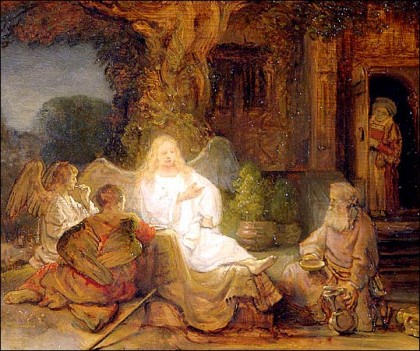

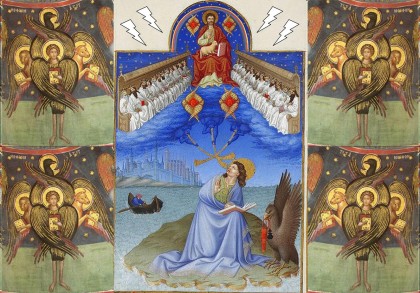 My first suspicion is that it is much like the nativity story, and perhaps the crucifixion and resurrection narratives, too, ex post facto events created to explain the origins and influence of remarkable individuals. Who would receive communications from beyond this reality? Individuals who’ve already been established as significant, powerful, influential. Like that guy Abraham, warlord, father of many children, father of our nation. How did he get where he is? He heard the still small voice. He understood things others of us missed. He was in touch with, what? Something many of us ignored, perhaps.

 In other trade folk news I had Will out on Tuesday to talk about stump grinding. Two years ago I cut down about 60 trees for fire mitigation. I can do it, but I can’t leave stumps cut very close to the ground, too hard for me to hold the saw steady far below my waist. Lots of centrifugal force on a chainsaw blade and I tip it into the ground. Instant dull blade. With 60 I’m not going to do it. He’s not gotten back to me with a bid because he usually bids stump removal by the inch diameter and I think he’s shocked at the potential cost.
 One night they found the gang around a camp fire somewhere still in the Webster area. The Militia, which I think was modeled after the Texas Rangers, did not what any upstanding law enforcers would do. They went in with guns hot, lighting up the night with muzzle flashes. All dead, except a small group, maybe 2 or 3, who escaped with the loot. No one saw them leave and they ran in the dark so they didn’t pay attention to where they ran.
 Yes. They dug a hole or found a small cave or animal den, stashed the loot and ran on to escape the militia. They lived long enough to mention to somebody that they’d stuck a knife in a tree to mark the sport. But the militia caught up with them later. Dead. So somewhere in the mountains around the former townsite of Webster is a tree with the tang of a knife protruding, probably about 20 feet up now, allowing for the growth of the tree.
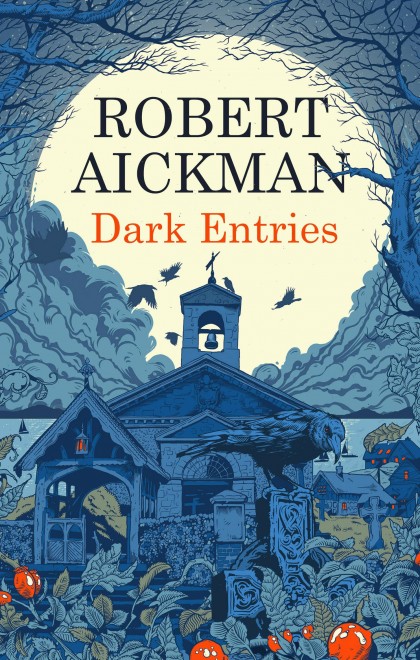 Trying my hand at a short story in the style of Robert Aickman. If you appreciate strange fiction with a literary style, then you’ll love Aickman. His work is as distinctive as Kafka and some use the term Aikmanesque to reference it, as the word Kafkaesque references Kafka’s unique style. Aickman uses dense description of place and characters to lull the reader into a sense of the narrative, but he subtly tweaks certain aspects that color a character’s mood or personality and the apparently normal world in which they live. At some point in the story, a line gets crossed between this world and a surreal one that you then notice lurked behind even the first few paragraphs.
 You can see on the board four terms and a fifth, panentheism, finishes it. (That’s Rami to the left standing and Rabbi Jamie to his right.) I think the first four are well known, panentheism perhaps not so much so. While pantheism says god is everything and everything is god, (all-god), panentheism says nature is part of god but god is more than that, too, perhaps even beyond time and space. The most well known panentheist, at least when I was in sem, admittedly 45 years or so ago, was Alfred North Whitehead, proponent of process theology.
 Perhaps better, polytheist agnostic. Even that doesn’t carry quite the right emphasis. What was it they said on the x-files? I want to believe? When I graduated from college, yes, it was 1969, 49 years ago, I decided to revisit Christianity. I chose to use Soren Kierkegaard’s leap of faith as a model. After reading his Fear and Trembling, I decided I would live as if the Christian god were real and that the gospel stories were true. That’s how I ended up in seminary in 1971.
 Martin Luther King, liberation theology, Jesus as a revolutionary those were my touchstones. Yes, I meditated, prayed, interpreted scripture, very occasionally served the sacraments, but the core of my shift from college non-belief to Christian clergy lay in the political implications of Christianity. This was a thin rationale for a metaphysical commitment. And, it broke apart. By the time I left the Presbyterian ministry in 1991, the scaffolding of bible, god, jesus, prayer had long ago collapsed.
 What if Cernunnos, the horned god of nature in Celtic myth, was real? Tailte, a Celtic goddess of the earth, came from a euhemerized Welsh woman.
 So, I have become a polyagnostic. I doubt the existence of all the gods and goddesses ever imagined. I do not chose Yahweh to doubt anymore than I choose faeries and Odin to doubt. Yet. I want to believe. I want to see Pele at work in the now 18 fissures breaking through the human hubris of Leilani Estates. I want to find the god and the goddess, Cernunnos and the Maid, frolicking naked in the fields of Beltane. I want to see the Wild Hunt cross the sky. And, yes, I’d like to see Yahweh deliver the tablets or speak from the bush. Hell, I’d even like to watch Allah send Mohammad by horse to the temple mount, through the sky. I could stand in the Mithraeum and be doused by blood or water. It’s not hard to imagine, for me, diving into a holy well and ending up in the Otherworld.
 If we were to divide polyagnosticism into two camps, one leaning toward belief and one leaning toward polyatheism, I would be in the leaning toward belief group. I suppose that’s what keeps me a friend of all sorts of religious belief systems, all sorts though not all. I believe in the numinous, in the unseen mystery, in the still small voice that comes from the rock, the mountain top, the flowing river, the growing grass, the blooming flower. I believe it’s no accident that these forces have been named sacred, called divine. I think it’s appropriate to anthropomorphize them, to find in the wind Boreas, to find in the magma chamber, Pele, to find on Mt. Sinai, Yahweh. These are sources of wonder for me and ones I cherish.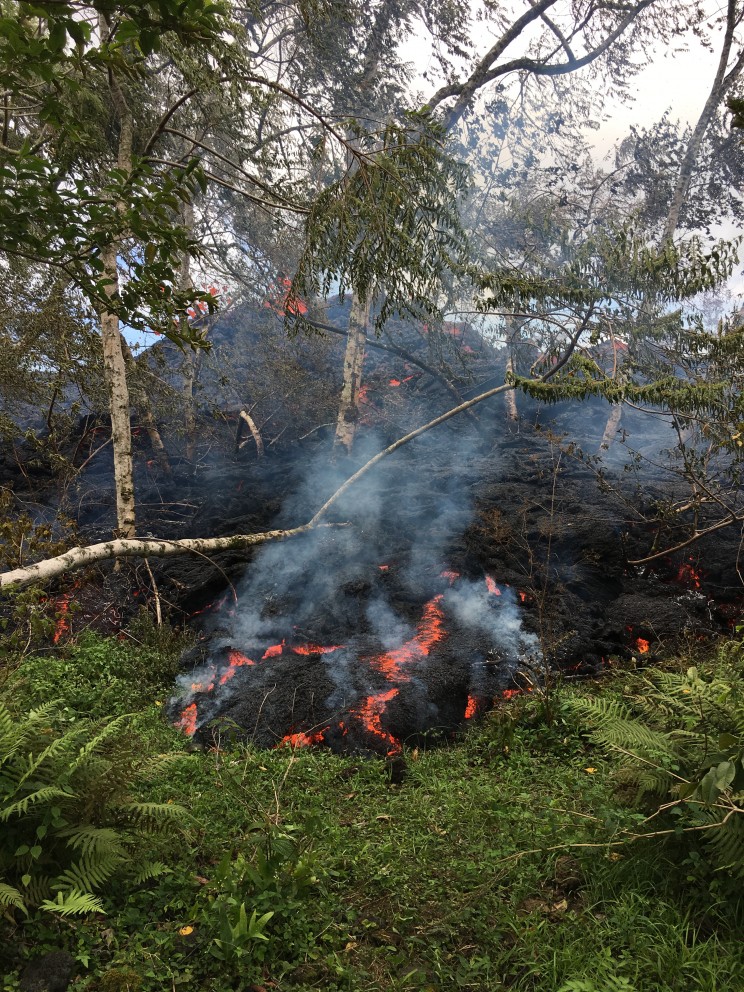


 In the present, which has never existed before and will recede as if it were never there, all things can be made new. This is a subtle idea, at once obvious and at the same time almost impossible to grasp. Yet it is true that the 71 years of my life have passed in moments, always in the now. Even in 1947 my life passed moment to moment in increments, the very same as the increments I experience today in 2018.
 Back in the day, the now further and further away day, I always went to class. I might have missed a few, but it was rare. I enjoyed learning from lectures, getting in the mix of dialogue, thinking out loud. Last night I was the only student in the qabbalah class on Time.
 Being human is a daunting task, steeped in misdirection, existential isolation, perception clouded by tradition, by language, even by our body. Qabbalists and taoists and ch’an buddhists have worked, hard, to peel the onion of our awareness. They are subtle, in their own way as subtle as particle physics or genetics or neuroscience, attempts to understand this task, the one none of us can jettison, save through suicide. They differentiate from the narrowing tendency of science by insisting on a full, a comprehensive positioning of this strange creature that we are in the wild.
 Thought experiments like taoism, qabbala, ch’an or zen buddhism try to shock us out of our stupor, the life lived without seeing the wilderness for what it is, the life lived within the conventions of a particular time, a particular language, a particular place, a life lived without knowing what life is. Most people find little reason to peak behind the curtain of this emerald city that we think is what is. The apparent life, the one with family and money and the NFL and food and houses and sunlight and night, seems to be all that could be. We do not question, we try to paddle the little barque of our body on this river (life) often using only our hands over the edge of the boat.
 And yet there is more, not more in the sense of more layers or more depth, for those layers and depths, the wilderness, always surround us, are the water to which we are the fish, but more in terms of what we can know, what we can access, what we can use to help us become awake. Woke, in the current vernacular, not woke to racism and sexism and oppression in this instance, but woke to the true majesty and wonder of life itself, of this wilderness journey, this most ancient of ancientrails.