Category Archives: Myth and Story

Lughnasa 2011

Lughnasa                                                          Waxing Honey Flow Moon

The third cross-quarter holiday in the Celtic calendar, Lughnasa follows Beltain and proceeds Samhain, thus it cuts the once much longer Beltain season, essentially the growing and harvesting season, in half.  It marks the first fruits of the harvest, a time of gathering in and being nourished by the summer’s heat, the plants’ flourishing.  Lughnasa apparently celebrates the god Lugh, a sun-god, though the relation between him and this festival is uncertain.  The Catholics honor this pagan tradition through the feastday, Lammas, when parishioners bring in bread from the first grains harvested.

In the old days these festivals lasted a week or more, with farmers coming into the village from the countryside or meeting at a customary spot to set up a market.  Feasting, drinking, games, searching for a mate or for work blended with the serious task of laying up sufficient stores to survive the winter, foreshadowed now by the earlier setting of the sun.

A remnant of these market fairs continues on in county fairs and state fairs where feasting, drinking, games, searching for a mate or work blends with honoring those who still provide our food.  Yes, we have the grocery store now and no we don’t wonder about surviving the winter, at least many of us don’t, but the old need to come together and crown a Princess Kay of the Milky Way, to sculpt her in butter lingers.

Lughnasa here at Artemis Hives will find the honey harvest joining the tomatoes, the potatoes, beets, carrots, beans and onions.  It also finds us reaping the harvest of new learning:  Latin, Tai Chi, quilting techniques, potting and celebrating family.  The dogs have become a calmer pack thanks to an investment of time over the last few months.  Mark has made some progress towards a job and a healthier future.

Celebrate your harvest, too.  Raise a glass of wine or water, eat a meal with friends and loved ones.  Wear a flower garland and go the state fair or the farmer’s market.  Why?  Because these are things we humans have done for centuries, for millennia, they keep us alive and healthy.

Tru-Blood

Mid-Summer                                                                           Waning Honey Flow Moon

It doesn’t fit very well with other parts of my life, but I’m a big fan of the supernatural, maybe a hold-over from my orthodox religious days.  Don’t know.

Sookie Stackhouse, a telepathic waitress in Bon Temps, Louisiana, is the heroine of Charlaine Harris’s novels, 12 in all.  She lives in a vampire, werewolf, fairy, shapechanger and maenad infested region which impacts her day-to-day life in ways wonderful and mysterious.  The HBO TV series, Tru Blood, roughly follows the novels’s plot lines.

It made me smile when I read this paragraph in an LA Times short piece on the 5th year of Tru-Blood.  It features my congresswoman, who has made such a name for herself and our district.

“Ball did hint, though, that the vampires might continue to fight over Sookie, but they will unite to fight for their survival as the season reaches its dramatic conclusion. The year’s big baddie, Marnie, played by Fiona Shaw, isn’t exactly the threat Ball mentioned, though: “They’re going to stick together because they are fighting against a common enemy,” he said. “And that enemy is Michele Bachmann.””

Kate’s Hip

Mid-Summer                                                                     Waning Garlic Moon

The ritual masters of the American medical system had us rising with the sun at 5:00 am for the Admittance to the Hospital ceremony, then the Cutting of the Flesh.  By getting us up at a time far earlier than our usual 7:00-7:30 we knew this was a magical moment.  We proceeded through the rush hour traffic to Fairview University where attendants took our vehicle away, out of view.  After appeasing the money changers, Kate received the ritual accessories, bracelets of varying colors including one with the mystical words:  Fall Prevention.

They came for her, the blue-gowned deacons of this mega-church, and led her away where her clothes were removed and hidden away.  She received a lavender gown of paper, marking her as the morning’s sacrifice.  The high priest and his acolyte came in to see her and the acolyte initialed her thigh so the Cutting of the Flesh would be done in a way approved of by the medical gods.

As in many ancient rituals, Kate received a powerful drug that made her smile and seem goofy just before the blue-gowned ones wheeled her away to the secret chapels where the High Priests work their magic.

Satisfied that the gods had received the offerings of insurance and accepted them, I left for home.

Still Alive.

Beltane                                                              Waxing Garlic Moon

Oh, boy.  I’ve not gone a day without a post in a long time.  Yesterday went by so fast.

Worked on Latin for a bit, but a brightening day pulled me outside.  I plucked tulip detritus out of a bed where some tomato plants needed to go.  These were full grown ones, liable to produce tomatoes as opposed to my healthy, but still immature seedling started back in April.

At the Minnesota Hobby Beekeepers meeting Tuesday I learned that honey filling what could be brood frames means the bees in colonies 2 and 3 felt crowded.  I got out my honey supers, scraped them free of propolis, something I realized I could have done last fall, and excess wax, then plopped two each on 2 & 3.   These are the colonies that will be allowed to die out over the winter.  Colony 1 already has its 3rd hive box on with the queen producing brood at a quick pace.  All three of these colonies started out on drawn comb which reduces the initial work load significantly and allows the bees to focus on brood raising, foraging and honey and pollen collecting.

All of this means Artemis hives have positioned themselves for the start of the honey flow.

Then it was quick get into my nicer clothes for a 3 hour stint at the Netroots Convention in downtown Minneapolis.  I volunteered for service at the Sierra Club table in the convention’s exhibit hall.  We highlighted our Beyond Coal campaign.  I got into a snit with an organizer who felt that chairs should be anathema at tables.  He feels this creates a climate that forces staff and volunteers out into the stream of traffic, pressing cards and information into people’s hands, getting names and addresses.  At 64 standing on a concrete floor for 3 and 4 hours in a row is not something I choose to do.  A chair gives me an opportunity to take a break now and then.   Which I need.

The organizer’s view saw volunteers as numbers useful for gaining more numbers, rather than people.  This is an instrumentalist view of the person, an error in judgment not unusual among utopians who willingly sacrifice today’s people in service of a better future.  It ignores the true and only reason for organizing which is to gain a better life for others, a better life which begins in the present, not in some imagined or hoped for more powerful future.

Do we need to sacrifice to move our political ideas forward?  Of course.  Do we need to sacrifice our health and well-being?  Only in extreme situations.  Which the Netroots Convention in the Minneapolis Convention center is not.

After three hours of hawking underwear (I’ll explain later) and moving beyond coal as a source of electrical generation, I drove over to the Walker where I began a two session seminar at the Walker Art Center on THE BLURRING OF ART AND LIFE: IMPACT OF MASS CULTURE ON ART. Taught by an art historian from Hamline College, Roslye Ultan, this seminar approaches modern and contemporary art especially since Dada and Marcel DuChamp.  There are ten or eleven of us in the class, all women save for me and all Walker guides save for me.

This means I find in myself cast in the unusual role of traditionalist.  The MIA is an encyclopedic museum with an emphasis on the historicality and the geographicality of art from the earliest to the most recent, extending from a 20,000 year old Venus Figurine to a finished last year installation, Dreaming of St. Adorno by living artist, Siah Armajani.

Roslye takes her art historical cue from DuChamp who said he wanted to put art in the service of the mind.  Rosalye has expanded on or extended this idea into an assertion that it is not the object that is the universal, transcendent work but the idea given form in the object.  Seemingly entrenching my traditionalist orientation, I disagreed, holding out for the work of art itself as the what that transcended time.

She tried to tell me this was not right, but I am not easily budged by an argument from authority, so we had a tussle.  A mild one.  I backed off, as I often do in classroom settings, not wanting to waste other peoples time.  In this instance, as the class progressed, I found the tussle invigorated the class, gave it an edge and increased my focus.

That was two instances of conflict in one day.  On the drive home I turned them both over in my mind, like teasing a hole in a tooth.  Was I too much in the argument with the organizer?  Yes, my tone was over the top.  Did I regret?  Tone, yes. Content, no.  I’ll apologize for the tone to him today.  But not the need to treat volunteers as people not instruments.

The tussle in the class left me with no negative hangover.  In fact, when I put the two together, I realized they meant I’m alive and still living.  I felt good about that.

Bee Diary: Hive Inspections

Beltane                                                    Waxing Garlic Moon

Colony #1:  This is the colony in which my queen release went well.  She’s been busy.  The second hive box, on only a week, has all the brood frames with brood, some full, some partial, so I went ahead and added another hive box.  This is the colony I’m going to keep as a parent colony for next spring.  I’ve decided I want to manage the other two for maximum honey and then let them die out in the fall.

Colony #2:  The first of the one’s where the queen got to her job a week late because I didn’t handle the release well. (at least I didn’t kill her, which I did last year)  This colony seems to be putting a lot of honey in the two supers I added in place of a second hive box.  Not sure what that means, but it for sure means we’re not ready for another set of supers quite yet.

Colony #3:  The second late queened colony.  This colony has brood in the bottom of the two honey supers I added last week, and seems to be storing honey in the top one.  Again, I don’t know what this means, but this one is not ready for another two supers yet either.  I plan to check both of them mid-week, just in case they accelerate the brood production process.

Once again, these bees are placid, friendly, and diligent.  Great colleagues in our life here.  I feel lucky to have them.

Artemis, our patron goddess, has several images, as do most of the Greek pantheon, but this one always causes some consternation.  What’s with all those blobs on her chest?  Though a common explanation suggests they are breasts, symbolizing her role as a fertility goddess, some scholarship suggests they may instead be bull’s testicles or gourds, both also potent symbols of fertility in Asia.

I saw this statue in a museum near the ancient city of Ephesus.  From nearby it was also possible to see the one remaining pillar from her great temple, one of the seven wonders of the ancient world.  Now, it looks bereft, a lone monument in a not too well tended field.

On the same trip Kate and I went to Delos, the site of the Delian Leagues treasury during the glory days of Greece.  Artemis and her brother Apollo were born on this island. It’s a small, uninspiring rocky island, but it has a storied past that makes it more than repay a visit.

Horticulture

Beltane                                                              Waxing Last Frost Moon

Gardening commends itself in several ways, but two are most important to me.   Having life tuned to the seasonal and daily rhythms of heat, light, rain, snow, even frost like we have predicted for tonight, grounds me.  If the frost comes and I have nothing outside to protect, it is a passing phenomenon of little interest.  With delicate plants to protect I know what it means, cold enough to cause ice crystals inside plant cells to burst.  Likewise drought is of no notice to me if I live in a condominium or on a city lot where my grass and a tree or two are my only contact with the plant world.  With a vegetable garden, though, the plants dry up, don’t produce.  I have to consider the drought, see that my plants get adequate water.

When the rains come, followed by warming days and the seeds leap up through the soil, when the potato eyes push a stalk and early leaves through to the surface, when those leeks nurtured since early April stand up and begin to fatten, it matters to me.  Their work, much like the bees, comes from their essence, not from anything I do, but, also like the bees, I have a role, to protect them, to see they have what they need.  We work together, the vegetables, the fruit trees, the currant and gooseberries bushes and the bee colonies.

The food that comes from our garden does not see us through the winter, though some of our crops, like potatoes and garlic for example last that long, but eating close to the land, lower down the food chain, happens more naturally when some substantial part of the diet comes from home.  So, the food alone serves as a final link to the growing process, but as a present symbol of the food available in the vegetable world, it paints into our world color that needs to be at our table all year round.

This, then, has come to pass as my new faith, a link with the earth and its fruits, a role in caring for them and the constant reminder of our dependency, our interdependency on it all.  When I began to work with the Sierra Club three plus years ago, I did it to put my political experience to work on behalf of the living world, in part at least as a thank offering for the sustenance I have received from it all these many years.

Beltane 2011

Beltane (May 1)                                                        Waning Bee Hiving Moon

A bit about how I got interested in the auld religion, the ancient Celtic faery faith and from it, the Great Wheel.

23 years ago I left the Presbyterian ministry and wandered off into a life I could never have anticipated.  The writing turn I took then led me to investigate my Celtic past, the heritage of my Welsh and Irish ancestors.  I learned about Richard Ellis, son of a Welsh captain in William of Orange’s army who was stationed in Dublin.  After his father’s death, his mother paid Richard’s fare to America, to Virginia, where he was to become heir to a relative’s land, a common practice at the turn of the century since children died so often.  This was 1707.

Also a common practice at the turn of the century was a ship captain’s larceny, stealing Richard’s fare and selling him into indentured servitude in Massachusetts.   Richard went on to found the town of Asheville, Massachusetts and become a captain in the American Revolution.

My own other Celtic ancestors, the Correls, were famine Irish, part of the boat loads forced out of Ireland by the failed potato crop, or an Gorta Mór it is known in Gaelic, the great hunger. (Incidentally, this was due to planting potatoes as a mono-culture, much like we plant corn, soybeans and wheat today.)  They came to this country in the mid 19th century.

I did not go into the history of Wales at the turn of the 18th century, nor did I investigate the an gorta mor and its aftermath.  Instead, I went further back, into ancient Ireland and Wales; in fact I looked at all the Celtic lands, Isle of Mann, Scotland, Brittany and Galicia as well.  What fascinated me then, and still does now, was the auld religion, the Faery Faith, as represented in The Fairy Faith by W. Y. Evans-Wentz, more famous as the translator of the Tibetan Book of the Dead.

Not long after leaving the Presbyterian ministry I packed my bags for a week + at St. Denioll’s, a residential library in Hawarden, Wales.  While there I wandered northern Wales, visiting holy wells, castles and Welsh villages.  There was also an extensive collection of Celtic material at St. Denioll’s. Continue reading Beltane 2011

Ovid and Me

Spring                                                               Waning Bloodroot Moon

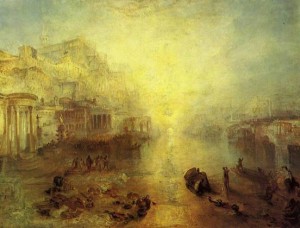
The Latin work has gone past difficult learning, though there is still that, too, into a different, almost ecstatic place.  Reading the words of another language and making sense, poetry, from them still seems magical to me.  I’m really doing it.  The closest analogy is my first set of glasses that corrected my far vision.  All of a sudden I saw individual stars in the sky.  william-turner-ancient-italy-ovid-banishedThe moment was extraordinary.  What had been a fuzzy, blurred night sky became black velvet set with bright points of light.

Now it appears I will finish Diana and Actaeon before the Titian show closes on May 1st and I might make my way through Diana and Callisto, too.  I’m enjoying translating the different stories, so I think I’ll move on to Medea, Pentheus and other discrete stories rather than try the full frontal assault I had planned, start with Book I, verse 1 and soldier through to the last verse of Book XVI.

Another idea that seems possible now is to investigate the Latin texts behind other objects in the museum:  Theseus and the Centaur at the Lapith wedding,  Ganymede and the Eagle,  Lucretia,  Germanicus.  I’m sure there are other objects that have particular Latin texts behind them.  I have no particular reason for doing this except to deepen my knowledge of mythology and of the specific objects in our collection with Latin connections.

Taking up a new intellectual challenge later in life is not only possible, it’s exhilarating.

Our Own, Original Relation to the Earth

Spring                                                            Waning Bloodroot Moon

I’ve discovered an analogy between translation and science.  Coming to a premature conclusion about the meaning of a passage causes chopping and cramping to fit meanings, declensions and conjugations into the preconceived notion.  The better way lies in suspending judgment, collecting all the possibilities, then, sorting them out in context, both with the larger work and among themselves, to find the probable meaning the original author had.  In science, the old method, the deductive method, began with a premature conclusion about the nature of reality, say, the earth is the center of the solar system and then made observational data fit the conclusion.  Francis Bacon summed it up well.  If method were a foot race, then the wrong method would take you further and further from your goal, no matter how fast you ran; the right method (the experimental method) carries you toward your goal, again no matter how fast you run.

Biblical translation often suffers from this very problem.  Predetermined theological or dogmatic conclusions force particular choices in translation, choices that support or reject a sanctioned premise.

It is, too, unfortunately, a trap fallen into by many folks I know.  Using second or third removed “sources” for so-called teachings is not new, but it’s phony baloney and muddies even the best minds.  Let me give you an example.  Many of the Wiccan or neo-pagan folk refer with confidence and certainty to certain Celtic religious practices.  Here’s the rub.  All we know about the ancient Celts in other than an archaeological sense, comes from three exceedingly suspect sources:  Roman writers like Julius Caesar and Tacitus, Roman Catholic monks who wrote down some material about the Celtic folk religion and a romanticized version of Celtic lore that surfaced in 18th century England.  The Romans conquered and subdued the Celts militarily; the Catholics oppressed them spiritually; and  the English treated the Celts as second and third class subjects.  Yet it is the literature of these three sources that contain the deposit of information about early Celtic religious practices and beliefs.

Now, even this data, through careful scholarship and skilled literary criticism, can yield solid or at least strongly suggestive information.   We learn some things about the Triple Goddess Brigit, for example, through material written about the Catholic saint who co-opted her place in Celtic lives, St. Bridgit.

It’s an odd field, these contemporary attempts to recapture a relationship in the present with the attitudes toward the earth held in our deep past.  I count myself as part of it, though with a twist, rather than retrieving the thought world and ceremonies of our ancestors, I’m following Emerson.  We need an original relationship to the earth, one based on our experience, not theirs, a religion of our own “revelations” gleaned from the earth as she is now, not the record of theirs.

As one way of getting at it, I take a cue from an Iroquois shaman I met long ago who prayed for the winged ones, the four legged, the ones who swim in the rivers, lakes and oceans, the flying ones and the ones who crawl.  When I asked him why he didn’t he pray for the two-leggeds, the answered, “Because we’re so fragile we depend on the health of all the others.”

We don’t need to become faux Iroquois to grasp and incorporate this sensibility.  All we need do is realize the onrush of climate change and the danger it poses to our species.  In that one move we can shift over to a deep respect for mother earth and all her parts, the living and the inanimate.

That is the fear based way and I’m perfectly ok with it if that’s what it takes to move you because not all fear is baseless.

Another way is to step up your own intimacy with the living world by growing vegetables, keeping bees, growing flowers, participating in the local foods movement, shopping at food co-0ps,  This web of activities coupled with mindfulness about where you are and what you eat can increase your sensitivity to the thrumming, vital interdependence of which we are a real and intextrictable part.

Many use camping, hiking, bird-watching, weather forecasting, fishing and hunting to put themselves into this I-thou relationship with the earth.

There’s so much more here, but I want to plead for direct experience, not the cadging of other cultures, not the assumption that by associating ourselves with indigenous persons we become somehow more in tune with the earth.  No, the one you need to be associating with is yourself and your daily, lived experience.  Can we learn from others?   Of course.  Can we become them in any authentic way?  No.  Absolutely not.

I (heart) Religion

Imbolc                               Waning Bridget Moon

Some people like NASCAR, others quilting, some the middle ages, some middle age.  Tastes and attractions vary for often indiscernible reasons.  Me, I like religions.  Most of them anyhow.  Islam, Judaism, Christianity, Hinduism, Zoroastrianism, Shinto, Taoism, Celtic Faery Faith, ancient Greek, Roman and Egyptian, Voodoo, Native American, Mayan, Aztec, Hawai’ian, Tibetan Buddhism, Jain.  Buddhism, except for its practices like meditation, mindfulness, some how doesn’t attract me.  Don’t know why.

A part of me, a strong, even dominant part never left the young boy stage where why came out at every instance of anything.  Why do birds sing?  Why do dogs die?  Why is the sky blue?  Why is Dad grumpy?  Why did you make noise last night, Mom?

Philosophy suited me, fit me like a bespoke suit straight from Saville Row.  What is beauty?  Why do we love?  What is justice?  What is the nature of reality?  What is reality anyhow?

Religion is often a folk way of asking–and answering–these same questions.

Let me give you an example from breakfast.  I just experienced transubstantiation.  The folks who run the monastery think that happens at the eucharist as the wine and wafer transform themselves into the actual body and blood of Jesus.  I”m not sure about that.  But, I do know that this morning I ate an apple, a slice of bread with peanut butter and drank some tea.  They became me.

No.  I’m not saying I’m Jesus, far from it.  I am saying that the apple, the peanut butter, the bread and the tea did transform, through the miracle of my digestive tract and its millions, billions, of host organisms, into me.  Think about it.  After the big bang and the gradual cooling of the universe, gas clouds gathered, due to gravity and created stars from the initial elements, thinks like hydrogen, iron.  The stars themselves, in their fusion furnaces, then combined and transformed those basic elements into the familiar elements making up the periodic table.

Later still, as the gas clouds and chunks of matter surrounding each star coalesced those elements deposited themselves inside and on the newly born planets, comets and asteroids.  Those same elements, the very same elements, then, through more eons, at least here on earth, combined and recombined to form simple organisms like single celled animals and  plants. Long after that those simple organisms combined to form multi-celled life forms, among them humans.

This morning I–consider that I–the end point of a certain historic chain of events traceable to the creation of the universe ate.  In eating I took in the products of other organisms, the apple which grew in the air on a tree, wheat which grew in fields across these very plains and peanuts which grew beneath the soil.  I also drank water, the same water present on earth for eons, perhaps the same water drunk by dinosaurs.

And it is, even now, as I write, becoming me.  The apple, the wheat, the peanut are also, like me, the end point of a traceable (if we had the instruments and skill) chain from the moment before time until now.  So we recombine, sift and shift elements.  A miracle.