Winter Waxing Moon

I’m gonna say between 12 and 15 inches over the last 36 hours. We’ve been plowed twice and our contract specifies 6 inches as the minimum for a push. I’ve cleared the back decks 4 times, or 5, and this morning it was as much as it was yesterday morning, maybe more. I’m pretty weary from it. With the new palette/deck it increases the amount of snow I have to move and reduces the places I can put it. Creates a tough situation.
All of us up here love the snow, in part for the beauty and in part for the practical reasons I mentioned yesterday. That doesn’t mean it’s always easy to remove or a joy to drive in. Right now, I could wait a bit for our next big storm. Nothing on the horizon right now.
Considering some snow shoeing. I’ve not done that much here. Great cardio and beautiful, quiet here in the mountains.
 Gonna look at material for the religious school class on the 16th. Alan will be back from Argentina. Our lesson theme is yirah, awe. Getting fifteen inches of snow over 36 hours creates yirah. We do not impact the weather, at least not directly. Yes, climate change is effecting the sorts of weather we get, but we don’t get to choose the diverse effects of our self-genocide. Fifteen inches of snow is like a volcanic eruption or a tsunami or a tornado, sudden, unpredictable except just before the fact, a natural act that changes the immediate environment dramatically. Though not as devastating as those violent manifestations, a great snow storm does show the power of the natural world, something to which we have to adapt rather than something we can manage.
Those of us inside homes with heat, water, plumbing, a full refrigerator, a kitchen can, and often do, ignore the rain, the snow, the high winds, perhaps only remarking casually, “Listen to the rain.” “The snow’s so beautiful.” “Those winds are really howling.” In doing so we shield ourselves from yirah. Yirah is the Hebrew word often translated as fear in the Torah, as in fear of the Lord. Remember Moses and the burning bush? Yirah.
 Yirah and kadosh, holy or sacred, go together. Rudolf Otto defines sacred as an experience of awe, yirah, and the mysterium tremendum et fascinans: mysterious, awesome, urgent, attractive in spite of our fear. “As mysterium, the numinous is “wholly other”– entirely different from anything we experience in ordinary life.” Kenyon College. I disagree here. We experience natural acts, acts that have a cause in the world we know, that are so far beyond our control that though we do find them in ordinary life, they are also, at the same time, wholly other. Ask anyone who’s seen the ocean recede, then come blasting in as a tsunami hits. Ask anyone who’s felt the earth, the solid stable never-changing earth, shake beneath their feet. Anyone who’s been been faced with pyrocastic flow.
When I was 10, back in 1957, I visited my aunt and uncle in Mustang, Oklahoma. About 3 am one morning, my uncle Rheford came in and shook me awake. “We have to go.” I followed him out the backdoor of the house and into the ground. Wind and rain battered us as we went down the steps into the storm shelter. The wooden doors closed behind us and a thick chain was passed through inside door handles then linked to a hook set in the concrete floor. When the tornado crossed over us, the oxygen got swept up and out of the shelter, the doors banged and clanged like living things. Afterward, we went back up the stairs, fearing what we might see. The post office, attached to the front of Uncle Rheford and Aunt Ruth’s house, was gone. Just. No. Longer. There.
 Something experienced in ordinary life but also wholly other. I’ve been following a sailing race, the Golden Globe, in which several skippers competed against each other in solo jaunts around the world. Ask any sailor, solo or not, who’s navigated the roaring forties about yirah and mysterium. They’re manifesting every day, every hour in places most of us will never go; but, a few do. Wholly other, but also part of the same puzzling universe which coughed us up into life.
A long road to an old observation, the sacred in the ordinary. Religion has too long tried to cordon off the domains of holiness, of the sacred, of the divine. And not only cordon them off, but claim control over the experience of them. This is human, yes, to identify our own experience as unique, as special to us and ours. But it is not true that either awe or mysterium tremendum et fascinans, is only wholly other, and it is especially not true that Christianity or Hinduism or Tibetan Buddhism or Islam or Mormonism has the only safe way to encounter them.
In just a moment I’m going to go back downstairs in a world transformed by snow. It’s awesome and mysterious. And right here, right now.


 Our first major snowstorm of the season is upon us. We’ve gotten 4 or 5 inches already and it’s only been snowing since midnight. May get 8-10 inches. Black Mountain has disappeared behind a gray-blue curtain, the lodgepoles look like flocked Christmas trees, and our solar panels have a 4 inch white blanket between themselves and the sun. No appointments today, no meetings. We can take this storm in as it comes, not see it as a barrier. We’ll get plowed today, I’m sure, so no worries there either. Let it snow.
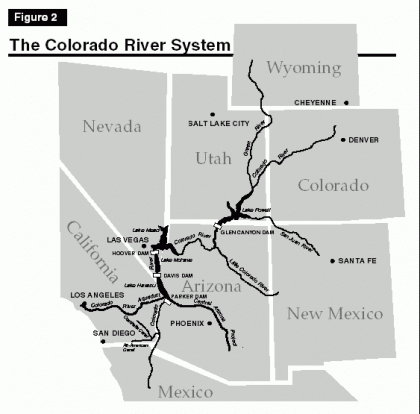
 There are two other effects that are critical to life both here in the Colorado Rockies and in the southwestern U.S. A good snow season reduces the threat of wildfire in the spring and summer until the monsoons come. That effects Kate and me and our neighbors directly. It feels much better going into summer having had plenty of moisture for the trees and the soil. A good snow season also recharges our aquifers, makes sure we’ll have water throughout the next year. This is an immediate, right here result of good snow.
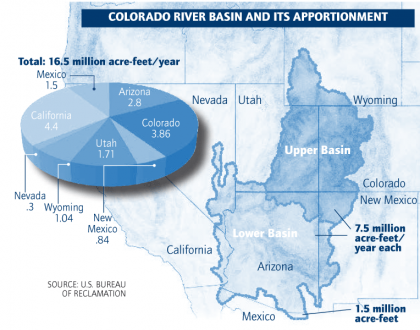 “Total population in the Colorado River Basin (CRB) increased from 4.56 to 9.44 million people from 1985 to 2010. Most of those people were in the lower CRB, with 86 percent of the total in 1985, and 90 percent of the total in 2010.”** The snowpack numbers, created by our annual snowfall, are critical not only here, because the Front Range and the Denver Metro rely on the Colorado River, but throughout the seven state CRB. These figures, almost invisible to the population of the humid east, are never far from the minds of government officials at the state, county, and municipal level here in the arid west, or the population as a whole.
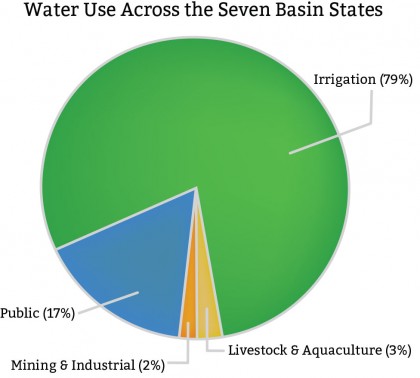 Finally, here is the problem that bedevils all those effected by The Law of the River, a web of compacts, federal laws, court decisions and decrees, contracts, and regulatory guidelines.* As this graph clearly shows irrigation is the largest claim on the CRB’s water by an order of magnitude. Add to that the allocation for livestock and aquaculture and 82% of the allocation goes to agriculture of one kind or another. We need food, those who grow our food need water. With public uses only 17% of the pie even the most draconian water policies in cities and areas like the Front Range will not move the needle much in total water use. Add to this the problem of the gap, droughts, and rapidly increasing populations, five of the fastest growing states in the nation are part of the CRB, then you can begin to imagine the tense negotiations required to maintain the status quo, let alone plan sensibly for the future.
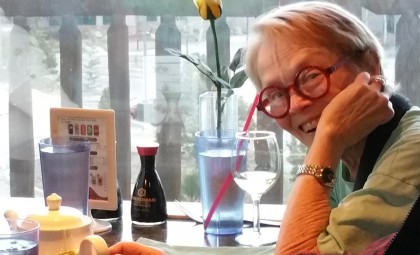 Kate’s wanting to get out and not just visits to medical facilities. Her stamina has improved some, she’s eating more. She’s still in the 80-82 zone, but I’m looking forward to her cracking 83. Then up from there. She’s laughing and smiling, things I didn’t see often over the last three months. Enjoying these moments. Both of us.

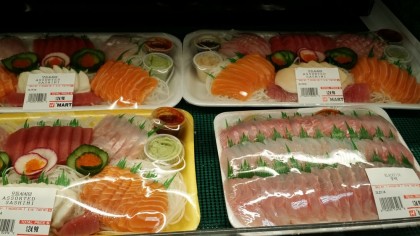 Over to the second H-Mart with SeoAh yesterday. This one is smaller than the one in Aurora, but is much better organized. It’s more like a US supermarket though with very different stock. The Aurora H-Mart is more like an Asian market. I love the produce, the array of seafood, and whole cold storage displays filled with things I can’t identify. As you might expect, there is also an amazing range of sushi, sashimi, (left) noodles, soy sauces, frozen dumplings, other prepared foods like soups and sauces. The beef is all Kobe beef, wagyu, but raised in the U.S.
 Cousin Diane wrote a “why don’t you slow down some, just be for a while?” e-mail. Interesting. When I had no choice, during Kate’s first hospitalization, I did prune out many things, but that was necessity. Daily trips into Swedish or Brookdale, occasionally more than one, left me too exhausted to do much more. My friend Mark Odegard made a similar comment on Sunday during our Zoom session. “Your life is always complex, lots going on.” Also interesting because Mark’s got a lot going on, too, but he sees my life, perhaps as Diane did, as having more going on than is necessary.
 Even as I write this I can feel it lifting. Writing can be therapy, taking what’s inside, putting it outside where its outline clarifies, where it doesn’t rattle around contaminating the rest of the mind. There’s a stress element. There’s also an oh, I’ll just lean back and let things go past inertia. I can’t be on all the time. And, if I’m honest, I sometimes hit this slump without any outside influence.

 Richard Feynman, the physicist, had
  OK. Let’s start with food. Where does food come from? The grocery store. Well, that’s where we buy it. But where does the grocery store get the food? From trucks? OK. How about the trucks. Where do they get the food?
 Did you notice that a lot of the food the animals eat comes from plants? Acorns, grass, roots, tiny plants that live in water? What about the rest? Insects, other fish? What do insects eat? Some do eat other insects, that’s right. Praying mantises, for example. But most insects eat plants. Grasshoppers do. Leafchewers. Some eat plant roots. Some eat the nectar, like bees.
 How do they do it? Even scientists have a hard time explaining it, but somehow the leaves take sunlight, water, and other things from the soil and make what the plant needs to live. Amazing, right? Sunlight, water, and nourishment from the soil. Nourishment? What does it mean? It just means anything that helps you live, or helps plants live. And you know what’s also amazing? Guess what the plants send out into the air when they’re done making food? Oxygen! That’s right, plants feed animals and they give off the thing we need to breathe to stay alive. Wow. Go, plants!
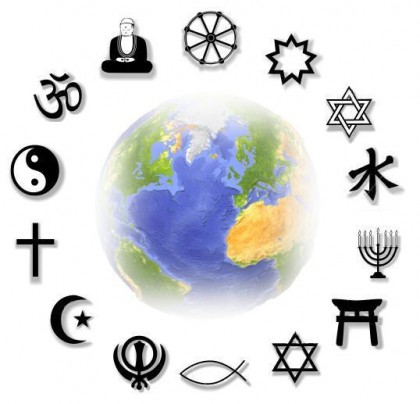 I used to be a Christian, a while back. But, not anymore. What is a religion, do you think? There’s so many different ones that it’s hard to say. To me religions are about what is most important to you. What matters. It might be your relationships with your mom and dad, or Ruth, or your friends. How are you supposed to treat those close to you? It might be about animals and how you’re supposed to treat them. Do you remember when Herschel died? Your great-grandma? Your great-grandpa? Did you ever wonder what happened to Herschel and your great-grandparents after they die? Me, too. I’m not sure, but it is a question most religions try to answer.
 Think of it, Gabe. The sun, that distant star that gives us daytime, the one we see everyday, provides us with the heat and energy to live. Mother earth, the ground we walk on everyday, that holds us up, that we see in parks and farm fields and mountains, provides a home for us and nourishment for the plants. The plants provide food for animals. And animals and plants make food for us. They also make our oxygen. You just breathed some in right now.
 I think of the holy as something both amazing and mysterious. Imagine all the time you spent inside your mom’s womb, growing from two cells into the boy you are now. Amazing and mysterious. Think about a plant’s leaf taking energy from sunlight, mixing it somehow with water and nourishment from the soil to create food, give off oxygen. Amazing and mysterious. Or, how about the change from winter to spring when the cold goes away. Flowers come up. Trees put out their leaves. Grass turns green. Up here in the mountains you see fawns and elk calves. Amazing and mysterious. All holy.
 What I’m seeking in Wonderland is a synthesis Tarnas contends is necessary for us now, a different sort of Great Work than Thomas Berry’s, yet related to it, I think. Berry, if you recall, said that the Great Work of our time is the creation of a sustainable human presence on earth. Not goin’ so well. Tarnas wants to take the ancient, ensouled universe that prevailed until the Enlightenment, mash it into the disenchanted universe occasioned by rationalism and the hegemony of science, and come up with a Hegelian synthesis that can move us out of the stuck place created by their tension.
 Made a big circle yesterday. Drove into Denver on 6, a six lane version of 6th Street between hwy 470 and Santa Fe. Wanted to try LeMar’s Donuts since Kate needs weight and likes donuts. It’s right at the intersection 6th and Santa Fe. I like Bismarck’s and crullers, Kate prefers original glazed. The Bismarck at LaMars was about twice the size of the usual. It was quiet there, mid-morning, after the before work rush. This picture is the counter.
 Kate wanted more mushroom empanadas, corn, and spinach. Lisa Gidday, our internist, had recommended the spinach. “Your new favorite food.” I got an Argentina which has steak, onions, and red peppers.
 As I drove further on the Green Mile, I came across Goddess Isis books. I thought it was on Colorado. I’d always wanted to stop and this was my chance. I’d accomplished my errands and had some free time.