Beltane Woolly Mammoth Moon
We’re out here in the land dominated, for the moment, by the 416 fire. I smell no smoke, see no smoke, but the fire’s presence a few miles north of here is evident in conversation, google searches, and the need to plan around it. It’s grown now to over 32,000 acres with 18% containment.
Yesterday was a red flag day, today is 90% chance of rain. Sounds good, right? Water puts out fire. Well. Water also courses down fire hardened soil, soil made, as inciweb calls it, hydrophobic. Result? Flash flood warnings, especially for Hermosa Creek and Tripp Gulch. Flash floods are one of the sequelae of these big fires that last long after the fire is out.
Our plan today is to head over to Mesa Verde, see what we can see, then, this afternoon or so, find the Durango RR museum. Google says Mesa Verde is about 40 minutes to the west. Not much further north is the Canyon of the Ancients where the mysterious Anasazi culture had its home base. We’re in land settled long ago by descendants of those adventurous souls who crossed the Bering Land Bridge. A sense of humility is in order out here.
The drive from Conifer to Durango is a lesson in geology, following Hwy 285 through the long Platte River Canyon up to Kenosha Pass, then the sudden appearance of the broad, flat plain, South Park. South Park and its fellows, Middle Park and North Park are Colorado’s high plains, South Park at an average altitude of 9,000 feet. Turning south at the road to Buena Vista (where Kate had her quilt retreat in February) we drove along more high plains, and, as the mountains impinged more and more on the road, found a long stretch of beetle-killed pines.
This is poor country with makeshift shelters made from hay bales and shipping containers, old pickups parked forever, and a general feeling of hard lives. Until Pagosa (or, in the Ute, as Paul found, Stinky) Springs. Pagosa Springs (stinky from the sulfur) is a fairly large town as is Durango. Surprisingly so given the land that precedes them from the north.
The creeks here are full, running fast. The mountains steep and tree covered. Yet I’m sitting in a Doubletree Hotel room with all the appointments you would expect. Colorado is a land of heights and valleys, rocky rivers and streams, elk and mule deer, black bears and mountain lions, sprinkled with pockets of population, often upscale.
There is a conversation, now over thirty years old, that continued on the way here. We know each other, have memories and friends in common. What are you reading? What is the nature of time? How do whirlpools form? Wives and kids. Dogs. Hopes. Fears. Creation of tidal tables. What have you been up to?
Well, gotta get a shower, then breakfast. Traveling to do.
 Mario is already in town, taking wildfire pictures with his usual acumen, traveling over mountain passes. Tom and Paul fly in today and we’ll have a slow cooker Irish stew up here on Shadow Mountain, all of us. These are friends of well over thirty years, men with whom I shared twice monthly meetings over that time, plus annual retreats. That bond was the toughest thing to leave behind when Kate and I moved out here.
 Here’s the key idea, from Mordecai Kaplan: the past gets a vote, but not a veto. That is, when considering tradition, in Kaplan’s case of course Jewish tradition, the tradition itself informs the present, but we are not required to obey it. Instead we can change it, or negate it, or choose to accept, for now, its lesson.
 Which brings me to another realization I had this week. Just like environmental action is not about saving the planet, the planet will be fine, it’s about saving humanity’s spot on the planet; the idea of living in the moment is not about living in the moment, it’s about remembering we can do no other thing than live in the moment.
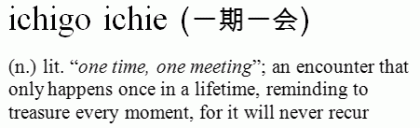 The past is gone, the future is not yet. Always. We can be sure, confident, only of this instance, for the next may not come. To be aware of the moment is to be aware of both the tenuousness of life, and its vitality, which also occurs only in the moment. To know this, really know it in our bones, means we must have faith that the next moment will arrive, because it is not given. Not only is it not given, it will, someday, not arrive for us. That’s where faith comes in, living in spite of that knowledge, living as if the next moment is on its way.
 Probably not many folks count down to the Summer Solstice, but I do. It marks my favorite turning point in the year, the point when the dark begins to overtake the light. Yes, it’s the day of maximum daylight, but that’s just the point, maximum. After the summer solstice, nighttime begins a slow, gradual increase until my favorite holiday of the year, the Winter Solstice.
 Summer and the light has its charms and its importance, too, of course. A warm summer evening. The growing season. The ability to see with clarity. The sun is a true god without whose beneficence we would all die. Worthy of our devotion. And, btw, our faith. So I get it, you sun worshipers. My inner compass swings in a different, an obverse direction.
 Of course, one of the things I forgot to mention about my brief, successful excursion into small engine repair is this. Now I can mow the fuel. That clogged carburetor had given me a pass for a week or so until I decided to tackle it myself. Mowing the fuel is much different from mowing a yard. The purpose has little to do with aesthetics or neighbor pleasing. The fines, as the fire experts call them, are grasses and flowers that, when dry, serve as a fuse so that ground fires can travel from place to place.
 Odd things. First, a small group of folks at Beth Evergreen, mostly qabbalah students like myself, report seeing me as an artist. A visual artist. This is based on my last two presentations, the first being Hebrew letters with quotes relating to their deeper meanings and the second, last Wednesday, that used the sumi-e zen practice of enso creation. Now I’m far from a visual artist, I have two very good ones in my immediate family, Jeremiah Miller and Jon Olson, but to be seen even modestly in their company is a real treat.
 Second. Damned mower wouldn’t start. As I said earlier. Put in fresh gas. No joy. Hmmm. You Tube. You Tube, that Chinese patron saint of the do it yourselfer. Looked up mower won’t start. Found a video of a guy. One with a small wrench who showed how to take apart the carburetor, poke wire into various holes and then, voila, vrrooom. Didn’t look too hard.
 Best of all, when I yanked the starter cord after closing the carburetor back up, the mower started. To those of you with a mechanical gene this no doubt sounds trivial, probably very trivial, but to me. Wow. I fixed it myself.
 I’m not an athlete, not a Latin scholar, not a very good visual artist and definitely not much of a mechanic, but I have an amateur’s capacity. Trying these things makes my heart sing, keeps life vital. I suppose, going back to yesterday’s post, you could say I have faith in myself. Not faith that I can do anything I try, that’s just silly, but faith that if I try I can learn something new, maybe introduce something important to my life.
 How does this make for an excellent practice? Doesn’t it really just increase anxiety? You might think so, but no, at least not for me. What it does for me is highlight the value, the necessity, of faith. How so? Faith is a choice to live in the face of doubt, faith is an act of courage that says, in spite of doubt, or because of doubt, I choose to get up in the morning. I choose life. Trivial? Hardly. Just ask Kate Spade, Anthony Bourdain, Robin Williams. Faith, not faith in a supernatural guarantor, but faith that for this moment the contingencies of life will not extinguish me, not overcome me, is a necessary virtue, in many ways, the sine qua non of virtues.
 I want to know that my choice to come up here this morning to write is an act of small courage, an act of faith that my breathing will not stop, not right now, that I will not fall down the stairs and break my neck, that what I write has some importance in spite of little evidence. Think, for example, of Stephen Hawking. The contingencies of life, the abyss, opened its maw for him early. Instead of cowering before it, he did not allow those contingencies to define him, instead he chose to live as if what he could do in spite of those contingencies, in spite of the moment to moment dangers to his existence, was important. True faith. The courage to become who you are in the face of dangers, toils and troubles. That’s faith.
 But life will not be fooled. That job will end. A marriage can falter. The children can move away, disappear. Our home can burn down or be lost to the mortgage brokers. What happens to your life when it has its own personal Ragnarok? Can you survive the death of the gods? The answer is yes only if you have known all along that they are what is secondary, that they are not gods at all, demi-gods at best, maybe dryads or nymphs, maybe not divine at all.
 On the ground in South Korea a vital and energetic economy has created a vibrant country with feet both in the world of Samsung and the past. Riding on buses or trains through the country side, ancient tombs dot the hillsides. We visited this palace/fort in a city near Seoul. The procession of women in hanbuk at the international airport in Incheon, with the Bottega Veneta and a moving walkway in the foreground brings the two worlds together.

