Samain Thanksgiving Moon
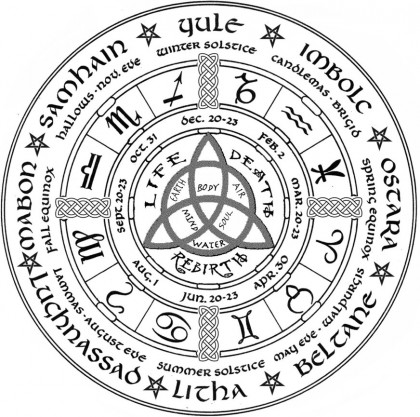
 We have reached the end of another Celtic year. Summer’s End, Samain, marks both the end of the growing season, really, the harvest season and the beginning of a new year. Rosh Hashanah and the Gregorian New Year celebration on January 1st, like the Celtic New Year, put the marker down for a new trip around Sol either at the start of the fallow season or in its midst. In these three instances the New Year seems to suggest a season of reflection, of inner work, as the harvest ends or is well over, while fall and winter stretch ahead.
The Asian New Year’s celebration, usually in February or a bit later, like the Persian Nowruz celebrated on the Spring equinox, occur at the end of the fallow season or near it, setting the new year at the beginning of the growing season. In my case I like them all. I’ll put on a silly hat, pick up a noise maker or dance around the bonfire whenever.
Samain finds the veil between the worlds thinner, with the dead returning and the folk of Faery leaving the Other World to interact with humans. Like the day of the dead and All Soul’s Day, it’s a moment to honor the deceased, often with elaborate meals and tableaus of favorite foods, music, decor.
In the Mussar class at Beth Evergreen I identified myself as a pagan while we ate in the Sukkah. I know what I mean when I say that, but I’m not sure it’s clear to others. It does not mean, for example, that I’m a polytheist. I’m no Wiccan or Neo-Pagan, not a witch or a warlock. I’ll not be saying Blessed Be with a coven tonight.
 So, what does my celebration of the Great Wheel mean? I began thinking about the Great Wheel when I chose to embrace my Celtic ancestry: Welsh and Irish. This was when I began writing novels a millennia ago in the 1990’s. As Kate and I began to garden seriously, joining our lives to the seasonal rhythms of the earth and its weather, the Great Wheel began to live. Time became, as it has remained for me, a spiral, a turning and returning to Beltane and the start of the growing season, to Samain, Summer’s End, and the end of the harvest.
To be a pagan as I understand it is to live into the Great Wheel, into the spiral turning of the seasons, to know the cycles of plant growth and harvest for what they are, the true transubstantiation, the everyday miracle of sustenance. To be a pagan as I understand it is to position myself in the ongoing story of the universe, not as a God’s experiment, but as a form of the universe able to reflect on itself. To be a pagan as I understand it is closer to animism than any formal creed or tradition. That is, the interlocking and interdependent nature of life and its interleaving with the inorganic world means all of it participates in the ongoingness of things.
 There is life and the spirit of the sun residing in every green thing on this planet. There is life and the spirit of the sun in every insect, mammal, protozoa, fish and flying creature. We are all more alike, much more, than we are different. Think of it. We share this planet, third from the sun, in the goldilocks zone. As living creatures on this one planet among billions of other solar systems, our home is a source of unity, a source of fellow feeling.
The inorganic participates directly in the same cycles as rocks break down into soil, as salt water evaporates and becomes fresh water. Fresh water falls as rain and slakes the thirst of growing plants and roving animals. A chemical like oxygen travels through the stomata of leaves, into the lungs of humans and whales. We are one, part of each other and dependent on each other. This is the sort of paganism I celebrate on this New Year’s.
It is creedless, institutionless, traditionless. It is, in its felt form, mystical. Why mystical? Because knowing this oneness, knowing the life and spirit of us all, is a direct knowing, a visceral experience. No seminary required. No monastic tradition required. No puja required. What is required was written over the gateway to the Delphic Oracle’s room, Know thyself. Yes, know thyself. It is the knowing of our Self as a participant in this great, this cosmic adventure that marries us to the ongoingness of this universe.
In this new pagan year take time if you can to breathe deeply, to see clearly, to listen closely, to taste and touch with delight, with joy. That’s all that’s needed. All.
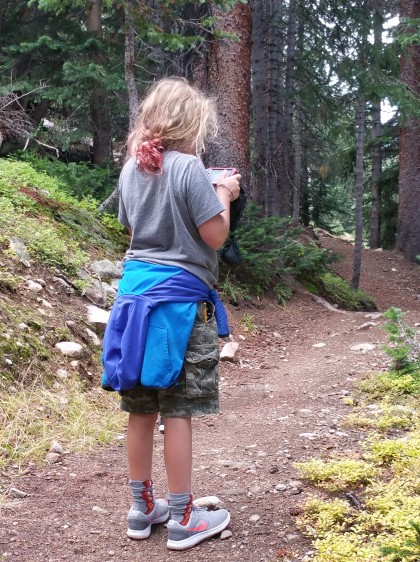 Ruth is filling out her application for the Denver School of the Arts. The application process includes an audition sometime in January. She’s going for fine arts. Ruth is a printmaker, a painter. She draws well, too. I really hope she gets in. She needs peers, other kids with her level of talent, intelligence and curiosity. Otherwise, she gets in trouble. Grandpop did, too.

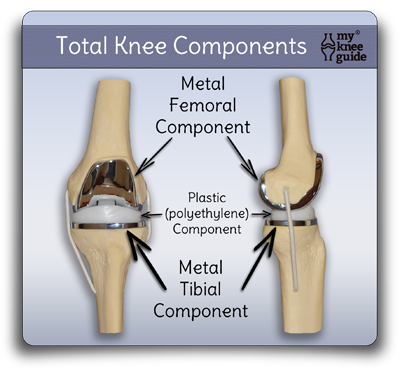 Brother Mark wanted to know if there were images of my new knee. This is a generic image that shows the components of a common knee prosthesis. Total knee replacement is an increasingly good procedure and all of the anecdotal data I’ve come across has been positive. To be able to walk easily, get in and out of the car without pain, exercise, hike with Ruth and Gabe, sleep with less pain medication, and build up my endurance will be wonderful. December 1st.
 Right now I have beef bourguignon cooking on the counter top. It takes 16-24 hours. Sous vide. French for “under vacuum.” I discovered this technique while reading the New York Times. It has apparently been a thing in commercial kitchens for years, but recent products have made it accessible to home kitchens.

 The big news here on Shadow Mountain. Orthopedic surgeon William Peace added some surgery days. Result: total knee replacement on December 1st. I’m excited because this pain is distracting and medication intensive. Currently using CBD’s and acetaminophen during the day and vicodin at night. This works, sort of, but I still can’t exercise, hike, twist suddenly, get up and down easily.

 Pain. Can make you tired. Can make it difficult to focus. Just plain hurts. My left knee has gone from bad to very bad. Trying various meds as a way to make it from now until January. Some success. Pain is a peculiar phenomenon, so assertive, so real; yet totally individual. Inaccessible to another. A message that, once sent, it would be nice to be able to turn off.


 Racism. Is complicated. Very complicated. And, yes, I believe all white Americans are part of its grip on our culture. I’m going to try to boil down a very thorny subject into a few words, see if I can convince you that you are part of the problem if you’re white and live in the U.S.
 Slaves did not vote, but if counted as full persons for population purposes they would have given slave states and the whites who did vote greater representation in the U.S. House. This would have unbalanced power between the North and the South.
 They also had an unearned advantage in their social status as at least higher than that of the slave, the three-fifths of a person enslaved. This unearned social status gave low income whites, often share-croppers, a psychological and social boost which had nothing to do with their personal merit. They were better, at least, than those who toiled without compensation and freedom. That unearned and undeserved lift in personal status persists in the minds and hearts of all white Americans.
 The civil war, you might say, shows the inherent goodness of the north and the hostile debasement of southerners. You might say that if you don’t factor in the unearned economic and social advantages even northerners gained from the enslaved. You might say that if the wreck of reconstruction hadn’t resulted in Jim Crow laws throughout the south. You might say that if you hadn’t grown up near Elwood, Indiana which had a sign at its city limits, No Niggers In Town After Sundown. This was taken down only after the civil rights act in 1964.
 How have all these terrible realities managed to remain in place? Because those with power rarely give it up willingly. We white Americans, through our avoidance of these issues, have capitulated to the structures already in place. Why? Because those structures: biased employment choices, biased voting requirements, lack of affordable housing, lack of available health care, still unequal education, are on the fringe of our lives, happening to someone else, some other African-American self. And to fix them would cost us in taxes, in our unearned advantage in employment, in our ability to control local and state and national elections.