Summer Full Strawberry Moon
Here is a video that warmed my heart. This little boy has just had his cochlear implant turned on:

Summer Full Strawberry Moon
Here is a video that warmed my heart. This little boy has just had his cochlear implant turned on:
Summer Waxing Strawberry Moon
Gyatsho Tshering* died a year ago today. He left his wife and daughter who live in a neat home in a first ring suburb of Minneapolis, Columbia Heights.
Regret is not a big part of my vocabulary. What’s past is past and cannot be changed. A healthy life, I  believe, leaves yearnings for past deeds, past achievements and lost loves behind us, where, I believe, they belong.
I do have regrets about Gyatsho. Read the material below and you will learn what an amazing man he was. I sat in a class with him on South and Southeast Asian Art that he, no doubt, could have taught himself. He was a shy man, a bit introverted, although that could have been partly his immersion, late in life, in U.S. culture.
He loved to share his knowledge, to speak from within his own experience and learning. He was a sweet man, and, as I told Scott Simpson today, I don’t meet many sweet people, a result, no doubt, of the company I keep.
We had plans, Gyatsho and I, but we both tarried in fulfilling them. I was going to eat at his house, learn more about Tibetan Buddhism, just spend time with him. He didn’t call. I didn’t call. Then, he died. Tarrying has a cost.
As a result, I went to his house today with a lump in my throat, a combination of grief and yearning, grief for Gyatsho’s absence and yearning for the time we did not get to spend together.
Tibetan Buddhists, as in the Jewish tradition, commemorate a loved one on the anniversary of the death. Monks come to chant, friends and family prepare food, people sit on folding chairs and eat from styrofoam plates using plastic spoons and forks. Sound familiar?
Gyatsho’s gracious wife, Namgyal Dolma, received guests and guided us in the ritual. Scott, Yin and I went in, one at a time into the tiny corner bedroom transformed into a small temple with thangkas and prayer flags, an altar with offerings and the monks on low cushions and the smell of incense. The chanting was remarkable, mesmerizing. I wanted to be there, bowing first to the monks, hands folded in a namaste like position, then to the altar.
The chanting fell over me like a shroud, no, like a prayer shawl, a tefillin. It moved me into a sacred space at once, the repetition soothing. One of the monks, thick of shoulder with a magenta robe crossed over one shoulder, the other shoulder bare chanted in two tones, the throat singing that has gained some fame here. The other three, with magenta robes and gold, chanted in a single tone. They began at 10:00 am and will end around 5 pm, with, as Namgyal said, a break for lunch.
Namgyal said, “He was my husband,” she paused, “and my teacher, too. He still lives here.” Her hands swept over her body. Me, too. In a much less intense way of course, but his presence lives on for me, as well.
In a setting back home in Dharamsala or Tibet the monks would have been at one end of a long room, the food and the guests distributed further back. Every one would pray. In the more cramped conditions of a 1960’s working class suburban home, the whole became fragments: the monks in the corner temple room, the guests outside under an amazing orange tent, food being cooked in the garage with propane burners and woks.
So, yes, I admit it. I regret not pursuing with more vigor and intention my relationship with Gyatsho. Not many, but this is one.
| *Obituary: Gyatsho Tshering, Eminent Scholar of Tibetan Studies | ||
|
||
A Home for the Tibetan Mind: The Legacy of Gyatsho Tshering
| Phayul[Wednesday, July 01, 2009 18:59] |
|
by Rebecca Novick When the young Gyatsho Tshering approached the Tibetan government with the idea to build a library he was told that he was crazy. “They said, ‘This is impossible. You’re just dreaming.’” Tshering could see their point. “But I am a dreamer. I just go on trying and trying.”
Gyatsho Tshering (1936 – 25th June 2009)
It was 1967, during the early and challenging days of exile. The re-established Tibetan government, overwhelmed and under-funded, was struggling to provide for 100,000 traumatized and penniless refugees, flooding over the Himalayas fleeing the Chinese occupation. But Tshering had his sights set further than the immediate needs of food and shelter. Tibetan Buddhist texts had been arriving in the sub-continent across Tibet’s borders since 1959—carried on the backs of these same refugees. Tshering was profoundly impressed by how many people, only able to bring with them what they could carry from their homes, chose to rescue dharma objects from their altars; pechas (Buddhist texts) statues and thangkas (sacred scroll paintings) rather than items of monetary value. Tshering was deeply concerned that the millennium-old heritage of Tibetan wisdom was being destroyed by Communist forces in Tibet. Inspired by the stories of the great library of Alexandria in ancient Egypt built to house the knowledge of the world, he wanted to create a safe repository to preserve “the skill of the Tibetan mind.” He finally took his “impossible” dream to His Holiness the Dalai Lama who gave the project his blessing. “He was very pleased,” Tshering recalls. “He said, ‘Why not? Go ahead.’” But there were a few considerations. Firstly, there was no money. “We didn’t have any funds,” said Tshering. “Not one cent. Not one penny.” During visits to the West, he would always try to bring up his vision with potential supporters. He was repeatedly, if politely, turned down, with the explanation that the library would be a religious rather than educational establishment. But Tshering refused to become disheartened and he eventually found an ally in the Catholic Church that understood the importance of religious archives. “They were very generous,” he said. After this, other funders gradually began to come on board. The texts that managed to survive the punishing conditions of high altitude passes and a rugged month-long trek in the packs of Tibetans dodging Chinese bullets, formed the library’s very first collections which can still be seen today. Manuscripts were landing on Tshering’s desk battered and torn, with missing pages and passages smudged beyond recognition from snow and rain. It was clear that the challenges went far beyond those of cataloguing and archiving. This was first and foremost a restoration project. A team of the most learned Tibetan scholars was assembled—monks who had spent decades studying in the great monastic institutions of Tibet. “It had been part of their study to commit many of the texts to memory,” said Tshering. They worked from dawn often into the late hours of the night, filling in the missing parts of the texts by hand with nothing but their own memory as a reference. Gyatsho Tshering expressed his regret that with the computer-age Tibetan calligraphy is fast becoming a lost art. “Tibetan calligraphy has power. It has energy. That is something that I miss. But what can we do? The times have changed.” The manuscript restoration team lived without electricity in shacks that before them had housed cows. “We were living hand to mouth, but we didn’t care. We spent whatever we had that day even though we didn’t know what we would eat tomorrow.” Lamp oil was considered more precious than food. “Every day was a day of excitement for us because every day we discovered a new and rare manuscript.” Gyatsho Tshering’s most vivid memory of that time was the support that he and his team received from His Holiness the Dalai Lama. “He would personally take the time to come down and encourage each one of us.” The construction of the library building began in 1969 and took four years to complete and became known as the Library of Tibetan Works and Archives. But just as it was mostly the contributions of ordinary Tibetans who filled its shelves, it was the contribution of the poorest and most disenfranchised Tibetans that stood out in its construction. In those days, many Tibetans were literally carving out a living on road crews in the harsh North Indian mountain states, sleeping and eating in dust-filled tents, and earning a meager 3 rupees a day. Many of these workers put aside one rupee and donated it to the construction of the library. Others even took unpaid leave to come to Dharamsala to volunteer as laborers on the building project. Said Tshering “They built it as if it was for themselves. That was very moving.” As the Library of Tibetan Works and Archives began to gain international recognition acquisitions started to arrive not just from Tibet but also from Mongolia, Germany, and America. Private individuals began donating their personal collections, including a number of gifts that had been given to them or their family members by the Thirteenth Dalai Lama. Tibetan scholars and academics from around the world began making regular visits to Dharamsala to the library that was becoming renowned for its rich and comprehensive collection of authentic Tibetan texts. Tshering recalled people like Jeffrey Hopkins, Robert Thurman, Stephen Batchelor, Alan Wallace and Alexander Berzin who went on to become seminal figures in the Tibetan Buddhist movement in the West. “I remember every one of them,” he said fondly. Today, the Tibetan Library houses the entire collections of Tengyur and Kangyur —the complete Indian commentaries on the Buddha’s sutras and the Tibetan Buddhist canon respectively. Every evening you can find Tibetans, generally the older ones, ambling clockwise around the building, rolling prayer beads through their fingers. “Wherever you find the collection of Tengyur and Kangyur, you will find people doing circumambulation around them,” noted Tshering. “Whenever they feel sad, whenever there is someone sick in their home, or when they want to find consolation, they go to the library and pray.” “The library was a pioneering institution in many ways. We started a thangka painting school, a woodcarving school, a philosophy school. We had the cream of the scholars. Each one of them was a specialist in some field of Tibetan learning.” The original idea was for the library to house only written works, but Tibetans were arriving with so many statues, and other religious artifacts that Tshering saw the need to also incorporate a museum. “To outsiders it’s a museum, but to Tibetans it’s something living.” Tibetans going back and forth from Tibet in the 60s and 70s were often requested to look out for missing parts of key manuscripts that made up the monastic curriculum, and without which monks could not complete their studies. Although they risked arrest and imprisonment for bringing such items out of Tibet, to Tshering’s knowledge no one ever got caught. He believed that there are still many important texts and documents languishing in drawers and file cabinets in Tibet, some that could prove politically “sensitive” for the Chinese authorities who have no interest in seeing them made public. Born in 1936 in Gangtok, Sikkim, a country where Tibetan Buddhism dominates, Gyatsho Tshering grew up with a love of Tibetan culture, particularly its literature. “The attitude of the Tibetan people towards Buddhist philosophy was very different to now,” he observed. The generation of which he was a part, was in his view motivated by a purity of purpose and a sense of altruism that’s becoming harder to find in the Tibetan community. “Nobody thought to extend their hand to outside help,” he said. “We all thought, if we don’t do it, who will do it for us?” Tshering served as the director of the Tibetan Library from up until 1998, after which he moved to the United States because he said, “I needed some rest”. He also wanted to have more time for his personal spiritual practice—an ironic reversal of the West-East trail that has led legions of Westerners to seek spiritual opportunities in Asia. “I feel very satisfied that I was able to do something that was very much of benefit not only to Tibetans but also to people around the world. I’m a very lucky person in that I led a useful life. I have no regrets. When I die, I will die in peace.” Gyatsho Tshering passed away at the age of 73 on 25th June 2009. —– |
Summer Waxing Strawberry Moon
I got through 2.5 hive inspections. The package colony has beautiful comb, an excellent egg-laying pattern and is now ready for the third hive box. That’s as far as it needs to go as soon as it fills out at least 8 frames in the new hive box. That should happen over the month of July.
The divide has had three hive boxes for a week now and has begun to fill up frames in the third hive box though they are far from full. I see no evidence that either of these two have swarmed and I saw few swarm cells. Still a bit difficult for me to recognize for sure.
All of the colonies were a bit more aggressive than usual this morning, a surprise to me since it’s sunny and warm, a good day to go gather nectar and pollen. In my opinion there was no need to harass the bee-keeper, but the divide began whacking at me and got me in a tender space right on top of my thumb’s joint. That hurt! I completed that inspection, too, trying to follow the check every frame idea.
When I got to the parent colony, I removed the two empty honey supers I put on last week. Nothing. Nature’s Nectar, a blog about bee-keeping kept up by the guy who sold me my queen and my package, however, said he had little new honey, too. He’s thinking it will pick up this week. It’s nice to have that kind of confirmatory message since it makes me think things are ok here at Artemis Hives.
When I got the honey supers removed, I began my inspection of the top hive box. It is full of bees. Mad bees. I to about half way through the inspection of the top box and the bees had begun to dive bomb my hands as I reached for a frame. Game over. I’m not willing to spend a week with swollen hands.
I’ll go out tomorrow or Saturday to finish the inspection. I don’t know for sure whether the irritation of hive inspections transmits from colony, but if it does, then the parent colony was ready for me. I may try starting with it next time.
Other than that my fears of a foul-brood infection seemed to be misplaced. I saw none of the signs. The egg laying pattern in the parent colony seems uneven to me, where the other two looked more compact. (better) I’m still a long way from feeling sure about what I see and what to do with the information. But, I’m much further along than I was in April.
Summer Waxing Strawberry Moon
It seems the gods of fate have not left our pack just yet. Today was the annual physical for all of our dogs, a process that begins with luring Vega and Rigel into the back of the truck. Hilo and Kona just jump up into the front seat. That all went fine. Kona and Rigel were a bit nervous, panting and walking around in the exam room at Foley Blvd. Animal Clinic. Hilo sat on my lap and Vega, still a bit dopey from the stings, I think, laid on the floor as if she lived there. Or, as if, as Kate suggested, she hoped she was invisible.
The exam went well enough. Vega came in at 115 lbs and Rigel at an even 100. Kona had gained half a pound and Hilo had lost a pound and a half. During the results, Dr. Roger Barr, a friend now after 16 years of Irish Wolfhounds and Whippets, said he would, “save Hilo for the last.”
Our littlest girl and the dog most devoted to me has some form of kidney disease. Roger says within two months or so she should start to show symptoms as her kidney functions slowly shut down. There’s not much to be done about it. A round of antibiotics could, but probably won’t, knock out a pyelonephritis, if it’s there. If it is an infection, then her kidney function tests will return to normal. It’s possible, but not likely.
Hilo is 9, so she’s not a young dog, but Emma was 14 when she died a couple of weeks ago. Hilo’s not gone yet, we have some time with her, in some senses as we always have, but now with a knowledge that those times are nearing an end.
Each dog is different and special.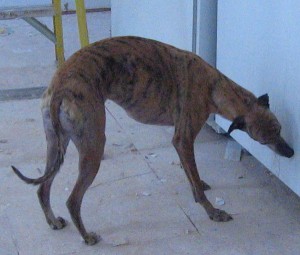 When they die, a unique aspect of our life here comes to a finish. It is the unique and the special traits or memories we recall when we speak of them in later years. Celt’s stepping on my snow shoes, barking at the flapping black plastic bag, receiving attention at the St. Kate’s Art Fair as if it were his due. Buck’s careful positioning of the pillows and blankets so he could lie down on the perfect spot. Iris retrieving and shredding tissues. Emma standing on the tree.
But in the immediate aftermath of a death it is the hole in the fabric of our life that tears the heart. We were seven and now we are six. Soon, if Roger Barr is right, we will be five.
Summer Waxing Strawberry Moon
A bit more on time. Cybermage, Woolly Brother and sheepshead player William Schmidt begs to differ on the notion of cyclical time. He references the geology of Minnesota and, I imagine, the information about the evolution of the universe which he so wonderfully makes understandable with lights and rope.
It is difficult to understand the two apparently conflicting ways of understanding time, the cyclical view that I suggested yesterday over against the deep time recorded in our genes, our own earth’s mantle and the red shifted lights in the heavens. Let me see if I can be a little clearer about what I think.
Instead of time as a characteristic of the natural world, that is, an experience of things occurring in sequence: t1, t2, t3, t4 out there, beyond the reach of our sensory apparatus, I see it as a means of ordering that same sensory experience, a means imposed on it by our mind’s need for order, order that can have a useful meaning for us. In other words, time and space, both, in this view, exist to help us survive in a world of chaotic events happening in overwhelming numbers.
They create a sort of mental short hand that gives us a way of predicting, in a probabilistic manner, the outcome of things we perceive as happening outside us, things important to us as an animal: will that animal be beyond that tree when I shoot this arrow? will the arrow actually travel through the apparent intervening distance and strike the animal? how long will it take me to hike to the berry patch? Or, contemporary equivalents: do I have enough time to go to the grocery store after work and before the kids get home? Can I fit in a round of golf before the rain predicted at 3 pm? how long does this flight really take?
Does this a priori understanding of time and space invalidate deep time? I don’t know. Does cyclical time invalidate deep time? I don’t know. I admit there is one part of me that says, Oh, come on. The earth is 3 billion years old or so. The universe 13.5 billion years. Whatever those words mean, they mean the beginning of both was a long, long time ago. Yet, another part of me, ascendant right now, wonders if our conclusions about the passage of time mean what we think they mean.
This much I know for sure, on this planet, at this latitude and longitude, in 365 + days, we will spin around to the summer solstice again. This I can experience as a non-linear mode of time, a mode of time that relies on the cycles of the natural world rather than on the progression of anything through vast stretches of the past and on into the infinite future. This cyclical mode of time I can referent, whereas the notion of yesterday and tomorrow seem to me to be no more than place markers, file cabinets for data.
Summer Waxing Strawberry Moon
Vega took a nap on the couch this afternoon. Not unusual. She likes that spot. When I came upstairs after my workout, she was still on the couch and I went over to pet her, as I sometimes do. In looking at her I noticed that her eye looked strange, swollen. Oh, boy, was it swollen. Her muzzle, too. Vega had become curious about the bee colonies.
Bees know how to deal with curiosity, nip it in the muzzle and the eyes and the mouth.
When I took the bee course, more than one person asked about dogs, concerned that the dogs would attack or knock over the hives. Each time the question was raised, I could see a slight sense of amusement on the bee folks.
“You don’t have to worry about the bees,” they said. But, they might have usefully added, you might need to worry about the dog.
In other bee news I forgot to mention that during hive inspections last week, I saw a new bee work its way out of the hexagonal cell in which it had grown from egg to larvae to pupae to adult bee. She gnawed away the cap, wriggling to get out, but needing to remove almost all of the cell’s beeswax cap before she could get free.
When she emerged, she looked like a puppy, all shiny and eager, untrammeled by the world. Then, she flew off and got to work. That’s the way bees are.
Summer Waxing Strawberry Moon
Hot today. At least by our standards. 85. Plus a dewpoint of 70. Not outside weather for this gardener. I did work outside this morning, weeding in the orchard and checking the trees. I’m going to need a consultation with Ecological Gardens because some of the stuff they planted, I don’t recognize and I don’t want to remove friendlies out of ignorance.
Kate’s off getting a pre-op physical, having dental work done and nails and hair. A sort of clean up, paint up, fix up day for her. Her surgery is a week from tomorrow and can’t come a day too soon for her. The pain in her hip gives her fits during the day when she walks and at night when she sleeps. She looks forward to having more than two sleeping positions. So would I.
The Romance of the Three Kingdoms has held me for several weeks now, though I’m not reading in large chunks. It’s a three-volume work about the end of the Han Dynasty and the emergence of the three kingdoms of Wu, Wei and Shu. This period only last for about 45 years, but it holds a position of particular importance in Chinese culture, with many of its figures like Liu Bei, Cao Cao, Zhuge Liang and the three brothers: Guan Yu, Zhang Fei and Liu Bei attaining iconic and archetypal significance.
(Liu Bei, Zhang Fei and Guan Yu)
It’s not an exact analogy at all, but it resembles the mythos of the American West, a time when men were men and some men were very good and others were very bad.
If you enjoy political and military tales or have an interest in the logic of other cultures, then the Three Kingdoms may enthrall you as it has me. If you’re not sure, I recommend seeing the Red Cliffs, the two disc version. The movie showcases all the main characters and records a pivotal battle, one that has ongoing importance in Chinese culture. Not to mention that it’s great fun. Again, if political and military intrigue fascinate you.
Summer Waxing Strawberry Moon
“The trouble with life isn’t that there is no answer, it’s that there are so many answers.” – Ruth Benedict
Long ago, back in the Paleozoic 1960’s I majored in anthropology. Anthropology taught me a lot, shaped my view of the world. In anthropology, long before it became fashionable enough to merit bashing on the then non-existent Fox News Network, multi-culturalism was an everyday conversation. Ruth Benedict, herself an early anthropologist and student of Franz Boas, the father of anthropology reflects just that sensibility in this quote.
Anthropologist’s developed the idea of cultural relativism and it was and is crucial to anthropology as a discipline. Anthropologists do field work using the participant observer method, which involves immersing oneself in the cultural of another, then writing about it. Boas and the early anthropologists, among them Margaret Meade, had to undergo psychoanalysis as a preliminary to field work. This was to enable the field worker to grasp, as best he or she could, the difference between something they brought to the interaction and the actual expression of a different worldview.
Cultural relativism meant that much as we might like to believe otherwise (manifest destiny, Hail Britannia) one culture’s solution to the way of surviving and flourishing is as valid as any others. This is the core idea behind multi-culturalism, not merely a liberal tolerance of difference, but suspension of our own values and beliefs in order to accord respect to the other.
Does this have problems? Yes, it does. Critics like Alasdair MacIntyre in his book, After Virtue, say it represents an essential of Modernism, that is, ethical relativism. MacIntyre suggests we consider Hitler’s Nazi party or, I suppose, Pol Pot’s Khmer Rouge. Using the notion of cultural relativism are we not bound to honor their horrific outcomes?
Academics often get caught in the absolutizing of their notions. It’s either cultural relativism or a solid tradition, like the Thomistic Catholicism that MacIntyre puts forward. In fact, I think these are more tendencies, ways we lean when assessing data. Cultural relativism and the thinner soup of multi-culturalism are an inoculant, a vaccine against imperialism, against the unthinking imposition of a more powerful culture on a weaker one.
Tradition, on the other hand, seems an inescapable and therefore most likely necessary ingredient of the human lived experience. Within in it we learn how to behave as an American, a Vietnamese, a Hmong, a Trobriand Islander. We come to assume that the tradition and the culture in which we are raised is normative, and, in fact, it is normative in the vast majority of situations which we encounter. It is when we cross cultures or traditions that questions arise that we may not have considered.
Who says democracy is the only acceptable form of government? Who says individual rights always come before the needs of the tribe or the state? Who says marriage between homosexual couples is wrong, ipso facto? Who says circumcision is critical? Who says we cannot execute anybody we want to by firing squad, lethal injection or the electric chair?
It occurs to me that cultural relativism is a necessary defense against the arrogance of power, just as tradition is a defense against the moral relativism that a global perspective seems to require. To position these two powerful aspects of human life, culture and tradition, against each other goes too far. Instead, we need to learn the lesson each has to teach us and apply them both with humility and care.
NB: Back to Hitler and Pol Pot. We do not need to accept their violent prejudice as normative even under the notion of cultural relativism. What is necessary in those cases is to go within the culture of Germany and Cambodia, to mine their traditions and to critique them from within their worldviews. It can be done and can easily be shown to be possible. Then, we respect culture and yet have an avenue for expression of our deeply held values in a different cultural idiom.
Summer Solstice Waxing Strawberry Moon
The Woollies gathered tonight at Charlie Haislet’s place in the Rock Island condos, just north and a bit east of downtown. We gathered, our numbers shrunk by various summer activities to: Charlie, Warren, Frank, Scott, Bill, Mark and myself. The conversation went on as it does, checking in on how folks are, what’s going on, but Charlie turned the conversation toward Father’s day. It seemed to me, as I listened, that we have all rooted ourselves in family, our nuclear and extended families, and, further, that as we have grown older, those connections have grown richer and deeper, occupying the central spot in each of our lives that the voice of tradition has suggested they might.
Charlie’s 7th floor (top) condo overlooked downtown; the waxing strawberry moon hung over the glass and stone cityscape, the dying sun reflecting in the mirrored surfaces of the IDS, the Northwest Building and all the modernist architecture there. I’ve been critical of it as lacking flair and imagination, but tonight, a clear warm summer night, the reflections and the twilight, then the advance of night and the reflections of lights was glorious. It looked like Oz, as I think of it when I turn on Hwy 610 heading south and see it far away, maybe 15-20 miles.
Before the meeting, I arrived a little early and took advantage of the time to walk through the neighborhood, a now populous community that is no more than 20 years old. There was a couple with a young boy in a stroller and a dog, a young man with his white shirt half out, tie askew with his dog, a couple with a puppy, all walking, off work and at home. The buildings were brick, a few old, like the Rock Island and The Creamette, but many new.
Some had iron barred and locked fence doors protecting patios which anyone could easily vault onto from the railing. There were signs: no walking on the grass, dog waste here, guest parking only, towing $260.00. The green space that existed had a manicured and distant feel, as if its purpose was to recall, to remind rather thanto be. The windows had blinds and shutters; thanks to air conditioning almost none were open, so the few people I encountered while walking were all I could see other than tailored walls and well hung windows, the odd bit of decor. It felt, not empty, but not lively either.
Putting myself there as a resident, I tried to decide if this would work for me. It has the advantage of being near to the main library, downtown, the shopping around University and Hennepin, the Mississippi and its parks. There would be neighbors aplenty and the urban feel has a certain up energy to it.
These days, though, when many folks I know have moved or want to move from the burbs into the city, I’d have to say I surprised myself. It felt too confining, too many neighbors, too many shared walls, too many signs and restrictions. Too little room to plant, to have dogs run, to exercise a horticultural or apicultural inclination. It surprised me because I consider myself a city boy, wedded to political work and aesthetic work that require the urban environment for their realization.
I’ve changed. I’m now an exurban man, grown used to the quiet here, the open space, the land on which we can grow vegetables and flowers, have a bee yard, a honey house and a separate play house for the grandkids. When I drive by Round Lake, I’ve come home.
Summer Solstice Waxing Strawberry Moon
The longest day of the year. Light triumphant, streaming, steaming. The darkness held at bay.
Summer Solstice
This is an astronomical phenomenon transformed and translated into a spiritual one. We humans have over millennia taken solstice and equinox alike as moments out of time, a sacred caesura when we could review our life, our path as the Great Wheel turns and turns and turns once again.
The Celts first divided their year into two: Beltane, the beginning of summer, and Samhain, literally summer’s end. As their faith tradition developed, they added in both solstices and equinoxes. Since Beltane and Samhain occurred between the spring equinox and the summer solstice and the autumnal equinox and the winter solstice respectively, they became known as cross-quarter holidays. Imbolc and Lughnasa filled in the other two cross-quarter spots.
It is the eight holidays, the four astronomical ones and the four cross-quarter, that make up the Great Wheel. In the most straight forward sense the Great Wheel emphasizes cyclical time as opposed to linear or chronological time. This seems odd to those of us raised in the chronological tradition influenced by Jewish and Christian thought in which there is an end time. With an end to time the obvious influence on our perception of time is that we progress through the days until they become years, which become millennia until the Day of the Lord or that great risin’ up mornin’ when the dead live and time comes to a stop.
That this is an interpretation rather than a fact rarely crosses the mind of people raised on birthdays, anniversaries, celebrations of one year as it comes followed by the next. Our historical disciplines from history itself to the history of ideas, art history, even geology and the theory of evolution all reinforce the essentially religious notion of time as a river flowing in one direction, emptying eventually into an unknown sea which will contain and end the river.
Immanuel Kant, in attempting to reconcile the dueling metaphysics of two apparently contradictory philosophical schools (rationalists and empiricists), hit on the notion of time and space as a priori’s, in a sense mental hardwiring that allows us to perceive, but is not inherent in the nature of reality. That is, we bring space and time to the table when we begin ordering our chaotic sense impressions. My interest in the Great Wheel and in the traditional faith of my genetic ancestors came in part from a long standing fascination with the question of time. We are never in yesterday or tomorrow, we are always in now. What is time? What is its nature and its correct interpretation relative to the question of chronological versus cyclical time?
I have not settled these questions, not even in my own mind, and they continue to be live topics in philosophy. Learning to pay attention to the Great Wheel, to the now, and to the specific place where I live has pushed me toward the cyclical view, as has gardening and now the keeping of bees. It is, today, the Summer Solstice. Again. As it was the last time the earth visited this location in space (ah, yes, space. another conversation which we’ll bracket for now) and as it will be the next time. This is a literally cyclical view of time based on the earth’s orbit around the sun, one which returns us, over and over to much the same spot.
Next summer when the solstice arrives the asiatic lilies will be ready to bloom, Americans will be getting ready to celebrate the fourth of July and kids will be out of school. The mosquitoes will have hatched, the loons returned and basketball will finally be over. These kind of phenological observations depend on the repetitive, cyclical character of natural events. There is a real sense in which this time does not move forward at all, rather it exists in a state of eternal return, one solstice will find itself happening again a year later. Is there any progress, from the perspective of the solstice, from one to the next? Not in my opinion.
I don’t deny the intellectual value of arranging knowledge in what appears to be a rational sequence. It aids learning and explanation, but it may well be a mistake to think that sequence exists outside our mental need for it. It may just be that time is, in some sense, an illusion, a useful one to be sure, but an illusion none the less.
Even if it is, we still will have the Summer Solstice and its celebration of light. We will still have the Winter Solstice and its celebration of the dark. We can see each year not as one damned thing after another, but as a movement from the light into the dark and back out again. We can see the year as a period of fallowness and cold (here in the temperate latitudes) followed by a period of fertility and abundance. This is the Great Wheel and it currently makes the most sense to me. That’s the light I have today anyhow. Let’s talk next year at this time.

