Category Archives: Great Work

Bee Diary: July 7, 2010

Summer                                  Waning Strawberry Moon

Dave Schroeder, president of the Minnesota Hobby Beekeepers, came by this morning to look at my bees.  We opened up the package colony first.  “They’re drawing out comb, look good.”  He gave me a tip about keeping megan173/8″ inch between foundations–bee space. “If they have more space than than, they’ll fill it with comb.  Wasting their time.”  “You moved a frame up from below. Good.  Just like you’re supposed to do.”
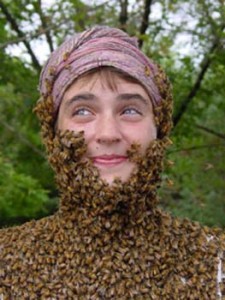
(a fellow docent’s daughter, Megan.  she was a graduate student in the bee department at the time.)

We cracked the parent colony.  Taking the telescoping cover off he placed it bottom side up.  “That’s where I put the supers,”  he said, “Helps you avoid killing bees.”

As I lifted the top two off, he asked, “Any weight to’em?”

“Nope.”

He checked them.  I then took the fullest honey super off.  It weighs about 50 pounds.  Heavy, man.  And the next one.  A bit more weight on that one than last Friday.

We checked the colony itself, in this case I wanted him to take a look, give me his impression.  “That on top is drone comb.  That means you’ve got a happy colony.  Now, I always scrape this off.”  He took his hive tool, scraped along the top of the frame, lifted off the drone cells with their white larvae exposed and dumped them in front of the hive.  “It’s just neater.”

He made sure each box was square and fit perfectly on the next one.  I like to do that, too, but the heat or the weight of the box sometimes makes it hard for me.  I’m a little guy.

After that, we replaced the queen excluder, the honey supers and moved 05-31-10_queenexcluder1over to the divide.  Oh, he did tell me I had the queen excluder on upside down.  Ooops.
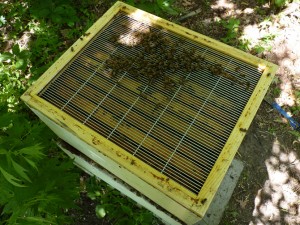
Commercial beekeepers apparently refer to queen excluders as honey excluders.  The bees don’t like to climb through’em, so it slows down honey production.

On the divide, the one that prompted me to connect with him, we removed the two honey supers I’d put on as he suggested.  Then we looked at the top hive box which had honey on almost all of its frames.  There he showed me about moving end frames into the middle of the box.  “The bees won’t draw out comb on the side facing the box.  This way they will.”

“Yeah.  This is plugged with honey.  If you don’t put supers on, they’ll crawl up here (into the third hive box), think, well, we’re done.  Ready for winter.  Then they won’t go up into the supers.”  I’m not clear why putting the honey supers on solves this problem.

He suggested I take the queen excluder off  this one for a week.  That will encourage the bees to go up.  “Bees like to go up.”  Takes one barrier away.

After we closed this colony, he said, “Where did I shake out those bees?”  Dave had shaken bees off the queen excluder as we checked it in the parent colony.  “Oh, yeah.  Let me show you another trick.”  He searched around, found a stick a bit thicker than a thumb and round.  Breaking it off at about 8 inches, he put it in the middle of the bees on the ground and rested the other end against the hive entrance.  “They’ll climb up that and get back in the colony a lot faster.”

As we finished, he said he likes to have all his colonies facing south and in the open. “That way, they come to the entrance, look out, go, Oh, it’s sunny!  Think I’ll go out and go to work.”

A lot of the comments he made were straight forward tips gained from years in bee-yards.  He’s been at it since 1974, 46 years by my count.

(Got this on 7/8 from Bill Schmidt.  Why I’m not a scientist.  By the way, your math on the beekeepers years with bees needs attention.  2010 – 1974 = 36 years, not 46.)

After we finished the hive inspections, “Your bees are doing good.” we sat in front of the honey house and talked bees for about a half an hour.

He keeps about 100 colonies and plans to take them to California this fall.  “Out there they can work.  Get strong.  Here, they’re just struggling to survive.”05-31-10_filledhoneysuper
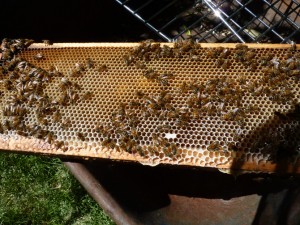
He told about honey extracting, the relative merits of different kinds of equipment, about the high trailer he uses to store honey supers near his colonies, the years he spent working for his brother-in-law, “I wouldn’t take no money.  I was just in it for the education.”

He says 100 doesn’t make him commercial.  When I asked him what does make a commercial bee-keeper, he said, “Oh, 400-500 colonies at least.”

It was a pleasure to have him over and very useful.
Natural Capital

Summer                                    Waning Strawberry Moon

I’ve not written much about permaculture for a while.  Here’s a one-pager* from our landscapers, Ecological Gardens.   It defines a new term for me:  natural capital.  I’ve since discovered that this is a term with a larger history which I haven’t explored fully, but I like the Ecological Gardens version.

Just imagine the kind of revolution we’d have if each person with land–in the whole world or in a whole city or in a whole county like Anoka County–committed themselves to increasing the natural capital of their land.  It’s a little bit like that old boy scout motto:  Leave your campsite better than you found it.

We could, each one of us, take multiple unique tacks on the notion of natural capital.  Some of us might focus on small commercial crops, others might raise chickens for meat and eggs, still others might band together as neighborhoods and grow crops in tandem, some folks doing one thing, others another and producing a local horticultural economy.

A federal or state program that made low cost loans or outright grants for the establishment of permaculture at the local level makes a lot of sense to me.  Like the 160 acres and a mule of yesteryear.  We need a horticulture and an agriculture that increases the carrying capacity of the earth, helps clean up the rivers, streams and lakes.


*Would you like to:
•   Maintain beautiful self-sustaining gardens organically?
•   Pick fresh, nutrient-dense foods from your own backyard?
•   Create habitat for the nature you love?
•   Build resiliency into your landscape to help fight climate change?

These are all products of natural capital. Our first priority at Ecological Gardens is to help you increase the natural capital of your land. This means assessing the unique combination of resources – sunlight, wind, water, and microclimates – and turning them into productive investments that will yield benefits today and for many years to come.
Soil is the foundation for natural capital in our northern temperate climate. Healthy soil creates a condition for healthy plants, produces nutrient-dense foods for humans and wildlife, reduces water use, and minimizes leaching and runoff. Building healthy soil usually requires an investment since most soils are compacted and chemically treated.
Plants are the primary producers of value on the land. They take up sunlight, water, and nutrients turning them into nutritious foods, medicines, fibers, fuels, oils, and wood. Increasing productivity on your land requires an initial investment since plants of low productivity tend to dominate the landscape.
Your return on investment will vary depending on the size of your land and the configuration of resources but will increase exponentially as plant diversity and abundance grows.

Short-term returns (1-5 years)
•   Lower water bills (up to 30%) for yard and garden care
•   Lower maintenance costs for fertilizers and lawn care products
•   Lower food bills as you begin to harvest food, flowers and medicines
•   Greater wildlife value (bees, birds, and beneficial insects)
•   Greater beauty

Intermediate returns (5-15 years)
•   Lower energy costs for air conditioning and heating by strategically locating trees and vines
•   Lower labor requirements as natural processes begin to work for you
•   Increased property values due to abundance and beauty
•   Increased food security as you provide more of your own food

Long-term returns (15 + years)
•   Lower fuel costs as you begin to harvest your own wood [for larger properties]
•   Increased productivity as your land matures

You Say You Want A Revolution? Yep.

Summer                                            Waning Strawberry Moon

It’s been done, I know.  Still, I’d like to put in a call for a 2nd American revolution.  Oh, ok, I don’t care what number it is.  I’ll settle for another American revolution.

My American revolution has a bit of  Norman Rockwell, a touch of Helen and Scott Nearing, more than a dab of Herbert Marcuse, Paul Goodman and C. Wright Mills, some Benjamin Franklin, the spirit of pioneers and native Americans alike when they relied upon on this seemingly limitless land for food and space.  There’s a Victory Garden or two in there as well, plus generations of smart women who canned, dried, jellied, smoked and pickled all sorts of produce and meat.  This New American Revolution demands no marches, no banners, no barricades, no guns and no repression.  And you can dance all you want.

What is it?  It is a revolution of and for and with the land.  It is a revolution that takes the wisdom of a 7th generation Iroquois medicine man who said:  “We two-leggeds are so fragile that we must pray and care for all the four leggeds, the winged ones, those who swim in the waters and the plants that grow.  Only in their survival lies the possibility of ours.”

What is it?  It is a revolution of and for and by the human spirit.  It is a revolution that insists, but gently, that we each put our hand and our back to something that feral nature can alter.   It could be a garden.  It could be a deer hunt.  It could be a potted plant outside where the changing seasons affect its growth and life.  It could be a regular hike in a park, through all the changes of the seasons, seeing how winter’s quiet fallow time gives ways to springs wild, wet exuberance, the color palette changing from grays, rusts and white to greens, yellows, blues, reds the whole riot.

What is it?  In its fullest realization this revolution would see each person responsible for at least some of their own food, food they grow or catch or kill.  In its fullest realization each person would use whatever land they share with the future in such a way as to increase its natural capital, using the land in such a way that it improves with age and gains in its capacity to support human, animal and plant life.

What is it?  In its fullest realization this revolution would find each person closer, much closer to the source of their electricity, their transportation and its fuel, their work and their family.  In its fullest realization this revolution would shut down the coal-fired generating plants, shutter the nuclear generating plants and have maximum and optimum use of wind, geothermal, hydro, solar and biomass generation. In its fullest realization each person would eat food that had traveled only short distances to their table, the shorter the better, the best being from backyard or front yard garden to the table.

What is it?  Well, we have a ways to go yet.  Perhaps a long ways, but if we want our descendants to have a chance to enjoy the same wonders in this land that we have known, we will have to change.  We will have to change radically.  We need, as I suggested, another American revolution.

The 4th

Summer                                        Waning Strawberry Moon

The 4th of July.  A time to think about our country, our home, our sea to shining sea.  Are we in decline?  This chestnut has begun hitting the op ed pages again.  I don’t know, they don’t know.  Only history will tell us.  Does it matter?  Not to me.  We’ll still be Americans, just like the British are still British in spite of the collapse of the empire on which the sun never sat.

Are there major problems within our body politic?  Oh, my, yes.  Does this make our time different from any other time?  Emphatically, no.

Here’s an example from a Frederick Douglass speech quoted in the Star-Tribune today:

“Fellow citizens, above your national, tumultuous joy, I hear the mournful wail of millions, whose chains, heavy and grievous yesterday, are today rendered more intolerable by the jubilant shouts that reach them. If I do forget, if I do not remember those bleeding children of sorrow this day, “may my right hand forget her cunning, and may my tongue cleave to the roof of my mouth!”

To forget them, to pass lightly over their wrongs and to chime in with the popular theme would be treason most scandalous and shocking, and would make me a reproach before God and the world.

My subject, then, fellow citizens, is “American Slavery.””

Does this harmony of misery make us any less accountable for the unemployed, the dying lakes and rivers, the immigrants who would live among us and share this land?   Emphatically, no.

Whether in decline or doggedly ascending the hill to that Bright Shining City so beloved of our forefathers, we must attend the great American ideals of liberty and equality, the twin conceptual mounts on which both our past and our future rest.

And not these only.  We now have before us the Great Work, the demanding and joyful task of creating a human presence on this planet that is benign, not malignant.

Here are the things make me believe we will continue to rise to these challenges no matter our relative status in the world:  we ended slavery.  we fought and defeated fascism.  we looked at old age poverty and created social security.  we have a statue at what used to be the main entry point for immigrants; it is a statue of liberty and one which says to the world, give us your huddled masses, yearning to breathe free.  we have brilliant scientists, great laboratories and universities, students even at this moment learning to be the future leaders that we need.  we have poets, movie makers, authors, critics, musicians, painters and sculptors all ready to help us see what we do not see.  we have neighborhood after neighborhood of people who want only a chance, the same chance many of our ancestors have already had.  we are a people who have won great victories for humanity.  we are a land unparalleled in its ruggedness, its beauty, its flora and fauna, rivers and streams, lakes and forests.

All of these things make me happy and hopeful on this 4th of July.

Hooray for the Red, White and Blue

Summer                                            Waning Strawberry Moon

Hooray for the red, white and blue.  That is, the blueberries, the raspberries and the white clover among which I picked them this morning.  Worked outside for an hour and a half, moving an outdoor table back to its original place on the brick patio outside our garden doors, a plastic table into the honey house for some  more space.  Can’t set the smoker on it though.

(Georgia O’Keefe, 1931)

This all has two purposes, getting the house nicer and in better shape for our own use as the summer begins to take up residence and for our guests in July:  Jon, Jen, Gabe and Ruth and the Woolly Mammoths.  I also moved some potted plants around and am mulling painting a post I stuck in concrete a few years ago.  Painting it some bright, contrasty color that will make the green pop.

Only 83 this morning but the dew point’s already at 67.  Glad the bee work got done yesterday.  On the bees.  The president of the Beekeeper’s Association lives in Champlin (near us, sort of ) and has offered to come over himself after the fourth.  I’ll be glad to have his experience looking in on my colonies.

While I picked mustard greens this morning, I noticed a bee making a nectar run on a clover blossom near my hand. “Keep up the good work.  Glad to see you out here and hard at work,” I told him, rather her.  She jumped at the sound of my voice.  One of those workers best left to her own initiative.

Haven’t heard yet from Kate but the plan is for her to come home today at some point.

Science Is A Poisonous Net

Summer                                            Waning Strawberry Moon

The bee goddess piece in this video comes over half-way through, but the rest got my attention as well.  The quote in the title comes from the bee goddess shaman.

In addition, I saw an animated movie last night called The Man Who Planted Trees.  It is a fictional account of a shepherd who begins to plant oak trees.  He goes on to plant beech and birch as well.  He plants 100 trees a day and the story follows the eventual growth of the forest and how it transforms a barren and desolate mountain into a watery, fertile realm.  It’s a beautiful fable, well worth seeing.

In this video the old woman planting rice reminded me of the Man Who Planted Trees.  I think these folks are Hmong or close relations thereto.

Making Jam, Eating Greens

Summer                                     Full Strawberry Moon

Global warming, how fast can it happen?  I don’t know, but my lilies have begun to open 2-3 weeks ahead of time.  That’s a remarkable fact.  The garden overall seems about 206-28-10_earlylilies weeks ahead, at least that stuff that I got in the ground at temperature, but not date, appropriate times.  I know, this is weather and that’s climate, still, one measure of the advance of global warming is earlier springs, which bring earlier plant blooming cycles.  Of course, one year is not a trend.

Kate and I  made 10 jars of scarlet currant jam, putting them in a hot water bath for 5 minutes to decrease the air pressure inside and get that satisfying ping when the atmosphere, barometric pressure 29.57 right now, presses the lid tight and seals.

We had a mixed green salad with onions, all from the garden, plus a wonderful spicy peanut jasmine brown rice dish right off the brown rice package.  With the bees, the planting, the harvesting, the jelly making and the dinner this was a very local food type day.

Kidneys and Bee Stings

Summer                                Full Strawberry Moon

The dew-point and the temperature are one, 67.  That means a cloud hangs not above us but around us.  It’s a drippy, soggy Saturday fit for neither garden work nor bees.  And I have work to do in both places.  There’s always Latin.

Hilo now takes naps with me every day and sits upstairs with me longer at night.  I want to have as much time with her as possible before her kidney disease takes over.  Kidney disease is strange.  As long as there is at least some kidney function, the disease doesn’t manifest itself much except in heavy drinking of water.  The creatinine level and other measures of kidney function reveal a different, starker picture.  They show the gradual, then exponential depletion of effective kidney reserves.  Once the body tips over into renal insufficiency, things can get bad quick.

As the universe would have it, at the same time Hilo had her labs confirming her problem, I had to go to the lab at Allina Coon Rapids to get my creatinine levels.  Witnessing the steady and relatively rapid deterioration in Hilo’s situation, I awaited my lab results with somewhat more intensity than I might have.

Mine remain unchanged from December and not appreciably different for several times in the past.  Looks ok for now.

After my thumb got all black and blue following my last sting, I began to investigate bee defensive behavior.  I learned a lot of interesting things, a few very practical that I hope I remember the next time.  It seems that when a bee stings it releases an alarm pheromone that attracts others to the location of the sting.  So.  I should scrape off the stinger (not pull it out because that causes the stinger to pump more venom into the wound), then smoke the area stung to mask the pheromone.  I also learned that the same alarm pheromone expresses when a bee gets crushed during hive inspections.  Of course I try to avoid this but it happens.  That situation, too, calls for smoke.  Last, and most obviously, if the bees are ornery on a particular day, put on gloves.  Oh, yeah.

Cultural Relativism

Summer                                 Waxing Strawberry Moon

“The trouble with life isn’t that there is no answer, it’s that there are so many answers.” – Ruth Benedict

Long ago, back in the Paleozoic 1960’s I majored in anthropology.  Anthropology taught me a lot, shaped my view of the world.  In anthropology, long before it became fashionable enough to merit bashing on the then non-existent Fox News Network, multi-culturalism was an everyday conversation.  Ruth Benedict, herself an early anthropologist and student of Franz Boas, the father of anthropology reflects just that sensibility in this quote.

Anthropologist’s developed the idea of cultural relativism and it was and is crucial to anthropology as a discipline.  Anthropologists do field work using the participant observer method, which involves immersing oneself in the cultural of another, then writing about it.  Boas and the early anthropologists, among them Margaret Meade, had to undergo psychoanalysis as a preliminary to field work.  This was to enable the field worker to grasp, as best he or she could, the difference between something they brought to the interaction and the actual expression of a different worldview.

Cultural relativism meant that much as we might like to believe otherwise (manifest destiny, Hail Britannia) one culture’s solution to the way of surviving and flourishing is as valid as any others.  This is the core idea behind multi-culturalism, not merely a liberal tolerance of difference, but suspension of our own values and beliefs in order to accord respect to the other.

Does this have problems?  Yes, it does.   Critics like Alasdair MacIntyre in his book, After Virtue, say it represents an essential of Modernism, that is, ethical relativism.  MacIntyre suggests we consider Hitler’s Nazi party or, I suppose, Pol Pot’s Khmer Rouge.  Using the notion of cultural relativism are we not bound to honor their horrific outcomes?

Academics often get caught in the absolutizing of their notions.  It’s either cultural relativism or a solid tradition, like the Thomistic Catholicism that MacIntyre puts forward.  In fact, I think these are more tendencies, ways we lean when assessing data.  Cultural relativism and the thinner soup of multi-culturalism are an inoculant, a vaccine against imperialism, against the unthinking imposition of a more powerful culture on a weaker one.

Tradition, on the other hand, seems an inescapable and therefore most likely necessary ingredient of the human lived experience.  Within in it we learn how to behave as an American, a Vietnamese, a Hmong, a Trobriand Islander.  We come to assume that the tradition and the culture in which we are raised is normative, and, in fact, it is normative in the vast majority of situations which we encounter.  It is when we cross cultures or traditions that questions arise that we may not have considered.

Who says democracy  is the only acceptable form of government?  Who says individual rights always come before the needs of the tribe or the state?  Who says marriage between homosexual couples is wrong, ipso facto?  Who says circumcision is critical?  Who says we cannot execute anybody we want to by firing squad, lethal injection or the electric chair?

It occurs to me that cultural relativism is a necessary defense against the arrogance of power, just as tradition is a defense against the moral relativism that a global perspective seems to require.  To position these two powerful aspects of human life, culture and tradition, against each other goes too far.  Instead, we need to learn the lesson each has to teach us and apply them both with humility and care.

NB:  Back to Hitler and Pol Pot.  We do not need to accept their violent prejudice as normative even under the notion of cultural relativism. What is necessary in those cases is to go within the culture of Germany and Cambodia, to mine their traditions and to critique them from within their worldviews.  It can be done and can easily be shown to be possible.  Then, we respect culture and yet have an avenue for expression of our deeply held values in a different cultural idiom.

Summer. It’s About Time.

Summer Solstice                                      Waxing Strawberry Moon


The longest day of the year.  Light triumphant, streaming, steaming.  The darkness held at bay.

Summer Solstice

This is an astronomical phenomenon transformed and translated into a spiritual one.  We humans have over millennia taken solstice and equinox alike as moments out of time, a sacred caesura when we could review our life, our path as the Great Wheel turns and turns and turns once again.

The Celts first divided their year into two:  Beltane, the beginning of summer, and Samhain, literally summer’s end.  As their faith tradition developed, they added in both solstices and equinoxes.  Since Beltane and Samhain occurred between the spring equinox and the summer solstice and the autumnal equinox and the winter solstice respectively, they became known as cross-quarter holidays.  Imbolc and Lughnasa filled in the other two cross-quarter spots.

It is the eight holidays, the four astronomical ones and the four cross-quarter, that make up the Great Wheel.  In the most straight forward sense the Great Wheel emphasizes cyclical time as opposed to linear or chronological time.  This seems odd to those of us raised in the chronological tradition influenced by Jewish and Christian thought in which there is an end time.  With an end to time the obvious influence on our perception of time is that we progress through the days until they become years, which become millennia until the Day of the Lord or that great risin’ up mornin’ when the dead live and time comes to a stop.

That this is an interpretation rather than a fact rarely crosses the mind of people raised on birthdays, anniversaries, celebrations of one year as it comes followed by the next.  Our historical disciplines from history itself to the history of ideas, art history, even geology and the theory of evolution all reinforce the essentially religious notion of time as a river flowing in one direction, emptying eventually into an unknown sea which will contain and end the river.

Immanuel Kant, in attempting to reconcile the dueling metaphysics of two apparently contradictory philosophical schools (rationalists and empiricists), hit on the notion of time and space as a priori’s, in a sense mental hardwiring that allows us to perceive, but is not inherent in the nature of reality.  That is, we bring space and time to the table when we begin ordering our chaotic sense impressions.  My interest in the Great Wheel and in the traditional faith of my genetic ancestors came in part from a long standing fascination with the question of time.  We are never in yesterday or tomorrow, we are always in now.  What is time?  What is its nature and its correct interpretation relative to the question of chronological versus cyclical time?

I have not settled these questions, not even in my own mind, and they continue to be live topics in philosophy.  Learning to pay attention to the Great Wheel, to the now, and to the specific place where I live has pushed me toward the cyclical view, as has gardening and now the keeping of bees.  It is, today, the Summer Solstice.  Again.  As it was the last time the earth visited this location in space (ah, yes, space.  another conversation which we’ll bracket for now) and as it will be the next time.  This is a literally cyclical view of time based on the earth’s orbit around the sun, one which returns us, over and over to much the same spot.

Next summer when the solstice arrives the asiatic lilies will be ready to bloom, Americans will be getting ready to celebrate the fourth of July and kids will be out of school.  The mosquitoes will have hatched, the loons returned and basketball will finally be over.  These kind of phenological observations depend on the repetitive, cyclical character of natural events.  There is a real sense in which this time does not move forward at all, rather it exists in a state of eternal return, one solstice will find itself happening again a year later.  Is there any progress, from the perspective of the solstice, from one to the next?  Not in my opinion.

I don’t deny the intellectual value of arranging knowledge in what appears to be a rational sequence. It aids learning and explanation, but it may well be a mistake to think that sequence exists outside our mental need for it.  It may just be that time is, in some sense, an illusion, a useful one to be sure, but an illusion none the less.

Even if it is, we still will have the Summer Solstice and its celebration of light.  We will still have the Winter Solstice and its celebration of the dark.  We can see each year not as one damned thing after another, but as a movement from the light into the dark and back out again.  We can see the year as a period of fallowness and cold (here in the temperate latitudes) followed by a period of fertility and abundance.  This is the Great Wheel and it currently makes the most sense to me.  That’s the light I have today anyhow.  Let’s talk next year at this time.