Reimagine

Samain                          Moon of the Winter Solstice

Jon sent these two links.  Wish I’d had’em when I owned that farm up near Nevis, Minnesota.  I might still be up there, motoring around on some of these very clever inventions.  They show what an ingenious mind can do when rethinking what appear to be over and done with ideas.

http://opensourceecology.org/
http://www.ted.com/talks/lang/en/marcin_jakubowski.html

Makes me wonder what other ideas need a complete rethink.  Computers have followed a pretty standard architecture up to now, one based on a central processing unit.  I read an article in Scientific American last week about a neural computer which, in essence, gives each unit of a computer a cpu, allowing for massively parallel processing as an integral part of the design. It’s modeled on, but not attempting to replicate, the human brain.

How about housing?  Cars?  Or, my personal quest and long time obsession, religion?  The family?  Electrical generation?  I’m interested in distributed generation where a cul de sac or an apartment building or a couple of blocks city residential units might get their electricity from, say, a combination of wind, solar and geo-thermal units sited in their immediate vicinity.

Here’s another one that could use a complete overhaul, reimagining:  nations.  The nation state is a relatively new phenomenon, most experts date its rise somewhere around 1800, perhaps a hundred years earlier in the instance of Portugal and the Netherlands.  In the wake of the globalization of economic life national boundaries have much different meanings that they did, say, 50 years ago.

Let’s go back to religion for a second.  Over the last several years, 23 to be exact, I’ve wrestled with the hole left by Christianity in my life and sought to fill it through what I call a tactile spirituality, one wedded to the rhythms of the seasons, of flowers and vegetables, of bees.  This direction took its initial impetus from an immersion in Celtic lore while I sifted for writing topics.

Then, I began to follow the Great Wheel of the seasons, a Celtic sacred calendar focused on 8 seasons, rather than four.  That led me to integrate gardening with my sacred calendar.  In the wake of these two changes in my life, I began to see the vegetative and wild natural world as more than tools for food or leisure, rather I began to see that they were my home, that I lived with them and in them, rather than having them as adjuncts to my anthropocentric life.

This whole change, this rethink of what sacred and holy mean, what the locus of my spirituality is and where it is, has had a long maturation, much thought and experimentation.  My hope is that my reimagining might provide a common religious base, a sort of ur-religion, which all humans everywhere can embrace.

As in times past this base religion could certainly have others layered on top of it, its essence after all is to be non-exclusive.  What I hope further is that reasserting, inviting, even luring others to see the sacred and the holy in our planet and its other living beings, they will be more likely to join in to see it healthy and vital.
Woolly Mammoths, 6 pm

Samain                            Moon of the Winter Solstice

First time at the Marsh, out on Minnetonka Blvd.  The Western burbs version of a California health spa.  In a small room off the dining area for their food service was a sign:  Woolly Mammoths, 6:00 pm.

Inside were Bill , Warren , Frank , Stefan and Mark.  Tales of the trip, yes, but mostly we were there to support Warren whose mother received a cancer diagnosis two days before Thanksgiving.  She’s now in hospice care at an assisted living center, asking only for palliative care.

Warren has been intimately involved with both his parents and his wife’s parents in their aging and decline.  They represent a degree of love and concern in that situation seen all too rarely.

On the way back I couldn’t find any music I liked, so, as I’ve done a lot lately while driving, I turned the radio off and entered into a road trip state of mind, a little bit country and a little bit Zen.


The Incarnation

Samain                               Moon of the Winter Solstice

Snow.  And darkness.  So different from spring and the lengthening days of South America. The darkness and the snow both make me feel at home, rooted in the season that my genes tell me ought to be going on in December.

Cold seems to have abated and I’ve been working on my nativity presentation.  Now I end with the depression era photograph by Dorothea Lange.  The mother and her children.  A universal and timeless theme.

I’ve just created my first slide show, this one done in the presentation format of openoffice.doc because that’s the software I have on my laptop. (it’s free.)

It gives me the ability to project full view images which I could not do in the .pdf format I used when I checked out the projector on Thursday.

The whole nativity story, of course, comes into the Jesus narrative as an afterthought, a reflection that such an important guy must have had a special and memorable birth.  Not an unusual phenomena in history, but it does make the familiar stories and images very much in the realm of myth and archetype and not history.

The big idea I take away from the nativity narratives is the incarnation.  God becomes human.  Especially in a monotheistic faith this is an extraordinary idea, mind blowing.  Seemingly impossible.  Debate over just how it was possible occupied the Christian church until the Chalcedonian council when competing ideas got sorted and the notion of Jesus as both fully human and fully God became dominant.

In m own breakaway syncretism I put the notion of incarnation in synch with the Hindu namaste. The God in me bows to the God in you.  This way we don’t have to wrestle with the unusual task of fitting an omniscient and omnipresent being into a frail human vessel.  Instead, each of us is a splinter of the divinity, a chip off the old divine block.  We don’t have to pray upward and outward to reach the holy, rather we can go down and in, plumbing our depths, depths which have their roots in the sacred river.

No matter how you understand it this holiseason represents and celebrates the divine human.  Sounds about right to me.  Lets go caroling.

Art and Politics

Samain                              Moon of the Winter Solstice


In to the city to meet with Justin, Sierra Club’s lobbyist and policy wonk.  We’re putting together a campaign strategy for this upcoming session.  I love the ins and outs of politics, the practical, no nonsense nature of the analysis, the calculations.  The realities of power, not its dreamy possibilities.

It is though, at this stage of my life, not as exciting as taking in a new painting, wandering through a new exhibition, revisiting a print I’ve seen many times.  Even so,  politics are deeper in my life, started earlier, continued throughout my life while the arts have been only a once in a while thing until the last ten years.

The man I am now, the man I am becoming, loves the museum gallery more than the legislative chamber, the exhibit hall more than the voting booth, research for a tour more than campaign planning.  Part of me is not sure what to make of this change, but that it has happened there is no doubt.

Perhaps these later years have bent the knee toward beauty rather than the lady justice.

No, of course it’s not either art or politics, of course not.  There is, though, a real matter of how much time I want to devote to life outside our home, how much energy I want to give to projects for others and how much I need to spend on my own work.

These are not easy matters for me, questions I’ve juggled my whole life, but I’ve always tried to remain true to what my inner life tells me.  Just now, it says open that new book with all the paintings in the Louvre.

The Problem of Competing Versions of the Truth

Samain                                 Moon of the Winter Solstice

Colds.  Yeccchhh.  Feels like another one coming on.  In the list of things to consider when theodicy is under issue, colds would be at the top of my list.  If God created a good world, why does it have the cold virus?  Or, yes, if you want to be more to the point, cancer or blood clots or the human propensity toward violence.

Some people, read religious fundamentalists of all stripes, believe moral relativism, occasioned by secular humanist cynics or their equivalents, lies at the root of all social ills.  If people would just learn the commands of:  the Koran, Jesus, Hinduism, laissez-faire capitalism, Marxism, and FOLLOW them, then all the speed bumps and wild curves of history would iron out and we could get down to the smooth, orthopraxic life God or Allah or Vishnu or Adam Smith or Karl Marx intended.

Without even delving into the particulars expected by each fundamentalist group, we can see immediately one of the chief problems with fundamentalism.  They can’t all be right.  In other words if the absolute tenets of, say, strict Calvinism and Wahabi Islam conflict, who’s got the right answer?  Marx or Smith?  Vishnu or the Pentecostal Christian?  To make the absolute claim, which does soothe the believer with apparent predictability, you also lay yourself open to the catastrophic consequences of error.

Instead, colds come into the human body because the evolutionary process has created this dance between viral entities and,  in our case, mammals.  In the dance the virus hunts for a home with all the elements it needs to survive and reproduce.  The mammal’s body, as that home, tolerates its presence if it doesn’t throw things too out of whack, when it does.  Bam.  The body’s shock troops go into action.

Is the virus bad?  No.  It just is.  Is our body’s response good?  Well, to us as an organism, bent on survival, yes, but, in the ongoing dynamics of life, no, even our body’s response just is.

In the same wise human acts of all kinds can be judged according to criteria so certain, so dogmatic that they can be determined bad or good, sinful or salvific.  Trouble is, if you step outside that zone of certainty, then the same act may change its colors.

Spare the rod and spoil the child is a good example.  In some fundamentalist Christian groups this dictum is taken as holy writ. This type of fundamentalist certainty is the one clear correlation with both child and domestic abuse.  Abuse is the evaluation of others outside the circle of fundamentalist dogma.

This difficulty becomes even more trenchant, and even more pertinent, when we look from culture.  In the US and the West in general individual human rights trump collective decisions.  That is, genocide such as that carried out by the mercenaries of Moammar Qadafi, though state sanctioned, violated the human rights of those who resisted his government.

In the East though human rights themselves are seen as collective, that is, the good of the whole comes before the individual.  This belief gets its strongest support in the traditional Asian family structure where each family members lives so as to strengthen the whole family.

We in the West see this submersion of the individual in the larger whole as crushing liberty and freedom, the East sees us as leaning toward the irresponsible, selfish.  We tend to act in our  own self interest rather than the interest of the community, so our parents can’t count on us in their old age.  Even our children can’t count on us in our old age.  At least some of the time.

So, who’s got the right of it?  One perspective says the right of it depends on location.  If you’re in the West, then the path of individual improvement and progress is right.  If you’re a contemporary Roman Catholic, then abortion is wrong and heterosexuality is good.

Another perspective, one I hold, acknowledges the multiplicity of perspectives and sees the dialectical truths often illuminated by the conflicts between and among ethical systems as productive for our overall advance.  More on this later.  Gotta go sign a refinance document.


Orthodoxy become Orthopraxy: A Political Sinkhole

Samain                              Moon of the Winter Solstice

An interesting article in this morning’s Star-Tribune about the conflation of economics and religion, in particular laissez-faire economics (individualism) and Christianity as defined in William Buckley’s God and Man at Yale.  The author of a biography of Buckley, Carl T. Bogus, also the writer of this column, identifies this conviction as a sentiment rather than an argument, that is, the United States must be as radically laissez-faire in its economics as it is pure in its Christianity, so orthodoxy conflates into orthopraxy, a recipe for political disaster.

Bogus sees these two sentences as central to GAMAY (as Buckley’s book is called by movement conservatives):

“I myself believe,” he declared, “that the duel between Christianity and atheism is the most important in the world. I further believe that the struggle between individualism and collectivism is the same struggle reproduced on another level.”

The effect of this framing is to create either/or, black and white analysis.  Either you are Christian or you are not.  Either you are a laissez-faire economics individualist or you are a communist/socialist collectivist.  Either you are a Christian or you are an atheist.  One side is good, the other bad.

Buckley was an Episcopalian and had definite opinions about the correct, or orthodox line of thought within Christendom, a bright line that defined his Episcopalianism over against diluted or deluded others.  In the same way either you were a free-trader, a hands-off the individual para-libertarian or you were a collectivist, crushing the individual and the marvel of the free-market.

This splits the world, shattering the notion of a dialectic where individualism and collectivism, for example, exist as poles on a continuum, in dialogue with each other and informing each other.  In dialectical thinking the world is more complex, more given to nuance, there may be times where collectivism makes more sense and others where individualism does.  They are not, in dialectical thought, opposites, rather they represent dynamic forces always at work.  In other words you can’t have one without the other.

Bogus helped me follow the trail from Buckley, who was well-known for his warm personal relationships with liberals, to Rush Limbaugh, Ann Coulter, Dick Cheney, evolution and climate-change deniers.  This underlying either/or analysis of Buckley’s has devolved into a crusade the evils of secular humanism and government action in general, though especially government action designed to show our collective responsibility as citizens of one nation.

I’m not sure what trail we follow to get back from this place where heaven is Milton Friedman and hell is John Maynard Keynes, where heaven is right-wing Christian evangelicalisim and hell is any other way of understanding the world.

Orthodoxy helps clarify and simplify the world, leading to clear lines of ethical and moral thought.  When orthodoxy makes the concomitant leap to orthopraxy, that is, practice must always be in line with orthodox belief, we find ourselves in the same spot as those with conservative Islam looming over them.  Mullah Limbaugh and his fellow clerics, Ann Coulter and others of the shock jock circuit lash waverers back into line.


Mi Casa

Samain                                     Moon of the Winter Solstice

Much as I enjoyed the travel, the close time with Kate, the ocean, new cultures and places, I find this computer and my own keyboard, my reference shelf and my library, mementos from past trips, family, collected art like slipping into a pair of comfortable bedroom slippers.  At its best travel allows for renewal, challenge, broadening, but an unexpected and forgotten pleasure, perhaps never noticed before, is this lifting up of home.

Home as reality and as metaphor carries a special valence for all of us, one way or the other.  I moved so often for the first 40+ years of my life I never had the time, the digging into a place where I could really feel home.  Here in Andover, although the burb itself is nada as place, the home Kate and I have created nourishes both of us.  We have space for our mutual creative work, space for mutual work outside and in, leisure space and fitness space.

Over the years, as is the case with most family homes, our sons have developed memories here, now grandchildren and in-laws, too.  Animals, both present and past, inhabit the hallways and the woods.  Storms past, challenges met and overcome, Thanksgiving, Hanukah, Christmas, birthdays, honey harvests.  All here.

Home.  This trip made me appreciate it more than I ever have.

Peace? Prize? Putin?

Samain                          Moon of the Winter Solstice

Apparently, I was not the only one taken aback by the Confucian Peace Prize.  Here’s a quote from the NYT about the prize and the award givers rationale behind it:

“It praised his decision to go to war in Chechnya in 1999.

“His iron hand and toughness revealed in this war impressed the Russians a lot, and he was regarded to be capable of bringing safety and stability to Russia,” read an English version of the committee’s statement. “He became the antiterrorist No. 1 and the national hero.”

Not only that, it applauded him for “acting as the propagandist of current political events” while still in high school, and for being selected to join the K.G.B. while in college, “which made true his teenage dream of joining the K.G.B.” Much later, of course, came the “large-scale military action towards the illegal armed forces in Grozny, Chechnya.””  NYT, 11/15/11

Another article I read said that the CCP has distanced itself from the organization that has given now 2 peace prizes, the last one to a man who refused to show up.  Observers believe this was an attempt to divert attention from the awarding of the Nobel Peace Prize to Liu Xiaobo, imprisoned Chinese dissident writer.

Oops.  Didn’t work.

Oh. Yeah.

Samain                           Moon of the Winter Solstice

We have entered my favorite season of the year, the slow slide toward the Winter Solstice, the longest night of the year.  Cue Robert Frost.

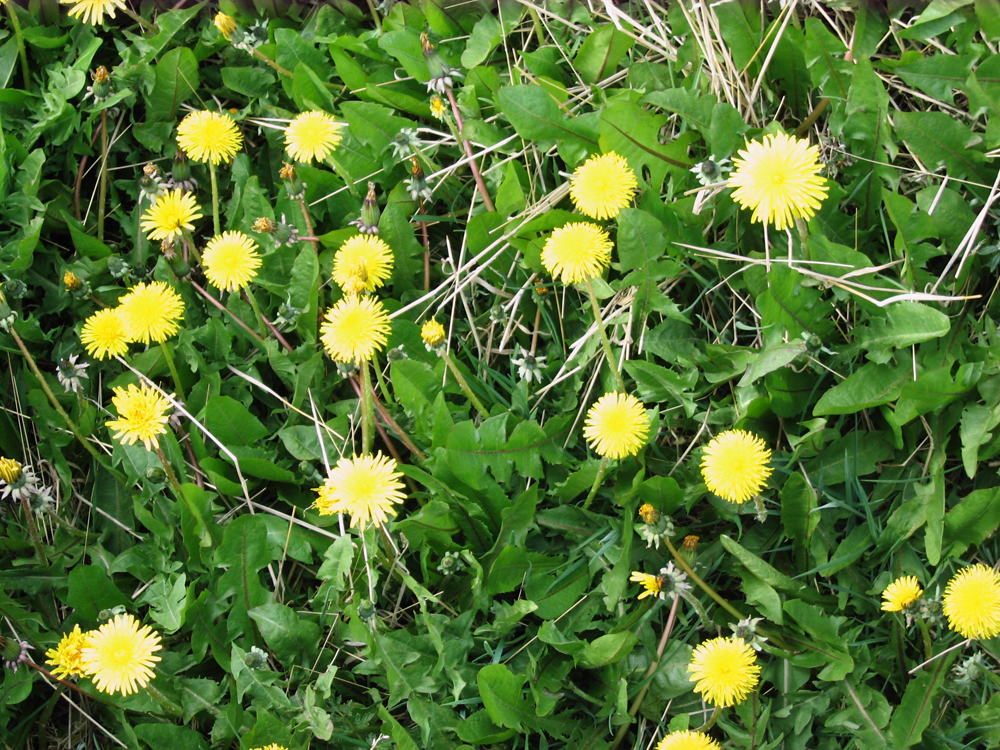
(Dandelions at Lapatia Bay, Kate)

In Ushuaia the sun did not set until 9:30 pm.  Here it sets at 4:30.  As we traveled south along the west coast of South America, the days grew longer and longer.  The evening I went into Ushuaia to have supper, it was 8:00 pm and still quite light.  People strolled the streets, window shopping, holding hands, glancing here and there at other walkers.

They’re headed for a date with December 21st as well, but for them it will be the summer solstice and the longest day of the year.  I knew this intellectually, but it was the little things, like taking pictures of the dandelions at Lapatia Bay, the southernmost harbor of Tierra del Fuego, that pressed its reality into my experience.  Let’s see.  Dandelions here.  Leafless trees at home.  Spring.  Autumn.  Oh. Yeah.


Quotables

Samain                                     Moon of the Winter Solstice

Quotables

Bumper sticker today:    Think about honking if you love conceptual art.

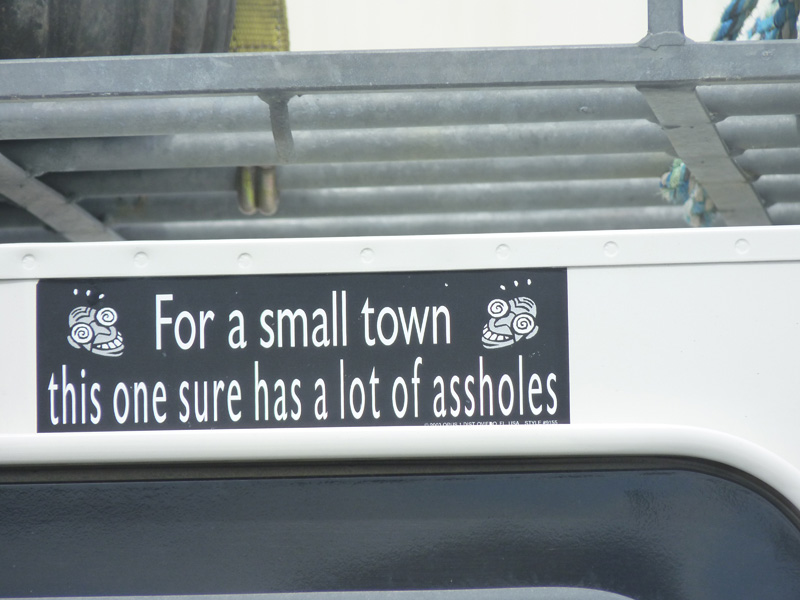
Bumper sticker in Stanley, capitol of the Falkland islands (2,500 people):  For such a small town there sure are a lot of assholes.

Heard on the cruise:  Hope you have a good day.  Reply:  It already is a good day, we both woke up.