Happy medical people. “Everything looks good. We didn’t find any problems!” Sounds good, right? Well, we’ve reached the odd juncture with Kate where these are not the exclamations we want to hear. We want to hear, “Ah, so this is what causes the nausea.” Yesterday’s endoscopy was yet another “positive” result. So frustrating. Another test in the near future, looking for something in the liver, gallbladder area.
After we went to one of Kate’s happy places, Appleby’s. A light lunch. 93 degrees yesterday down the hill. A fine July day. Except for it being the middle of September.
Back home I fed the dogs, changed shirts and drove on to mussar at Beth Evergreen. The topic was gossip. Jewish sages compared public embarrassment to murder. Seems extreme to me. Gossip is saying anything about someone that’s not there. Anything. Again, seems extreme to me. If I recall correctly from my long ago anthropology days, gossip is, like joking, boundary setting behavior. It’s one of the ways social cultures create and enforce norms. The sages, in this case, may be more scrupulous than usual. In the opinion of many of us, too scrupulous. Not a rant in favor of gossip. Just an attempt to soften the edges of the argument.
It seems to me that the more important issue with gossip is judgment. When gossip spreads a negative judgment about another, another who is not present to contest the judgment, then it becomes serious and harmful. The old cliche says it well, “If you can’t say anything nice about someone, don’t say anything.” I did show up late to the class, so I missed the early part of the discussion.
Rabbi Jamie has translated several psalms into a more contemporary, more in your face style. At some point here I’m going to share some of his work alongside other translations.
Brother Mark is inching toward the sands of Araby once again. I say inching because the visa process takes as long as it takes, even for those who’ve worked in the Kingdom before. When the visa processing completes, he will once again climb aboard a jet plane headed for what he calls SA. Good luck, Mark.
A Robert Indiana sculpture: Ahava, Hebrew for love
At Tu B’av, a minor holiday, now a celebration of love in Israel and dubbed by its restorers as Jewish Valentine’s Day, unmarried women would come together, all dressed in white, dance, and hope to find a partner. Matchmaker, matchmaker, make me a match.
We celebrated Tu B’av on August 15th at Beth Evergreen and Kate won a silent auction for a backstage experience at a local production of Funny Girl. We went last night. It’s tech week for Funny Girl and our friend Alan Rubin is a player.
I had nearly enough theater credits for a minor and acted quite a bit in high school, college and seminary. After that, nada, but Kate and I were regulars at the Guthrie. When I was in high school and middle school, our parents took us several years in a row to Stratford, Ontario, to the Stratford Shakespeare Festival. A passion, really, but one that has slowly faded.
Just before getting up this morning a strange, but somehow obvious thought occurred to me. While on the backstage tour we visited the dresser, an energetic guy who made or altered 490 costumes for the women in this performance. !. We saw the multiple props, a day bed, a drinks trolley, several doors with wheels, a set of steps for musical numbers, a kitchen table, a dressing table. Downstairs we saw the storage areas for costumes and prop making materials. We spoke with the dresser, the stage manager, the director, the actors, several of them, the lighting and sound people. All, to a person, warm and friendly.
We watched the rehearsal through until intermission at 9:30, then these old folks began to tire and went home.
Here’s the thought. Going backstage, seeing all the accoutrements for staging a play, especially going into the basement area, made me think of id, ego and superego. Of the masks and personas we wear. Of our brain as backstage, where we store props, costume changes, makeup, where we put together the elements of the show that is our lives. The show itself, and its superego, the director, is the life others see, the one we present as we strut and fret our hour upon the stage, then are heard no more.
Let me extend (overextend) the metaphor in one more significant way. All these various elements costumes, props, actors, the stage itself alter themselves for each new script. In other words it is the nature of the theater to be plastic, to use familiar elements for telling unfamiliar stories.
As our life goes on, we often get stuck in Groundhog Day times when we simply repeat the same script over and over. We don’t hear the audience, we don’t see the repetitiveness, are not aware that we’ve been mounting the same play again and again.
Here’s the takeaway for me. Examine the script. Become aware of the lines you’re delivering, the plot you’re pushing forward. Is it still the one you want? Is there another play you can put together with the props, the roles you’ve already played, the stage to which you’re committed? Could be. We can put on new productions, use familiar elements for unfamiliar stories. Might even be fun.
Tomorrow, in our second religious school class, this one unscripted by Moving Traditions, we’re going to do a get to know each other exercise. Your life in 5 objects. Taking my cue from the American History in 101 Objects display at the Smithsonian, I’ll start with my own five objects: a newspaper, a globe, artemis honey and apples, great wheel, family picture.
I’ll ask the kids to bring their objects, 7th graders next class and 6th graders the next. My hope is that as they look back over their life they will begin to reflect on childhood, their childhood and childhood in general. The dominant theme of this year is the huge transition underway for them from childhood to adolescence.
This will also help me get to the know the kids better since they’re all unfamiliar to me beyond names right now. Looking forward to it since the barrier between never having done this and being a rank amateur has been breached. I’m now a novice learning how to help others learn. I can work with that.
Kate and I went in early yesterday morning to help prepare the board’s luncheon for those attending the Rosh Hashanah service. I peeled laser cut lox off salmon fillets while Kate put schmeer on tiny bagels. The lox went on the bagels. Lois and Fran were making egg salad bagels. We set up water, lemonade, coffee stations, put out trays of cookies, dressed round tables with flowers, cutup fruit and vegetables. A platter with sliced apples and honey is traditional for Rosh Hashanah, dipping an apple in honey is symbolic of a wish for a sweet new year.
The service is long, over two and a half hours, so folks are hungry when it’s over. Kate and I got there about 8:50 to help with the prep. That lasted well past the service’s 9:30 start. The prayers and chants, Jamie’s sermon, were all in the background as we worked in the social hall. When we finished, most of us went into the sanctuary. Folks get up and move around, go to the bathrooms, even chat during the service itself. It is, in that sense, more casual than most Sunday morning Christian services.
all dressed up with some place to go
Bill Schmidt said something on our zoom session a couple of Sunday’s ago that keeps coming up. You may be more Jewish than you’re willing to admit, something like that. He could be right. I’m in this sort of hokey-pokey relationship to the tribe, one foot in and one foot out, then I shake it all about. I believe he made this comment when I said something like I’m becoming a Jew by osmosis.
We’ll see. I tell myself that I don’t want to join another religion, I’m happy with the earth/solar-centered focus of my own spirituality. And, I am. Further, I got sucked into Christianity by its unexpected (to me) intellectual depth, the beauty of its history. I can feel the same lure every time I encounter new things about Judaism, which is constant. My mind is so open that I can confuse excitement about learning new things with a personal commitment. The difference here, I suppose, is that I’m staying around, getting more deeply involved, not only because of the odd amalgam of tradition and anti-supernaturalism that is reconstructionist thought, but mostly because of the people.
Not sure where all this ends, but for now, I’m excited about my involvement at Beth Evergreen, happy to have new friends, and committed to this congregation. Beyond that? Not clear. Maybe there is no beyond that.
As the moon’s change, so does the Jewish calendar. We’re now in the month of Tishrei, its first day, Rosh Hashanah, the new year of the world. All over the world, throughout the diaspora and in Israel, Jews will be celebrating the new year, shana tovah. This is short for l’shana tova tikateyvu, “May you be written [in the Book of Life*] for a good year.”
This is not, as may be inferred from the paragraph below, primarily a message of judgment. Rather, it is a call for cheshbon nefesh, an accounting of the soul. That is, instead of judgment, the focus is on introspection about the last year, honestly acknowledging areas of life where we’ve missed the mark and then, developing a plan for a new year that includes both atonement and teshuvah, return to a path of holiness. This is an iterative process, it happens every year because there is no achievement of perfection; but there is, as one writer said, the opportunity in this life to become very good.
The soul curriculum of mussar, Jewish ethics which focus on incremental gains in character virtues, acknowledges both the strengths we have and the areas where we can improve our character. “My practice, for example, for this month, for the middot (character virtue) of curiosity, is to greet judgement with curiosity. That is, each time I feel a judgement about another come up, I’ll add to that feeling a willingness to become curious about what motivated the behavior I’m judging, what might be the broader context? Am I being reactive or am I seeing something that does concern me? Or, both? Does my judgement say more about me than what I’m judging?”
I thought about two boys of a man I know. I pictured them both, slovenly and overweight, and thought, what went wrong with them? I had added to those two judgments an assumption that they were lazy, had not fulfilled whatever potential their father, a successful and kind man, hoped for. Since I don’t know either of them, it’s obvious this reaction said more about me than about them.
Arthur Szyk (1894-1951). The Holiday Series, Rosh Hashanah (1948), New Canaan, CT
However, I woke up to the judgment and used it as a prod for curiosity. What are they really like? Why did I make those assumptions? What about my own fears did this judgment express? That I’m not in good shape, that I don’t always present my best self? That I had not fulfilled my own potential? Ah. Well, there we are. My judgment was not about them at all, but about me. Yes, I’m curious to know more about them, to learn about their lives because they’re the sons of a man I respect; but, that particular curiosity is not the one most useful here. In this case the curiosity needs to be turned back on my own soul.
So, curiosity is on my soul curriculum. When I’m incurious, I tend to be judgmental. When I’m curious, I learn new things, I can adjust my behavior. Also, when we’re incurious, we simply don’t learn. Because there is no need. That reinforces our judgments and makes us slaves to our biases and prejudices. Curiosity can be a sort of soul broom, sweeping away our assumptions to make room for new insights, new relationships.
It is this hopeful, supportive type of cheshbon nefesh that the metaphor of the book of life and the book of death encourages. We can have a sweet new year, one dipped in honey, if we are honest, acknowledge our strengths, and work to add to them.
*The language of our prayers imagines God as judge and king, sitting in the divine court on the divine throne of justice, reviewing our deeds. On a table before God lies a large book with many pages, as many pages as there are people in the world. Each of us has a page dedicated just to us. Written on that page, by our own hand, in our own writing, are all the things we have done during the past year. God considers those things, weighs the good against the bad, and then, as the prayers declare, decides “who shall live and who shall die.”
We may be inching toward a diagnosis for Kate’s nausea. As successive hunches and medical tests have identified nothing wrong with her G.I. tract, trés frustrating, one of Kate’s early notions might turn out to be correct.
She saw her rheumatologist, Dr. Westerman, yesterday and he conceded that gastroparesis may be the cause of her nausea. It’s a bugger. Something, usually unknown, causes the stomach to lose its motility. The result is that the stomach does not empty as well, sometimes, in severe instances, not at all. Weight loss, malnutrition, lack of appetite. All symptoms, all one’s she has.
Still, knowing the cause would mean we can begin to adjust things like diet for her. If gastroparesis turns out to be right, there are other things we can do, too, including possible experimental drugs.
this morning
Rain and chill here this morning, 43 and gray as the sky begins to lighten. All rain is welcome. Sleeping is much better with the cooler nights.
I zoomed again yesterday, this time with Jen Kraft of Moving Traditions (the b’nai mitzvah curriculum), Alan, Rabbi Jamie, and Tara Saltzman, director of religious education at Beth Evergreen. We were nailing down roles and expectations for the first night of religious school, tonight. My anxiety level has gone down as we approach the actual launch, which means I’ve prepared as well as I can. After that, inshallah.
Getting back to five days a week exercise. Always feel better. Trying to regain my former high intensity workouts on the off days from resistance work. These workouts increase cardiac fitness, important especially in the mountains. In my case I do two five minute sets, varying speeds each minute from medium intensity (30 seconds), high intensity (20 seconds), and as fast as possible (10 seconds), with a two minute rest between them. I like high intensity because it’s effective and short in duration.
Looked into stamina after last week’s exhausting day at CBE with Alan. Discovered that I’m doing, mostly, what can be done. The part I’d let drift away was the high intensity workout. So, I’ll return to that. But, the real message is that stamina decreases with age, even with good sleep, decent diet and exercise.
What’s happening for Kate and me, I think, is a difficult and grudging acceptance of certain physical changes. It’s easy, and understandable, to focus on what’s wrong, to look for the better tomorrow if only we can do this or that. Yet, and it’s a big yet, I feel there may be a tricky, more important, and nuanced reaction available. We need to also concentrate on what we can do well, even given the limitations of stamina and chronic medical conditions.
Back in the long ago faraway I went through a series of therapists, one a guy, Brian, I really liked. He was a former Catholic priest, insightful and well-educated. But, his approach, existentialist psychology, focused on what was wrong. Each session we would identify problems and seek solutions, changes in behavior or inner narrative. Each session. Problems, work for solutions. Always what was wrong, what needed to change.
I finally realized that a problem oriented therapeutic approach kept me trapped in a continuing circle of what’s wrong? What do I need to do? How can I change? In other words my life was always problematic. Like whack a mole for psychological issues. No relief, just unending work on what was wrong. What was wrong was me.
Nope. Needed to get out from under that weight, accentuate the resources I had, the strong parts. I needed a therapeutic approach (and, a concomitant approach to myself) that found strengths, that put my struggles in the broader context of a life that was not a problem, not a puzzle, but a human journey. Jungian psychology and John Desteian did that for me. What a relief and I finally got movement in my inner life.
Kate and I, I think, are at a similar cross roads. We need to accentuate the resources, the strengths that we each have, and they are considerable. Loss of stamina and chronic diseases (which we both have) are part of our lives, yes, but they are not our lives. Our lives are about sewing, quilting, the board at CBE, old friends, grandchildren, sons, our life together. They’re about writing and teaching and hiking and reading. About filling our days with purpose and love. Death is a certainty, but we don’t have to reach for it. It will come for us, in its own time. Until then, carpe diem!
The loft is clean. Sandy does such a great job. And, she does it while living with the after effects of two brain surgeries and the yet remaining tumor which necessitated a round of radiation to shrink. A tough way to earn your daily bread.
We tried a Colorado cure for Kate’s nausea symptoms. She toked up yesterday morning, lighting one of the pre-rolled Jilly Belly spliffs. She took four hits. Result: nausea subsided, heartburn began. And, she said, I feel spacy. Which she didn’t like. So she went back to bed anyhow. A work in progress. Next time she’ll try two tokes. If it does reduce the nausea, we will get her a bong and use ice in the water to cool down the smoke. I told her she was one toke over the line sweet Jesus; then added, well, maybe better, one toke over the line sweet Moses.
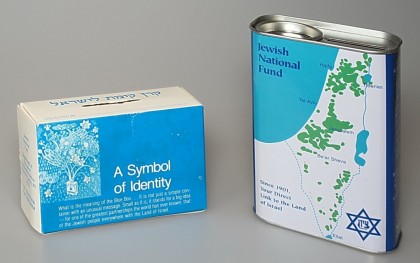
At mussar Ariel, the defense lawyer turned consultant to lawyers on how to navigate court procedures, gave a powerful and well-researched hour and a half on the concept of tzedakah. Tzedakah boxes are an art form in Judaica and usually have a slot for change or bills. The money collected typically goes to charities, in the American diaspora often charities that support the state of Israel, though the money can go to any good cause. In this way tzedakah has come to be associated with charity, but its real translation is justice, equity.
In the packet that he offered, Ariel quoted Rabbi Abraham Heschel, a great friend to Martin Luther King: “There is immense silent agony in the world, and the task of man is to be a voice for the plundered poor, to prevent the desecration of the soul and the violation of our dream of honesty.” And, “Morally speaking there is no limit to the concern one must feel for the sufferings of human beings, that indifference to evil is worse than evil itself, that in a free society, some are guilty while all are responsible.”
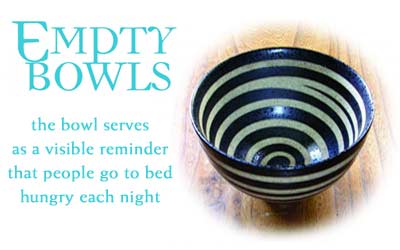
After mussar Kate and I went with many members of the group to a place called Go, Paint in downtown Evergreen. It was the start of an interesting local expression of an international movement called Empty Bowls. (the link is to an Empty Bowls event in Hopkins, Minnesota) Go, Paint has many objects in bisque (the stage for pottery after throwing and before firing when glazes and paints can be applied.). In this case we all had bisque bowls, dull white and maybe 8 inches across. There were various paints and glazes we could apply, even small clay creatures. Kate, for example, put a turtle in the bottom of her bowl.
We paid for the event. The bowls get fired, then distributed to two sites nearby which run Empty Bowl events. One is Mt. Vernon Country Club and the other is a church in Evergreen. At the empty bowl event a meal is served, $65 at Mt. Vernon, $20 at the church. When the meal is over, each participant gets a bowl. The money goes, in this instance, to the Mountain Resource Center. A friend of Kate and mine’s, Marilyn Saltzman, will be the incoming president of the MRC in January. Interesting idea.
Alan came over for work on the religious school lesson plans. Kate made her oven pancakes (always delicious) and Alan told us stories about early Jewish Denver. West Colfax (think Lake Street) between Federal and Sheridan was an orthodox Jewish community when he grew up. He said on Friday afternoons with folks scurrying from the deli to the bakery to the kosher butcher it looked like, well I can’t recall exactly, but any typical European Jewish community.
His dad was going to be a University professor before the Holocaust. Instead he came here and ended up in the dry cleaning business. In those day Alan’s friends and neighbors were either children of Holocaust survivors or survivors themselves. That old neighborhood, like north Minneapolis, has completely changed. The first synagogue in Denver is now an art museum on the Auraria campus of the University of Colorado. The Jewish community concentrated itself in south Denver, more to the east.
We worked for a couple of hours, putting specific lesson plans on the calendar, deciding which days to do the Moving Traditions curriculum, which days for middah, which days for Jewish holidays, which days for our own lesson plans. I’m experiencing some anxiety about this since we start next Wednesday with the first family session of the Moving Traditions curriculum. This approach to the student preparing for their Bar or Bat Mitzvah will, apparently, be controversial because it doesn’t focus on the ritual of the morning service, but on the students’ social, emotional, and developmental needs. Alan, Jamie, and Tara will deal with that. Not me.
Kate’s had several days in a row with no nausea. Yeah! That means she feels better and can get some things done. In doing so, however, the extent of her loss of stamina, weight loss and Sjogren’s Syndrome, has become apparent. She still needs to rest frequently. If she can modulate the nausea, either through careful eating or an eventual diagnosis or using medical marijuana, the next step is to get some weight gain, some stamina improvement. If possible. Or, we may have to adjust to a new normal.
I’ve been absorbed in lesson planning, training for the school year, climbing my steep learning curve about matters Jewish and matters middle school. That’s my way. Dive into something new, leave most other things behind until I’ve gotten where I feel like I need to be. Not there yet, though I imagine after a few class sessions, I will be. Sort of a head down, blinkers on time. My writing has dwindled and so have submissions.
Over the last couple of weeks, while I work out, I’ve been watching a Teaching Company course on the aging brain. I recommend it. Highly. It’s helped me understand why this approach, head down blinkers on, is developmentally appropriate for me. For example, the aging brain, on average, loses some processing speed, executive functions, and crispness of episodic memory (memory tied to a person or place and seen from a first person perspective.) over each decade, beginning in the twenties.
Myelin Sheath – a layer of fatty cells covering the axon, helps speed neural impulses.
The underlying issue seems to be gradual demyelination of the axons which constitute the white matter in our brain. With myelin sheathing over their length axons can carry information very fast, without it somewhere around 2 meters per second, or human walking speed. As our processing speed declines, so do brain functions like the executive management of brain activity by the prefrontal cortex. It’s this one, the decline in executive function, that requires the head down, blinkers on approach to new activity or to tasks we need to complete. As we age, we no longer handle distractions as well, getting pulled away from this to focus on the shiny that.
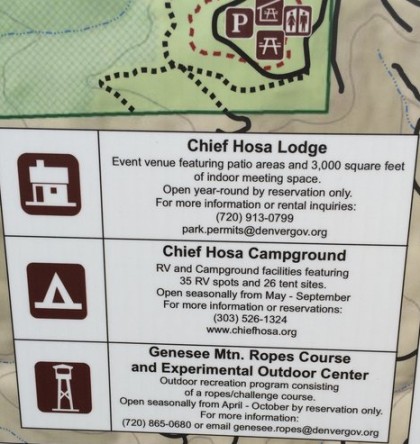
I like knowing this because it helps me understand my daily third phase life better. The thinking process itself is not impaired, just the speed and our ability to stay with a task. It helped explain a very uncomfortable moment for me at the Genesee Ropes Course on Sunday. Jamie and I were with the 6th and 7th graders. Adrienne, a ropes course employee had just explained the rules of a warmup game. One of the rules was that we had we could not throw a soft toy to someone who’d already gotten one on that round.
I got the stuffed unicorn on the third or fourth toss. When I tossed it to Alex, Adrienne asked, “Did he break a rule?” All the kids and Jamie nodded. Yes, he had. Why? Alex had already gotten the unicorn. Oh, shit. This was the first interaction between me and these kids as a group and I looked like a doofus. I didn’t remember the rule at all. There were plenty of things to distract me. The continental divide in the distance. A wind blowing through the trees. Trying to concentrate on learning kid’s names. General anxiety about not knowing the kids at all. Whatever it was, my executive function let me go, Oh, fish on bicycle, instead of hearing, no throwing to someone who’s already received it.
It still looks the same to the outsider. I missed the rule, and as a result, screwed up in its execution. But now I understand that this is not a sign of dementia or other deep seating problem, but rather a normal, though irritating, side effect of demyelination.
Kate’s birthday present came yesterday. It has excellent lumbar and neck support, plus it inclines with the press of a small lever. She’s the queen of Shadow Mountain.
Went down the hill yesterday to the Native Roots dispensary. I wanted something Kate could use to quickly attack nausea, perhaps eliminate it. Research suggested Durban Poison, Northern Lights, Lemon Haze, or a strain like those.
Native Roots is a franchise operation, very slick and a little cold in their approach. Like all the dispensaries they check i.d. Here they made me take off my hat and glasses so the camera could get a shot of me. Inside I made a mistake when the budtender (silly, silly name) called me forward. I told her my wife had nausea and I wanted something that might help. “Never tell a budtender you’re buying for someone else. That’s illegal.” Oh, ok. “Well, I have nausea, then.” “OK. We’re good there.”
They didn’t have any of the particular strains I wanted, but she recommended a strain called Jilly Bean, one they grow themselves. I wanted a bong, but they “…don’t sell glass.” She offered me pre-rolled joints. Oh, the distance from the late sixties and its furtive culture, wrapping papers, sorting seeds and stems out on the kitchen table. These joints, spliffs, blunts have a spiral filter on the end to cool the smoke and neatly wrapped wrapped paper twisted off at the end. Very producty looking. And, not cheap. $7 each.
I bought two. She’ll try them when the nausea hits next time. If it works, we’ll get her a bong and some flower rather than pre-rolled joints. Can you believe I just wrote that sentence? This is truly the new millennium.
Kate wanted spring rolls for supper using some of the mushrooms she grew. (I know. This sounds like a back to the sixties day for us.) I sauteed the mushroom at noon. Kate got some shrimp out to defrost. After her throne arrived, I got busy. Cut up cucumber into matchstick sized pieces. Mix chopped nuts and carrots, shredded. Add fish sauce, juice of two limes and sugar. Mix. Heat water to boiling, pour over rice noodles. Mint leaves. Cilantro leaves. Lettuce leaves. Run the rice paper under the tap. Put on plate, assemble.
These were our first spring rolls, so they weren’t as elegant as, say, the Jilly Bean prerolls, but they tasted great. A successful beginning from the new Asian cookbook.
Alan is coming today and we’ll work on a calendar for our lesson plans. Classes start a week from today. Oh, my. Lots more to say about that, but not now.
Up and out the door too early yesterday to write, too tired when I got home around 5:30. A long day. An education training session at Temple Emmanuel in Denver. A huge building, lots of cash there. Flowing cut stone for an outer wall, inside modern metal sculpture, lots of wood, a huge reception area, a Sisterhood Lounge, a more than gymnasium sized hall, divided by foldout doors, and lots of folks milling about.
(just noticed that the full waning summer moon stands about 4 degrees over Black Mountain in the dark early morning sky. Southwest. My cataracts give it four rays, two straight out from sides, two up and down at a slight angle.)
The sessions were ok. The food was great, lots of veggies and fruit and hard boiled eggs. All of us from Beth Evergreen had to leave early because we had an outdoor experience afternoon in Genesee Park, the oldest of the Denver Mountain Parks. Denver owns several parks in the Front Range, especially in and around Evergreen and Morrison. Genesee might mean shining valley.
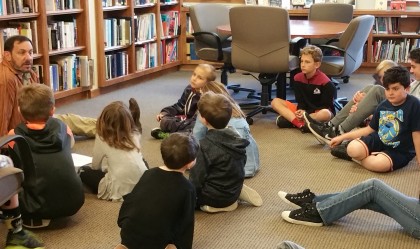
religious school at Jeffco Action Center, packing Thanksgiving meals
This was a ropes course for the purpose of team building. The students who will be in the religious school this fall and their parents came, as did Debra and me. We were the only teachers there. I knew a few of the adults, none of the kids.
No ropes for me. I did put on a harness (reminded me of the harnesses for sled dogs) and a blue helmet. Most of the rope features were reached by spikes driven into the trees and were high enough to require both a rope attached to the harness and managed by a Genesee Outdoor Adventure employee and the helmet.
Wasn’t the heights or the difficulty of the features that made me not go up. I realized only this morning that it had to do my with introversion and in particular my dislike of having others watch me exercise. That’s why I go to On the Move Fitness for two sessions, then follow the workouts on my own. If somebody watches me, I get self-conscious and screw up. I suppose this is something I could overcome with time and opportunity, but yesterday wasn’t enough of either.
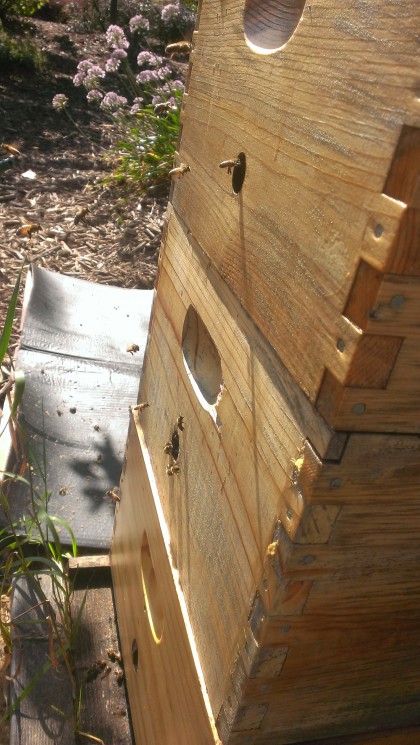
Artemis Hives
The day before, Saturday, I went over to Rich’s, also early in the morning to help him harvest honey. We cranked his hives down from the high wire on which they hang, much like a ropes course feature, and checked first his flow hive and then a honey super on another of the four hives he has on his primary line. He has a pulley system with which he lowers and raises the hives. They’re heavy even with the mechanical advantage of a four rope pulley. Unfortunately, for reasons I don’t understand, Rich has no honey in his flow hive or in the honey super. The colonies themselves looked healthy.
Afterward, Rich and I went over to the Muddy Buck and had some coffee. His daughter was still asleep at his house.
Kate had a good day yesterday. Unfortunately, I missed it out gallivanting for Jewish education. We’re investigating medical marijuana, specifically strains used by cancer patients for nausea induced by chemo. Kate may have a bong in her future.
At 7 I’m off to Evergreen to Rich Levine’s. We’re going to harvest honey from one honey super and try to use the flow hive. The flow hive is an invention by an Australian beekeeper that has the bees put honey in plastic frames instead of a honey super. An ingenious torquing mechanism uncaps the honey and it flows through a tube into jars or a bucket. Mine came just after Kate and I decided to move to Colorado, so I’d hung up my beesuit. I have it Rich. Hope it works. That was five years ago now, and they’ve come up with improvements. Rich has one of the new ones, too.
Kate’s growing more frustrated with her nausea and I don’t blame her. Imagine if, on any day, you could be debilitated, often without warning. Imagine, further, if that debilitation resulted in weight loss and as a direct result, loss in strength and stamina. Her gall bladder ultrasound came back normal. We’re in an odd situation now of hoping that at least some test will show something. Normal is usually a good result in any medical test, but when you have something unexplained. Well. What we want now is something diagnostic, and that something treatable.
I put up 7 lesson plans, or at least what qualify in my very rookie way, as lesson plans. Each lesson plan has to relate to the overall theme for the year, reconstruction and the b’nai mitzvah experience, yet stand alone. Here’s an example. Might be used before Simchat Torah, when the reading of the Torah finishes and then starts over again.
Understanding the centrality of Torah in Jewish life
Intro. What is Torah? Why is the Torah read through, then repeated? Discussion
Lesson content:
a. Write, in Hebrew, the names of the books of the Torah
b. A conversation about the broader and deeper meaning of Torah.
c. What stories shape your life? Family stories? Childhood stories? Books, movies, anime
Finish: Dance with the Torah scrolls. (a common practice on Simchat Torah)
I’m moving further and further into the life of Beth Evergreen. Kabbalah, mussar, Jewish Studies Sampler Sundays (or, as Rabbi Jamie said at the annual meeting on Thursday: Jesuss) teaching bar and bat mitzvah students about this central ritual in Jewish life. Participating in a mussar group focused on spreading mussar in congregational life. Getting to know well at least a few members: Marilyn, Jamie, Tara, Rich, Alan, Anshel, Sally, Ron, Susan, Sheri. Seems both odd and normal. Odd in that I’m a pagan; normal in that I love this community and want to help sustain it.

 Happy medical people. “Everything looks good. We didn’t find any problems!” Sounds good, right? Well, we’ve reached the odd juncture with Kate where these are not the exclamations we want to hear. We want to hear, “Ah, so this is what causes the nausea.” Yesterday’s endoscopy was yet another “positive” result. So frustrating. Another test in the near future, looking for something in the liver, gallbladder area.
 It seems to me that the more important issue with gossip is judgment. When gossip spreads a negative judgment about another, another who is not present to contest the judgment, then it becomes serious and harmful. The old cliche says it well, “If you can’t say anything nice about someone, don’t say anything.” I did show up late to the class, so I missed the early part of the discussion.
 Just before getting up this morning a strange, but somehow obvious thought occurred to me. While on the backstage tour we visited the dresser, an energetic guy who made or altered 490 costumes for the women in this performance. !. We saw the multiple props, a day bed, a drinks trolley, several doors with wheels, a set of steps for musical numbers, a kitchen table, a dressing table. Downstairs we saw the storage areas for costumes and prop making materials. We spoke with the dresser, the stage manager, the director, the actors, several of them, the lighting and sound people. All, to a person, warm and friendly.
 Here’s the thought. Going backstage, seeing all the accoutrements for staging a play, especially going into the basement area, made me think of id, ego and superego. Of the masks and personas we wear. Of our brain as backstage, where we store props, costume changes, makeup, where we put together the elements of the show that is our lives. The show itself, and its superego, the director, is the life others see, the one we present as we strut and fret our hour upon the stage, then are heard no more.
 Tomorrow, in our second religious school class, this one unscripted by Moving Traditions, we’re going to do a get to know each other exercise. Your life in 5 objects. Taking my cue from the American History in 101 Objects display at the Smithsonian, I’ll start with my own five objects: a newspaper, a globe, artemis honey and apples, great wheel, family picture.
 Kate and I went in early yesterday morning to help prepare the board’s luncheon for those attending the Rosh Hashanah service. I peeled laser cut lox off salmon fillets while Kate put schmeer on tiny bagels. The lox went on the bagels. Lois and Fran were making egg salad bagels. We set up water, lemonade, coffee stations, put out trays of cookies, dressed round tables with flowers, cutup fruit and vegetables. A platter with sliced apples and honey is traditional for Rosh Hashanah, dipping an apple in honey is symbolic of a wish for a sweet new year.
 As the moon’s change, so does the Jewish calendar. We’re now in the month of Tishrei, its first day, Rosh Hashanah, the new year of the world. All over the world, throughout the diaspora and in Israel, Jews will be celebrating the new year, shana tovah. This is short for l’shana tova tikateyvu, “May you be written [in the Book of Life*] for a good year.”
 I thought about two boys of a man I know. I pictured them both, slovenly and overweight, and thought, what went wrong with them? I had added to those two judgments an assumption that they were lazy, had not fulfilled whatever potential their father, a successful and kind man, hoped for. Since I don’t know either of them, it’s obvious this reaction said more about me than about them.


 Getting back to five days a week exercise. Always feel better. Trying to regain my former high intensity workouts on the off days from resistance work. These workouts increase cardiac fitness, important especially in the mountains. In my case I do two five minute sets, varying speeds each minute from medium intensity (30 seconds), high intensity (20 seconds), and as fast as possible (10 seconds), with a two minute rest between them. I like high intensity because it’s effective and short in duration.
 Looked into stamina after last week’s exhausting day at CBE with Alan. Discovered that I’m doing, mostly, what can be done. The part I’d let drift away was the high intensity workout. So, I’ll return to that. But, the real message is that stamina decreases with age, even with good sleep, decent diet and exercise.
 I finally realized that a problem oriented therapeutic approach kept me trapped in a continuing circle of what’s wrong? What do I need to do? How can I change? In other words my life was always problematic. Like whack a mole for psychological issues. No relief, just unending work on what was wrong. What was wrong was me.
 Kate and I, I think, are at a similar cross roads. We need to accentuate the resources, the strengths that we each have, and they are considerable. Loss of stamina and chronic diseases (which we both have) are part of our lives, yes, but they are not our lives. Our lives are about sewing, quilting, the board at CBE, old friends, grandchildren, sons, our life together. They’re about writing and teaching and hiking and reading. About filling our days with purpose and love. Death is a certainty, but we don’t have to reach for it. It will come for us, in its own time. Until then, carpe diem!
 We tried a Colorado cure for Kate’s nausea symptoms. She toked up yesterday morning, lighting one of the pre-rolled Jilly Belly spliffs. She took four hits. Result: nausea subsided, heartburn began. And, she said, I feel spacy. Which she didn’t like. So she went back to bed anyhow. A work in progress. Next time she’ll try two tokes. If it does reduce the nausea, we will get her a bong and use ice in the water to cool down the smoke. I told her she was one toke over the line sweet Jesus; then added, well, maybe better, one toke over the line sweet Moses.
 In the packet that he offered, Ariel quoted Rabbi Abraham Heschel, a great friend to Martin Luther King: “There is immense silent agony in the world, and the task of man is to be a voice for the plundered poor, to prevent the desecration of the soul and the violation of our dream of honesty.” And, “Morally speaking there is no limit to the concern one must feel for the sufferings of human beings, that indifference to evil is worse than evil itself, that in a free society, some are guilty while all are responsible.”
 After mussar Kate and I went with many members of the group to a place called Go, Paint in downtown Evergreen. It was the start of an interesting local expression of an international movement called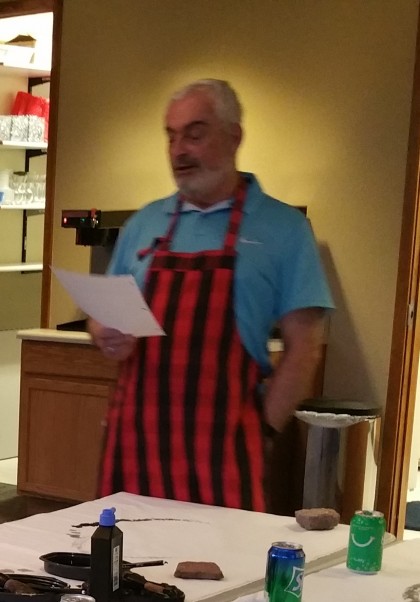
 Kate’s had several days in a row with no nausea. Yeah! That means she feels better and can get some things done. In doing so, however, the extent of her loss of stamina, weight loss and Sjogren’s Syndrome, has become apparent. She still needs to rest frequently. If she can modulate the nausea, either through careful eating or an eventual diagnosis or using medical marijuana, the next step is to get some weight gain, some stamina improvement. If possible. Or, we may have to adjust to a new normal.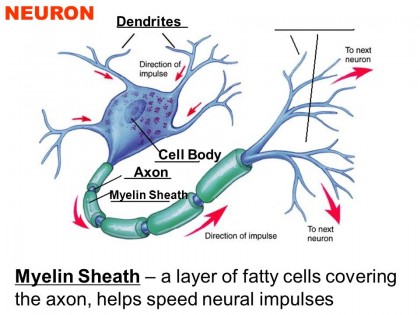
 I got the stuffed unicorn on the third or fourth toss. When I tossed it to Alex, Adrienne asked, “Did he break a rule?” All the kids and Jamie nodded. Yes, he had. Why? Alex had already gotten the unicorn. Oh, shit. This was the first interaction between me and these kids as a group and I looked like a doofus. I didn’t remember the rule at all. There were plenty of things to distract me. The continental divide in the distance. A wind blowing through the trees. Trying to concentrate on learning kid’s names. General anxiety about not knowing the kids at all. Whatever it was, my executive function let me go, Oh, fish on bicycle, instead of hearing, no throwing to someone who’s already received it.
 Kate’s birthday present came yesterday. It has excellent lumbar and neck support, plus it inclines with the press of a small lever. She’s the queen of Shadow Mountain.