Looking Backwards

Fall                                                                            Samhain Moon

After a good morning with Ovid, I went out to humble myself with my chain saw.  As I’ve written here before, I’ve used chain saws since 1974, 39 years.  Long enough, you’d think, to learn not to put the chain on backwards, but I did just that this morning. When a chain saw blade is on backwards, it burns the wood, rather than cut it.  Took me a second try to figure this out.  Back to the bench.

Sure enough, the little pointy sharp things were away from the cut rather than toward it. This seems pretty basic, doesn’t it?  Well, it is.  After solving the puzzle, I turned the chain around, retensioned it and went back out.  Ah, like a knife through butter.

Cutting wood for our Samhain bonfire next Thursday.  This will officially end the growing season and as things look right now, we’ll have finished the remaining tasks in the garden by then.  We have flower bulbs to plant, garlic to plant and leeks to harvest.  With minor exceptions that’s the end of it until next spring.  Which, if the climate keeps on warming, may come soon after my birthday on Valentine’s day.  Or, as it did this year, sometime in June.  Hard to tell up here.
Folks I Trust

Fall                                                                     Samhain Moon

Got a new bar for my chain saw a couple of days ago and in the process discovered Lehman’s Power Equipment.  The driveway for it slopes steeply down off East River Road, hiding the building from view as you drive in toward Anoka from Mercy Hospital.  When you get down to the bottom, Lehman’s Power Tools turns out to have a large bait wing, too, including a self-service bait shack open 24 hours.

The outside looks like an up north mechanic’s shop, the kind that has hubcaps and old Marathon and Sinclair signs tacked to the wall.  Maybe a rack of moose antlers, too. Inside the shop has chain saws, snow blowers, lawnmowers, lots of orange and red.  Most important to me this is a Jonsered dealer, so they stock parts for my 20 year old chain saw.

A dog gets up a bit creakily from its tan rug to greet us.  I make some comment about the dog and the guy behind the high counter says, “Yeah, been here the whole time.  Gettin’ old, though.”  I reply, “Yeah, me too.”  The counter guy smiles.  “Yep.”

Another, younger version of counter guy brings out two different bars, one more expensive than the other. “What do I get for my extra $19?”  “Well, this one’s reinforced and milled.  It’ll last longer than that one.”  Last longer always sells me, so I pick up the new green bar, Kate gives him the family credit card (I lost mine somewhere in the house.) and we settle up.

Outside we pick up a couple of used pallets from a pile with a free wood sign.  The sign goes on, “Don’t take sign.”  We’ll use this wood in our Samhain bonfire.  Gonna celebrate the end of the growing season with a big fire.

When we pulled away, I remarked to Kate, “I feel better having found that place.  Folks I can trust.”

Still At It

Fall                                                                         Samhain Moon

I’ve picked up the pace in translating.  Not a lot.   But I have.  My intention is to time myself from now on, figure out how I can increase my speed.  That will be important, as I said before, if I’m to translate the whole Metamorphoses.  (Ovid)

You might ask, why?  A few years ago I decided to read classics for a whole year.  I read the Koran, Faust, Dante’s Divine Comedy, Homer’s Iliad and Odyssey and the Metamorphoses among others.  As I did this, I also read commentaries and essays on these works to give myself a broader and deeper perspective.  When I got to the material on the Metamorphoses, I realized it stood at a critical juncture between ancient Greek religion (and, I imagine now, the Egyptian influence on the Greek) and Western civilization in the common era.

During the Renaissance it was Ovid’s work that moved Greek mythology into the mainstream of Western intellectual life.  The older sources were either unavailable at the time, as yet undiscovered, or simply missing.  That’s why the versions of the mythological corpus you know are most often Ovid’s version.

(Banquet of the Gods-Frans Floris)

If I could imprint Ovid’s stories into my brain, then I would have a vast resource, one with deep resonance in the entire Western literary tradition.  How to do that?  I had always wanted to learn a language but had told myself I couldn’t.  How about learning Latin, then translating the Metamorphoses? It could vanquish a self doubt, allow a peek behind the curtain of translation and help me absorb these wonderful stories.  All in the same project.

It’s not been, nor is it now, easy.  It is hard part of the time, difficult the rest.  But I’ve learned to enjoy that.  There are new insights often and results that I know are mine.  I’m learning the stories and advancing towards the skill level I need to go the distance.  This is the fourth year of learning and translating.  Many more to go.

BTW:  There is, somewhere in this, the novel I want to write.  A big one, a fantasy, because that’s how I think when it comes to fiction, but one deep in this material.  What it will be like, I don’t know, but I keep looking for fleeting images as I work.  Perhaps behind the story of the golden age?  Philemon and Baucus?  Medea?  Pentheus?  Perhaps in Ovid himself?  First century C.E. Rome?  All of these?  I don’t know.  But it’s the Moby Dick I’ve set sail to find.

Around and Around and Around We Go

Fall                                                                       Samhain Moon

Interesting convergence.  In Ovid today I translated some verses about the silver age in which Jupiter created four seasons from summer, brief spring, winter and autumn.  After finishing this work, I went out and joined Kate, already at work in the garden.  Small pellets of snow fell.

(The Close of the Silver Age by Lucas Cranach the Elder, c. 1527-35)

We went into the orchard.  Kate pulled back the landscape cloth around the remaining trees while I broadcast the fertilizer, sprayed with biotill and then worked them both into the top three inches of soil.  While she replaced the landscape cloth, I shoveled soil, mostly sand, back into two large holes dug by our energetic girls, Vega and Rigel.

At one moment I looked up at a tall Norway pine and felt a kinship with Ovid and those farmers in long ago Latium.  We had similar things to do at similar times of year.

The word annum popped up from today’s translating.  You know, I imagine, that it translates as year, but you might not know that its primary meanings are: a circuitcircular courseperiodical return.  In one sense this is obvious of course, but that term we use frequently could orient us not to linear time, as we tend to use it, but to cyclical time.

When I say, I am 66 years old, we tend to think, oh.  Born 66 years from this date.  But that’s not what it really means.  It really means I have experienced a full year 66 times.  The year itself, if we’re true to its Latin roots, is not a one after the other marker of chronos, but a complete set, 4 seasons here in the temperate latitudes, finished and done with each winter, begun anew each spring.  Or whenever you want to break beginning and ending.

We then start over again.  Another year as we often say.  Yes, just so.  Another year.  This time in the next year I’ll be fertilizing the orchard.  As I have this year.  So that moment of apocalypse when the earth becomes changed and brand new?  Spring.  When the earth becomes desolate and barren?  Late fall.  Happened before, will happen again.  Amen.


Far Out

Fall                                                                           Samhain Moon

Jazz at Barbette.  Kate and I have begun to go, every once in a while, to the jazz and dinner combinations co-ordinated by Kevin Barnes of KBEM.  Tonight the meal was at Barbette and the music, jazz guitar, by his brother, Brian Barnes.

If you’ve not been to Barbette, it’s a stainglass lights, art of many qualities on the walls kind of place coupled with the sort of small, but beautiful presentations that mean you’ve just paid a lot for the meal. Tables are set somewhat close together and there was, at least tonight, a genuine air of bonhomie.  The wait staff are quick, delicate and attentive.

Each course had a different craft or Belgian beer associated with it so I passed mine to Kate.  The first, a Duvel, came with the pretzel course.  Never have I seen pretzels so daintily and prettily presented and accompanied by a hot mustard sauce, a shallot marmalade and a wonderful gouda cheese sauce.  Tasty.

The second, a Maredsous, came with gravlax, collard greens and small discs of grits. Sounds weird, but it was pretty good.  The third, a Chouffe, graced a strange and new food experience for me, pork belly.  Now when I say pork belly you may think of bacon but in this case I believe they cut a square section out of a pork belly and cooked it.  I have a very broad palate, more gourmand than gourmet, and I like most things, but this had way too much fat for my taste.  And, of course, I didn’t have the Chouffe to wash it down with. Quel domage.

The final dish was a deconstructed smore with a square of marshmallow topped by a scatter of broken nuts, a tablespoon size and shape piece of ice cream all on a swoosh of chocolate. Outside my low to no carb emphasis, as was the pretzel, but I went ahead anyway.  Pretty good.

We had a university lecturer and her husband, a businessman and his wife, and two militant atheists, one of whom worked for the health insurance industry at our table.

In these settings I find listening to conversation can be a challenge though Barbette wasn’t terrible.

A fun evening.  Oh, and every one said oh! when they asked where we were from and we said Andover.  “So far.”  “That’s a ways.”


Go Now, The Growing Season Has Ended

Fall                                                                          Samhain Moon

Today chain saw bar and dental hygiene.  Real gritty home stuff.  A bit more Latin, of course.  My paperweight is still in the annealer.  Cooling down.  I can get it Wednesday.  It will sit next to my Father’s Day mug I made at Northern Clay Center.  Back to kindergarten only now I’m making my projects for myself.  Is this the beginning of the second childhood I’ve heard so much about?

The hosta and coleus have all gathered in on themselves, drooping in that post-frost finale.  As the Minnesota Updraft Blog said:  The Growing Season Ends.  It ended for us here last week when we pulled the tomato plants, the egg plants, the beets and the last of the greens.  Frost bit plants look hurt, their cell walls burst by ice, what was contained now loose and sharp.

This is the way the growing season ends, not with a bang, but a droop.

You Dip Your Honey Rod in the Molten Glass

Fall                                                                         Samhain Moon

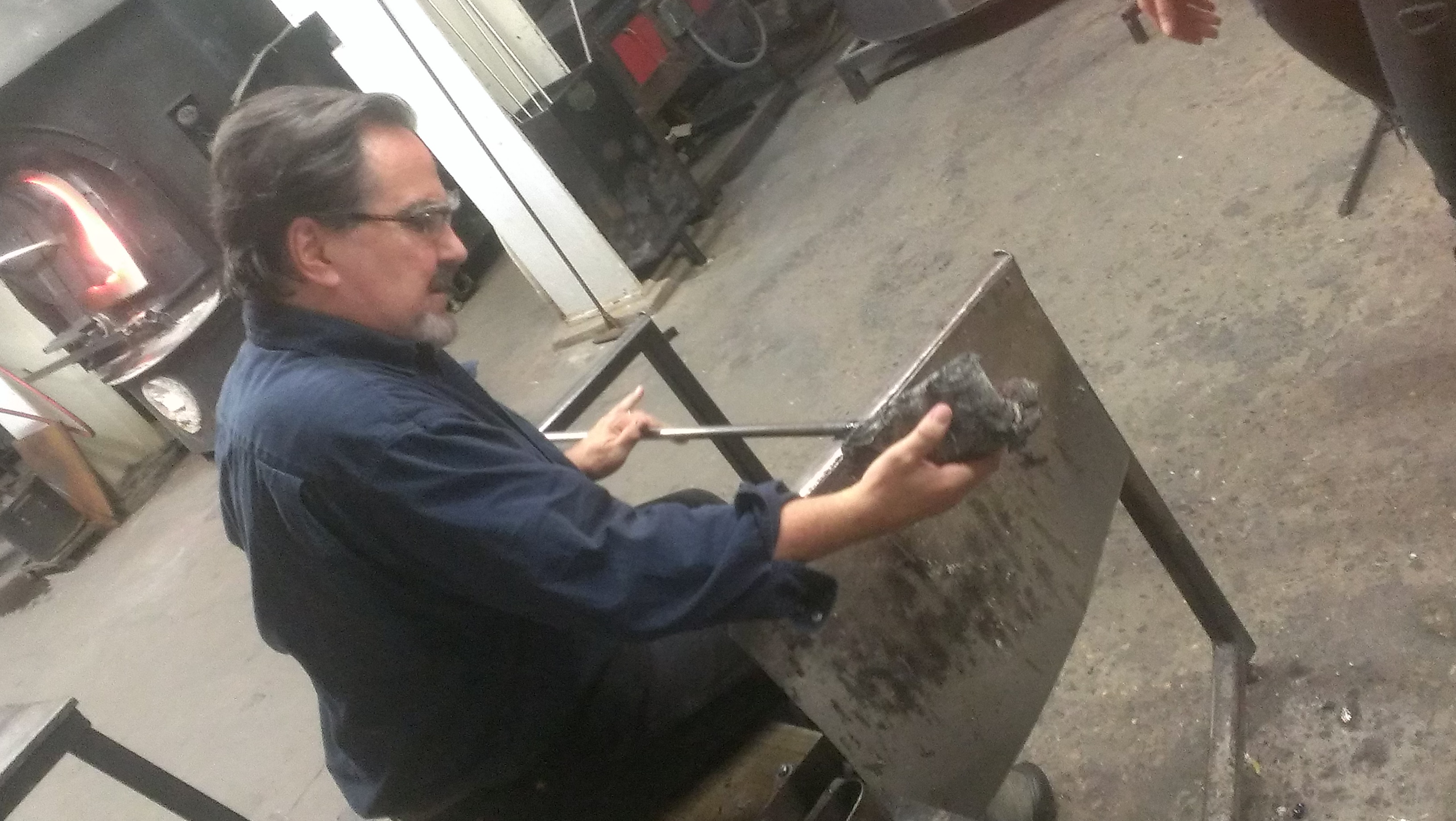
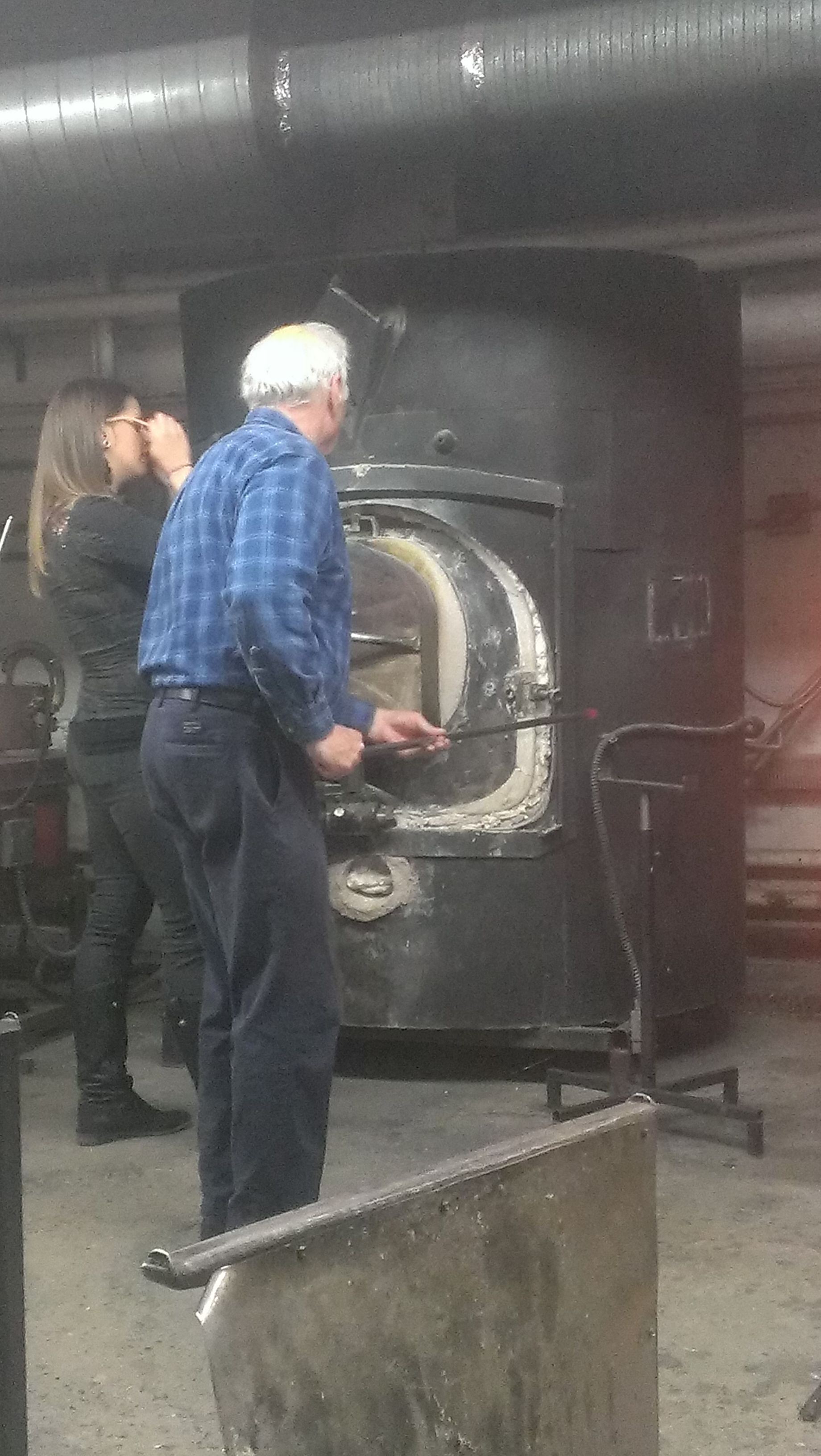
Glory hole.  Boil.  Jacks.  Crimpers.  Gathers. Honey rods. Annealer. Diamond shears. IMAG1071Taglia. Paddles. Tweezers.  If you encounter this unusual constellation of tools and equipment, you’re about to work with glass.  Molten glass.  Molten as in 4,300 degrees molten. Molten as in droops off the end of the honey rod if you don’t keep rolling, rolling, rolling.

(Frank ready for his first gather.)

You dip a honey rod into an oven, a 4,300 degree oven filled with about 350 pounds of molten, transparent glass.  Twist two or three times and get a good gather on the rod.  Pull it out, orange, heat blasting back from the oven.  Roll it.  Roll it.  Over to a table that might be an Indian spice sellers tables with small mounds of wares, dip the molten glass in yellow or white or blue, move it back and forth so the color coats the gather.

To the bench.  Rolling, this time maybe pull out the tweezers and grab the end of the IMAG1070gather, pull it, twist it.  Then maybe the shears to make a few cuts. Still rolling.  Rolling. Always rolling.  Another gather, bigger this time, over the first gather, the one with color. Rolling, rolling.  Always.  This time layers of newspaper soaked in water.  Yes.  Newspaper.

(Charlie with newspaper.)

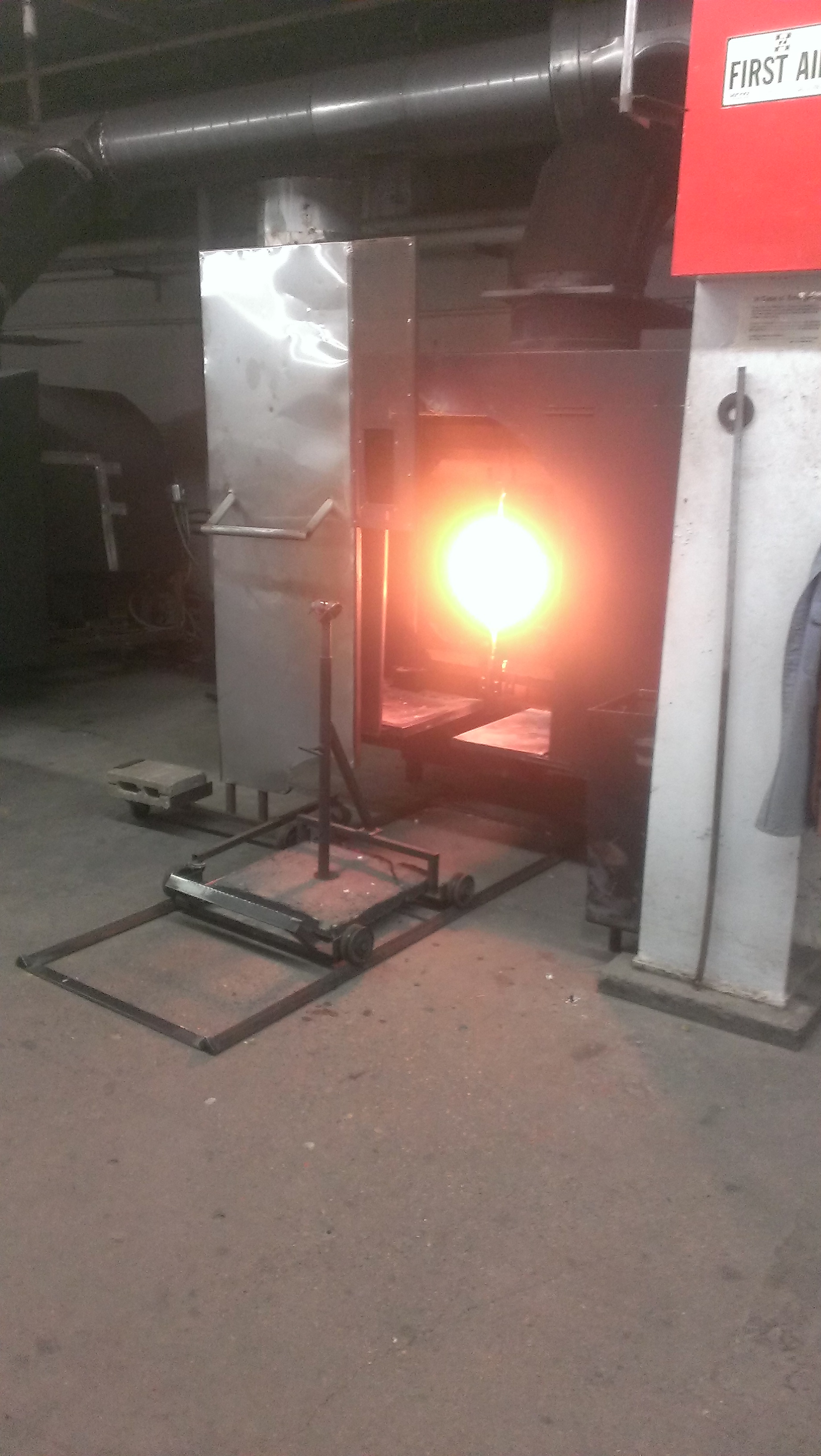
Wet newspaper.  Thick, wet newspaper.  In your hand, against the heat of the second gather, rolling still rolling, you shape the whole, now headed toward that most mundane, but forgiving of glass shapes, a paperweight.  Back in the gloryhole for a heat blast.IMAG1058

Back to the bench.  This time the jacks grip the molten glass at the rod’s end, making a line around it, a line that will make breaking the cooling glass off the honey rod possible.  “It perforates the glass.”  Oh?

(the glory hole)

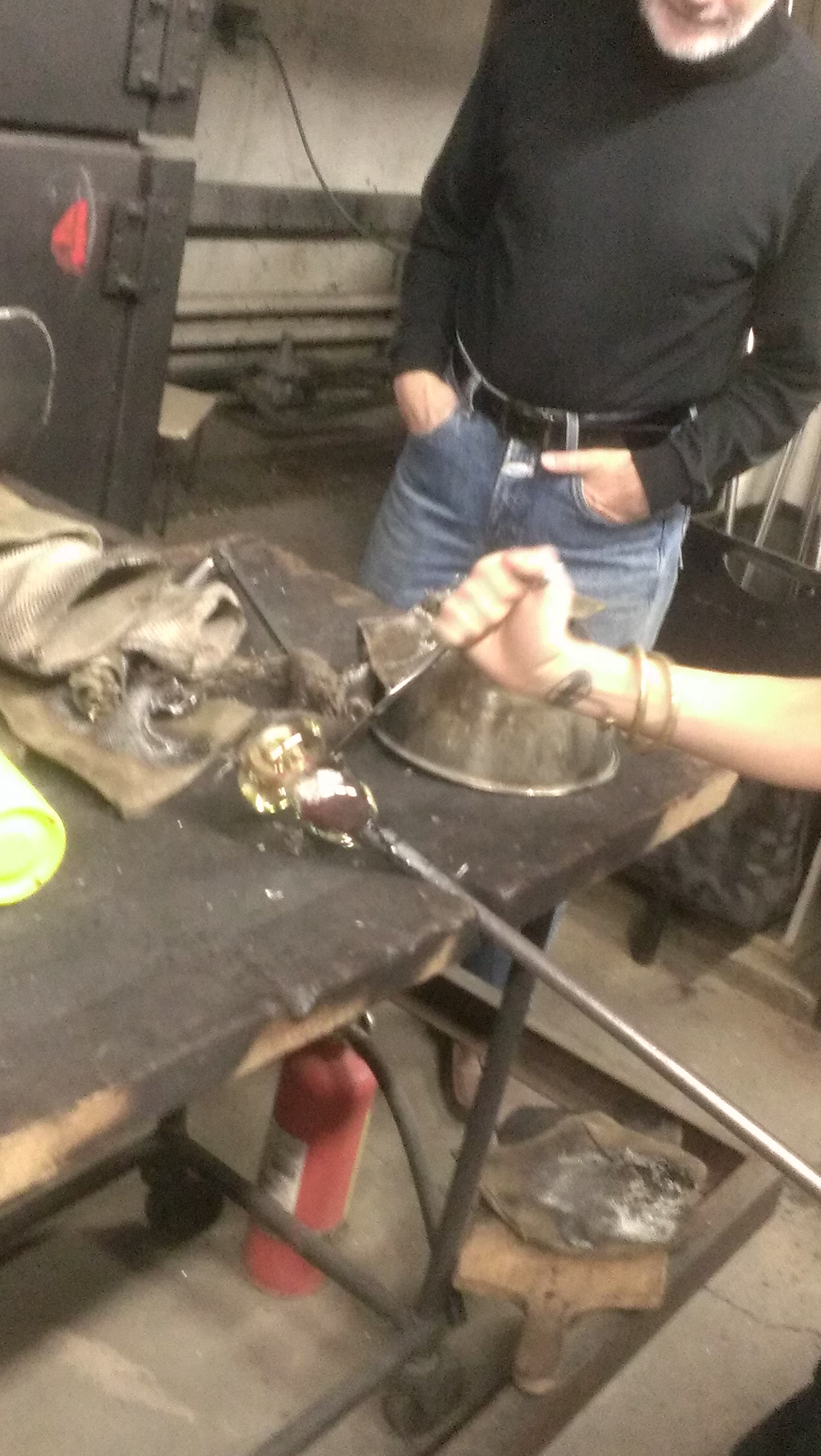
Whatever it does, sure enough, after gently tapping the gather at the jacks imprinted line, the paper weight falls off.  A blow torch comes out, heats the rough edges and makes the bottom molten enough to receive initials.  Gotten know which one is yours.

Then they go into the annealer.  It gradually steps down the heat so the coefficient of IMAG1063expansion doesn’t overtake the masterpiece and shatter it.  Ready on Wednesday.

What the Woollies did this Monday night at Minnesota Glass Arts.

(Jen releases her demonstration paperweight from the honeyrod.)

A Skull Expanding Moment

Fall                                                                           Samhain Moon

Can you hear that streeetcchhhing sound?  It’s my 20th century, 2nd millennium mind trying to shoehorn in some new ideas.  Not only the New York School poets, for whom Allison gave some appreciated homework help (locating the 5 spot and some info on O’Hara and Larry Rivers), but this afternoon I’ve finished the reading on Unbending Gender and another one on reflexivity*.

We’ve entered the realm in both these courses I most looked forward to, the section on post-modernism.  I’ve never been able to get straight in my head what post-modernism is, or is supposed to be.  I had the same trouble with dew point for a long time so I think there is hope.

Reflexivity is a key aspect of modern art as I now understand it and modern poetry, too.   The poem and the art work both are works of art and commentaries (self-reflective) on the act of art-making.  This is clear when painting turned away from realism and toward cubism and abstraction, collapsing perspective into 2-d, the act of painting itself commenting on the acts involved in producing the very painting in view.

A Pollock action painting is clearly 2-d, makes no attempt at 3-d perspective and the action of dripping the paint on is clearly evident.  In commenting on this point Michael Roth, teacher of the Modern/Post Modern class, made an interesting comment, referencing someone else:  The surface in these paintings, though bold, are fragile.  I understood this immediately, though I don’t know whether I could explain it.

At some point along here I’m going to synthesize my understanding of post-modernism. To see if I can put it out there clearly.  (that may not be very post-modern though)

*wiki  Reflexivity refers to circular relationships between cause and effect. A reflexive relationship is bidirectional with both the cause and the effect affecting one another in a situation that does not render both functions causes and effects. In sociology, reflexivity therefore comes to mean an act of self-reference where examination or action “bends back on”, refers to, and affects the entity instigating the action or examination.

To this extent it commonly refers to the capacity of an agent to recognize forces of socialization and alter their place in the social structure. A low level of reflexivity would result in an individual shaped largely by their environment (or ‘society’). A high level of social reflexivity would be defined by an individual shaping their own norms, tastes, politics, desires, and so on. This is similar to the notion ofautonomy.

Changes

Fall                                                                          Samhain Moon

Buddy Mark Odegard has found a new style in poster-like art about the Northshore.  Good

We’ve had snow and we’ve had rain, who knows when I’ll be back this way again.  I do.  Next season around the same time.  Loving the change of seasons.  The transitions may be later and milder, but they’re still coming and I still love le difference.

Found out my chain saw needs a new bar as well as a new chain, so I’ll have to visit the hardware store tomorrow:  new glasses, dental visit and a chain saw bar.  These are the kind of things that take me into the really retail and away from cyber-purchase.  Hands on matters where time counts.  Otherwise, I’d rather get it in the mail.  No schlepping and it saves on gas.

What?  I heard that.  Yes, it does save on gas.  Shopping on the internet aggregates deliveries among many people allowing for a much more efficient route and far fewer trips per item.

An Inside Day

Fall                                                                                     Samhain Moon

An inch of rain, a pinch of snow, some sleet and the weather’s gonna cool down this week. We’ll have some sun though and that’ll be good weather for finishing the orchard and harvesting the leeks and any stray raspberries that survive the freeze(s).  Closing the door on all but the flowers.

Yesterday was mostly outside, today mostly inside.  Lotsa Latin, some MOOC work, too.  I decided to hop on the Latin after my tutoring session with Greg because I had a tendency to go, yeah!  I’m done and not pick up the Latin again until the next Monday. By then I’d forgotten some of the key things Greg taught me.  This time I pounded away it afterward and, by golly, I did get better.  Back, maybe, to where I was before the break.

My goal over the next few months is to pick up my speed so I can translate several verses a day, eventually I’d like to hit at least 30 if not 50 a day.  That way I can actually contemplate translating the whole Metamorphoses in a reasonable time frame.  It will take practice and lots of it.

I did start reading the introduction to Unbending Gender, a reading for next week in Modern and Post Modern.  It’s saying something important about gender but the author’s academic style drove me nuts.  It’s the most poorly written thing I’ve read in the class.  Its ideas aren’t hard, but deciphering the prose is.  It’s supposed to be the other way around.

The general idea though is a big one.  It positions gender as necessary for a livable life and shows how difficult life can be if gender becomes an issue.  This lifts gender questions out of the realm of morality where they do not belong and places them squarely in the realm of basic human need; in this case, the need to live comfortably in one’s own skin.  How fundamental is that?  And how clear a way to underline the agony of having to explain your own self to others.